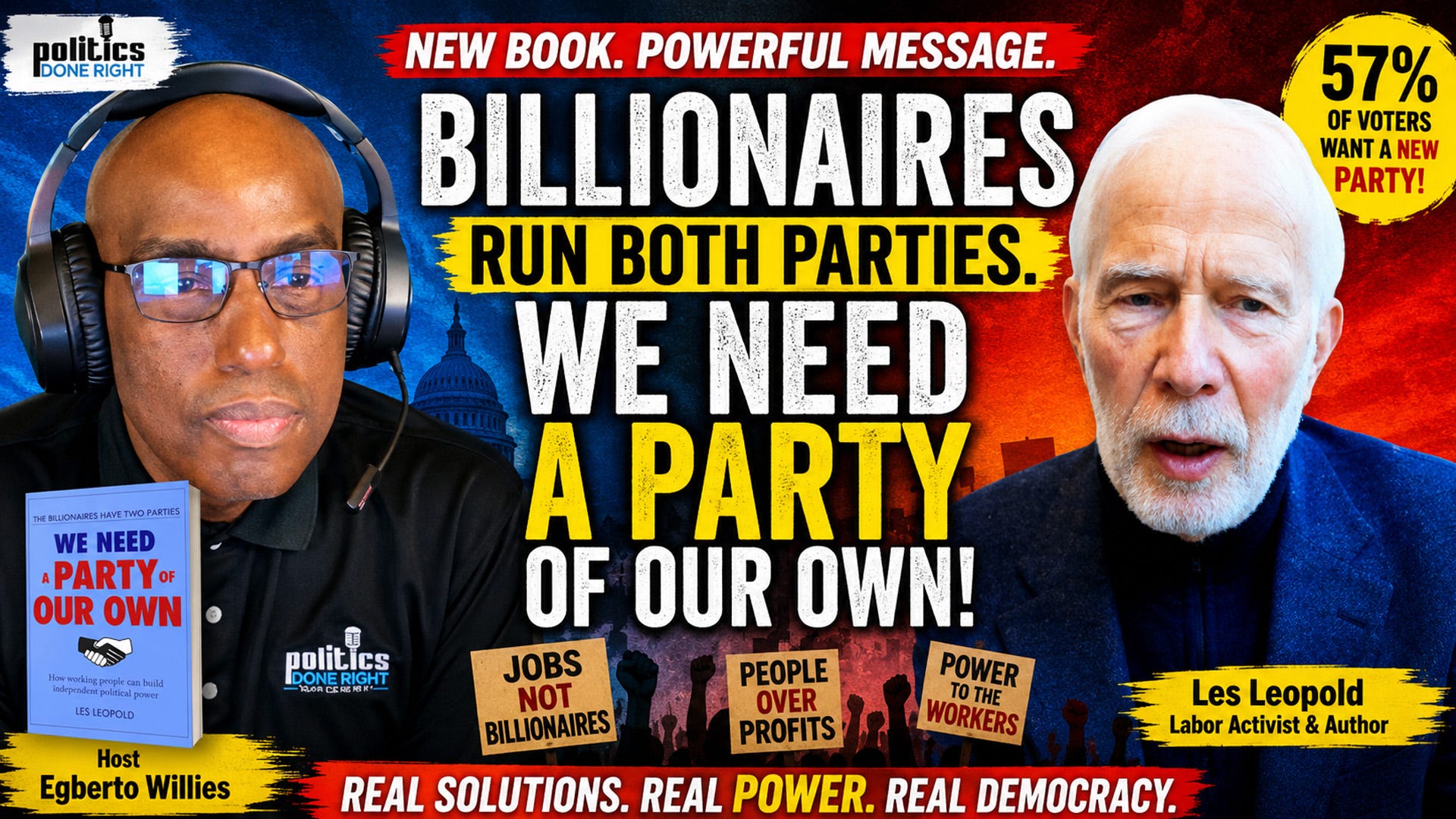
Billionaires Own Both Parties? Les Leopold explains why workers are demanding a new political movement.

Summary
Powerful and urgent. Labor activist and author delivered a blunt assessment of American politics and the abandonment of working people by both major parties. Drawing from extensive polling data and decades of labor organizing, he argued that millions of Americans—especially in former industrial regions—feel politically homeless because neither Democrats nor Republicans prioritize job stability, economic security, or working-class dignity. The interview explored how neoliberal economics hollowed out communities, why many workers drifted toward MAGA as a protest against a failed system, and why a new independent working-class political movement may now be necessary. The conversation centered not on culture-war distractions but on layoffs, corporate greed, elite betrayal, and the need for a people-centered economy that values workers over billionaires.
- Les Leopold revealed polling showing 57% of Rust Belt voters want a new political party focused on progressive populist economics.
- Working-class voters consistently prioritized job stability, economic security, and corporate accountability over culture war issues.
- The interview detailed how the Democratic Party lost credibility in working-class communities devastated by deindustrialization and layoffs.
-
Leopold argued that many Trump voters were not ideological conservatives but economically abandoned citizens casting protest votes against a broken political system.
-
The discussion emphasized rebuilding politics around labor, public investment, union power, and economic democracy rather than billionaire influence.
The interview exposed a political reality that establishment figures often refuse to confront: working Americans do not feel represented by a system dominated by corporate donors, privatization, and elite indifference. Instead of blaming ordinary people for political frustration, the discussion challenged progressives to organize around material needs—jobs, healthcare, wages, infrastructure, and democratic participation. The message resonated because it rejected cynicism and insisted that ordinary people still possess agency. If working people organize independently and refuse to accept billionaire-controlled politics as inevitable, the political landscape can change dramatically.
Premium Content (Complimentary)
Les Leopold’s Call for a Working-Class Political Movement Exposes the Failure of Neoliberal Politics
For decades, America’s political establishment insisted that globalization, deregulation, privatization, and corporate-led economic growth would eventually benefit everyone. Politicians from both major parties sold free trade deals, Wall Street deregulation, union weakening, and austerity policies as unavoidable features of a modern economy. Meanwhile, working people watched factories disappear, wages stagnate, healthcare costs explode, pensions vanish, and communities collapse.
The interview with labor activist and author Les Leopold cut directly through the mythology that still dominates mainstream political discourse. Instead of treating working-class frustration as irrational anger or cultural resentment, Leopold centered on economics, job security, and political betrayal as the true drivers of America’s democratic crisis.
That matters because corporate media frequently frames working-class discontent through the lens of culture wars alone. Americans constantly hear that voters moved right primarily because of immigration, race, religion, or “wokeness.” Leopold’s data tells a far more uncomfortable truth for establishment politicians: people abandoned the political system because the political system abandoned them first.
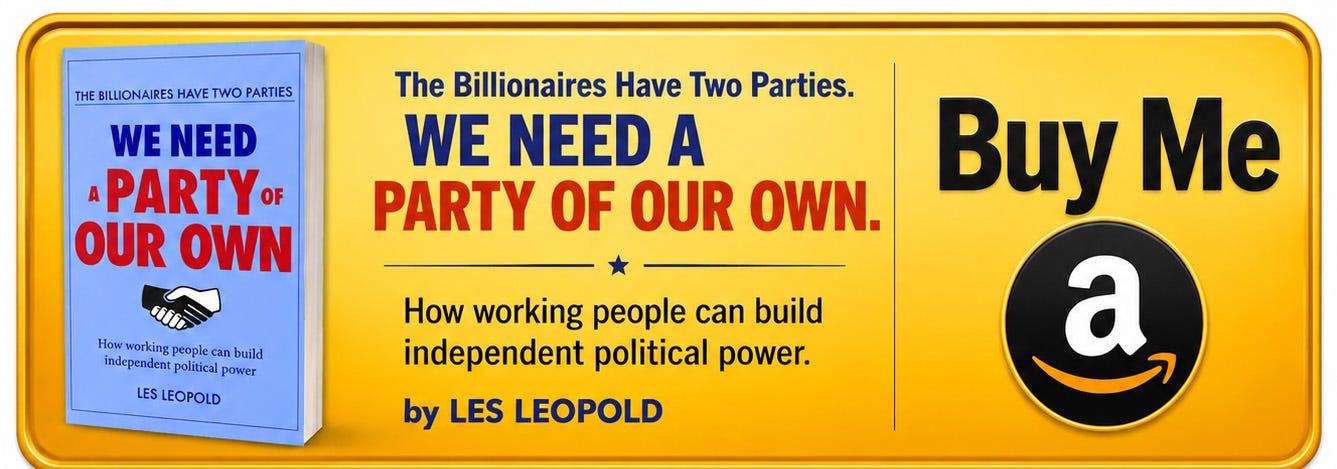
His polling in key Rust Belt states, which he detailed in his new book, “The Billionaires Have Two Parties, We Need a Party of Our Own,” found overwhelming support for a new political entity rooted in progressive economic populism. Even more revealing, many voters who supported Donald Trump also expressed openness to a new working-class party. That finding demolishes simplistic narratives suggesting that all MAGA voters are driven solely by reactionary ideology.
Many working-class voters turned to Trump because Democrats ceased offering bold economic solutions. The Democratic Party increasingly embraced donor-class politics, corporate-friendly trade policies, and technocratic governance while distancing itself from New Deal-style public investment. Leopold correctly identified the symbolic turning point when President Bill Clinton declared that “the era of big government is over.” That statement represented more than rhetoric. It signaled a surrender to neoliberal economics.
The consequences devastated communities across Appalachia and the industrial Midwest. Leopold’s discussion of Mingo County, West Virginia, illustrated the human cost of deindustrialization with painful clarity. Coal jobs disappeared. Public investment never replaced them. Opioid distribution filled the economic vacuum. Political hopelessness spread.
This pattern repeats across the country. According to the Economic Policy Institute, trade agreements and anti-union policies contributed significantly to wage stagnation and manufacturing decline over several decades. The Federal Reserve Bank of St. Louis shows that worker productivity soared while real wages failed to keep pace. Meanwhile, billionaire wealth exploded.
Leopold’s critique also exposed the limits of symbolic liberalism. His example of Oberlin College demonstrated how institutions that market themselves as progressive often betray workers when profits or budgets come under pressure. Union workers were replaced with subcontracted labor despite the institution’s liberal image. Workers interpreted that decision as betrayal, not merely economic restructuring.
That betrayal explains why many voters no longer trust establishment Democrats, even when Republicans actively pursue anti-worker policies. People lose faith when rhetoric and material reality diverge.
Importantly, the interview refused to romanticize the Republican Party. Leopold repeatedly emphasized that Republican economic policies also serve the interests of billionaires. The difference is that Republicans often channel working-class anger toward scapegoats while Democrats frequently offer managerial competence without transformative economic change.
The discussion, therefore, posed a difficult but necessary question: can working-class politics survive within a system dominated by corporate money?
Leopold believes many regions require entirely new political formations because the Democratic brand has collapsed in large portions of the country. Whether one agrees fully with that conclusion or not, the underlying critique remains valid. Millions of Americans feel politically invisible.
Yet the interview was not cynical. Its central message was hopeful.
Leopold argued that ordinary people still possess collective power if they organize independently around economic justice rather than partisan branding. The emphasis on agency distinguished the conversation from defeatist political commentary. Instead of insisting democracy is permanently broken, the interview insisted that working people can still build institutions capable of challenging concentrated wealth.
That argument aligns with historical reality. Every major expansion of democracy in American history—from labor rights to Social Security to civil rights protections—came from organized grassroots pressure, not elite generosity.
The path forward requires progressives to reconnect politics to material conditions. Voters care about healthcare, wages, housing costs, layoffs, retirement security, and stable communities. They want economic dignity. They want institutions that prioritize human beings over stock buybacks and billionaire tax cuts.
If progressives fail to offer that vision convincingly, right-wing populists will continue exploiting economic despair for authoritarian ends.
The interview made clear that America’s crisis is not merely partisan. It is structural. It is economic. And it is deeply tied to who controls political power in a system dominated by wealth.
That reality explains why conversations like this matter. They challenge Americans to stop treating corporate rule as normal and start imagining a democracy that actually serves working people.

Independent Media needs you
If you like what we do, please do the following!
- Become Patreon here.
- SUBSCRIBE to our YouTube Channel here.
- SUBSCRIBE to our Facebook Page here.
- SUBSCRIBE to our Podcast here.
- Support our GoFundMe equipment fund here.
- Share our blogs, podcasts, and videos.
- Consider contributing here.