Trump abandons diplomacy as war expands, Ro Khanna confronts armed settlers, ICE kills a Houston father, Platner exits Maine’s race, and Lindsey Graham dies.


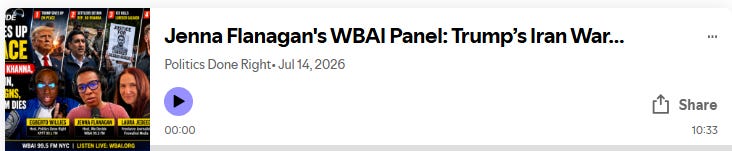
The embedded video contains solely the questions that WBAI’s We Decide’s Jenna Flanagan asked me. The entire panel discussion can be viewed here (Episode: 2026-07-13). We Decide is a joint Pacifica Affiliate, WBAI production, and the We Decide: America at the Crossroads with Jenna Flanagan.
Summary
A week of political violence, institutional failure, and hard democratic lessons.
WBAI’s We Decide panel confronted five stories that expose the same underlying crisis: powerful institutions increasingly operate without meaningful accountability. The discussion moved from Donald Trump’s abandonment of diplomacy with Iran to armed settlers detaining a member of Congress, ICE’s fatal shooting of a Houston father, the collapse of Graham Platner’s Senate campaign, and the death of Senator Lindsey Graham. The panel refused to treat these developments as disconnected headlines. Each story asks whether government will protect human life, uphold international law, investigate abuses, vet candidates responsibly, and demand accountability from those who wield power. The program’s central message remained clear: democracy cannot survive as a spectator sport.
- Trump chose escalation over diplomacy. Ending ceasefire negotiations and renewing military action deepens an already catastrophic regional conflict. War expands executive power, enriches military contractors, endangers civilians, and creates consequences that political leaders rarely bear themselves. Recent attacks on tankers and renewed U.S. strikes show how quickly military escalation can spread through the Strait of Hormuz and neighboring states.
- Ro Khanna’s detention exposed the impunity surrounding West Bank settlements. Armed settlers temporarily blocked a sitting member of Congress and his delegation until diplomatic and police intervention helped secure their departure. The incident offered Americans a glimpse of the coercion Palestinians routinely endure under occupation.
- The killing of Lorenzo Salgado Araujo demands an independent investigation. ICE admitted that Salgado was not the intended target. The agency claims he threatened officers with his vehicle, while witnesses dispute that account. The absence of body-camera footage and the exclusion of local investigators intensify concerns about transparency and accountability.
-
Graham Platner’s withdrawal revealed a breakdown in political vetting. Platner denied the sexual-assault allegation against him, but major supporters withdrew their endorsements, and he announced his departure from the Maine Senate race. Progressive media and organizations must never lower ethical standards merely because a candidate speaks the language of economic populism.
-
Lindsey Graham’s death requires honesty rather than mythology. His family and supporters deserve human compassion, but public officials must also receive an honest accounting of their records. Preliminary medical findings reportedly attributed his death to an aortic dissection related to cardiovascular disease, with no evidence supporting online conspiracy theories.
The panel ultimately returned to democratic agency. National personalities dominate political coverage, but local organizers, candidates, journalists, and voters determine whether authoritarianism advances or retreats. The answer does not lie in waiting for institutions to rescue the public. It lies in building informed movements strong enough to compel those institutions to serve the people.
PLEASE BECOME A PAID SUBSCRIBER TODAY
Countering billionaires—and soon trillionaires—is hard, probing work. They flood the zone with propaganda, policy distortions, and economic fallacies rooted in the Powell Memo and financed by concentrated wealth. We work every day to answer that machinery with truth, context, and critical thinking. But independent media cannot survive on conviction alone. It needs support from people who understand the stakes. Please become a paid subscriber today. Your support keeps this work alive, expands its reach, and helps build a media ecosystem that serves people, not plutocrats. This is not charity. It is an investment in truth, democracy, and the public good.
Premium Content (Complimentary)
War, Occupation, ICE Violence, Political Vetting, and the Accountability America Keeps Avoiding
The stories examined on WBAI’s We Decide appear unrelated at first glance. One concern is war with Iran. Another involves Israeli settlers detaining a United States congressman in the occupied West Bank. A third centers on the killing of Lorenzo Salgado Araujo by an ICE agent in Houston. Then comes the implosion of Graham Platner’s Senate campaign and the death of longtime Senator Lindsey Graham.
Yet every story raises the same fundamental question: Who restrains powerful people and institutions when they decide that rules no longer apply to them?
Donald Trump’s decision to abandon ceasefire negotiations with Iran illustrates the danger of placing war-making power in the hands of a president who treats diplomacy as weakness and military force as political theater. The renewed conflict has already extended far beyond a bilateral confrontation. Shipping through the Strait of Hormuz, regional military installations, civilian infrastructure, and neighboring states now face growing danger. Recent reporting describes renewed American strikes and Iranian attacks on oil tankers, underscoring how quickly escalation threatens civilians, sailors, energy markets, and countries that did not choose this war.
A progressive foreign policy must reject the false choice between supporting the Iranian government and supporting an American war. One can condemn repression by Iran’s rulers while also opposing U.S. military escalation. American leaders have repeatedly portrayed war as a clean instrument that can punish an adversary without unleashing broader consequences. History has disproved that fantasy in Vietnam, Iraq, Afghanistan, Libya, and elsewhere. Working people pay through taxes, inflation, lost public investment, military casualties, refugee crises, and shattered communities. Defense contractors collect the profits.
The detention of Representative Ro Khanna in the occupied West Bank exposes another system of unaccountable power. Khanna said armed settlers obstructed his delegation and that Israeli soldiers initially appeared to support the settlers. His group reportedly left only after contacts with American diplomatic officials and Israeli police. The Israeli military disputes portions of his account, but the larger reality remains undeniable: armed settlers felt sufficiently empowered to confront and restrict a sitting member of the United States Congress.
That incident should force Americans to consider what Palestinians experience without congressional status, diplomatic access, cameras, or an embassy ready to intervene. Israel’s government has continued expanding settlements that most of the international community regards as illegal. On July 14, Reuters reported that Israel’s security cabinet approved funding for 34 additional West Bank settlements and related roads, a move openly promoted as a means of tightening Israeli control and obstructing Palestinian statehood.
The detention of a congressman, therefore, did not represent an isolated misunderstanding. It reflected the political environment produced by occupation, settlement expansion, and impunity. American policy enables that environment when Washington supplies military aid and diplomatic protection without enforceable human-rights conditions.
The killing of Lorenzo Salgado Araujo brings the crisis of unaccountable state violence home. ICE shot the 52-year-old Houston construction worker during an enforcement operation, even though the agency later acknowledged that he was not its intended target. ICE says Salgado used his vehicle to threaten agents. Witnesses and family members challenge that narrative, saying officers did not identify themselves and that no agent stood in front of the vehicle when the shots were fired. No publicly released body-camera footage has settled the conflicting accounts.
That lack of evidence matters. Masked or unidentified federal agents, unmarked vehicles, absent body cameras, and resistance to local scrutiny create conditions in which the government controls both the violence and the narrative afterward. Salgado had lived in the United States for approximately 35 years, operated a business, raised three children, and had no criminal history, according to reporting and statements from his family and elected officials.
His humanity does not depend on whether he held the right document. No person should face summary execution during an immigration operation. But the details of his life expose the dishonesty of a system that labels people “illegal” to erase their labor, families, roots, and contributions. His killing also demonstrates how racial profiling makes every Latino worker, immigrant, naturalized citizen, and even U.S.-born citizen vulnerable when enforcement agencies receive broad power with weak oversight.
The Graham Platner scandal presents a different form of accountability. Platner built a populist campaign that energized many progressives seeking to defeat Republican Senator Susan Collins. After a woman accused him of sexual assault, Platner denied the allegation but announced that he would withdraw. Bernie Sanders, Ro Khanna, and other prominent supporters rescinded their backing.
Progressives should learn the right lesson. A compelling economic message does not excuse inadequate vetting. Outsider status does not automatically confer virtue. The left cannot condemn Republicans for protecting abusive men while dismissing credible allegations against candidates who use progressive language. Political movements strengthen themselves when they insist that values apply consistently.
An important admission: progressive media also bear responsibility for scrutinizing favored candidates rather than merely amplifying them. I must acknowledge having given Platner latitude before hearing more detailed reporting from the likes of excellent journalist Laura Jadeed. Progressive outlets must collaborate, investigate, and do better. That willingness to self-correct distinguishes principled journalism from propaganda.
Finally, Lindsey Graham’s death presents a test of moral and historical clarity. Human decency requires no celebration of death. It does not, however, require falsifying a public record. Graham championed militarism, supported the Trump movement after repeatedly condemning Trump’s character, and helped normalize policies that harmed people at home and abroad. A humane society can recognize his family’s grief while still evaluating his political legacy honestly.
Preliminary medical findings attributed Graham’s death to an aortic dissection associated with cardiovascular disease. Authorities have offered no evidence of assassination or foreign involvement, despite conspiracies spreading online. Serious political commentary should reject both hagiography and conspiracy.
These five stories point toward one conclusion. Democracy fails when leaders wage war without restraint, settlers act above the law, federal agents kill without transparent investigation, political organizations neglect due diligence, and the media sanitize the records of powerful officials.
The public must demand better. It must organize locally, support independent journalism, defend immigrants, oppose occupation, challenge militarism, and vet candidates without fear or favoritism. The panel ended by emphasizing that national headlines often obscure the “magic” developing in local races and grassroots movements. That is where democratic renewal begins—not with worship of personalities, but with organized people who understand that we decide whether power answers to the public.