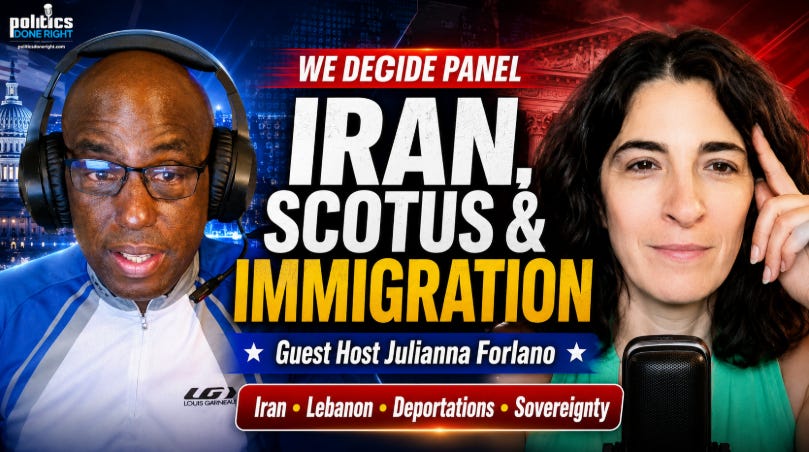
A WBAI We Decide panel tackles Iran talks, Israel-Lebanon conflict, SCOTUS TPS rulings, deportations, and America’s selective sovereignty claims.

Summary

The embedded video contains solely the questions that WBAI’s We Decide’s Jenna Flanagan asked me. The entire panel discussion can be viewed here (Episode: 2026-06-29). We Decide is a joint Pacifica Affiliate, WBAI production, and the We Decide: America at the Crossroads with Jenna Flanagan.
Summary
America keeps exposing its contradictions.
On WBAI’s “We Decide,” guest host Julianna Forlano led a panel discussion on Iran, Israel, Lebanon, deportations, Supreme Court power, and America’s selective use of “sovereignty.” The discussion made one truth plain: U.S. leaders invoke peace, law, democracy, and national borders when those words serve power, but discard them when immigrants, poor people, Black and Brown nations, or foreign civilians pay the price. The panel directly challenged that hypocrisy, especially as the country approaches its 250th anniversary while betraying many of its founding promises.
- The U.S.-Iran ceasefire framework and Israel-Lebanon negotiations show diplomacy can happen, but continued strikes and excluded stakeholders keep the region unstable.
- Netanyahu’s government must be separated from Jewish people broadly; criticism of a far-right Israeli government is not antisemitism, and destabilizing militarism deserves direct condemnation.
- The Supreme Court’s TPS ruling against Haitians and Syrians threatens hundreds of thousands immediately and could endanger many more immigrants who have built lives, families, businesses, and communities here.
-
America’s sovereignty argument rings hollow when the United States violates the sovereignty of other nations through bases, sanctions, military actions, regime pressure, and economic coercion.
-
Declining pride in U.S. democracy reflects not hatred of America, but rejection of an America captured by billionaires, Christian nationalism, militarism, and racialized hierarchy.
The panel exposed a hard reality. A country cannot celebrate liberty while deporting protected immigrants, funding war, mocking foreign sovereignty, and letting an extremist Court redefine democracy downward. Real patriotism demands repair, not propaganda.
Premium Content (Complimentary)
The conversation on WBAI’s “We Decide” landed exactly where responsible political commentary must land: on the contradiction between America’s advertised values and America’s governing behavior. Guest host Julianna Forlano guided a discussion that connected Iran, Israel, Lebanon, Supreme Court immigration rulings, and the rhetorical weaponization of “sovereignty.” The result was not a scattered foreign-policy-and-immigration panel. It was a single moral indictment of selective democracy.
The latest developments in the Middle East show the danger of pretending that diplomacy can succeed while militarism remains the default operating system. Reuters reported that the U.S. and Iran signed a ceasefire agreement, though details remained unclear, and Trump later threatened that the United States could “go right back” to bombing if he disliked Iran’s behavior. That is not diplomacy rooted in mutual respect. That is coercive bargaining with explosives on the table.
The Israel-Lebanon framework also carries contradictions. Reuters reported that the U.S.-mediated agreement includes mutual recognition of sovereignty, Hezbollah disarmament by the Lebanese Armed Forces, Israeli withdrawal conditions, reconstruction, and U.S. oversight. But Reuters also reported Lebanese criticism that the deal could deepen internal divisions, while analysts warned that it could entrench a stalemate rather than end the war because it demands conditions that Lebanon may not be able to enforce.
That matters because peace cannot be built by excluding central actors, imposing unrealistic terms, or letting one side define security as domination. The panel correctly separated Jewish people from Netanyahu’s government. That distinction remains morally essential. Criticizing Netanyahu’s far-right militarism does not attack Jewish identity. It attacks a political project that thrives on permanent conflict, regional destabilization, and the claim that overwhelming force can substitute for justice.
The same hypocrisy appeared in the Supreme Court’s ruling on Temporary Protected Status. The Court ruled to end protections for more than 350,000 Haitians and 6,100 Syrians, and that the decision could put broader TPS protections at risk. Reuters reported that the Supreme Court let Trump end deportation protections for Haitians and Syrians, while Roll Call summarized the decision as a 6-3 ruling limiting judicial review over most TPS decisions.
This ruling does not represent neutral law in any meaningful civic sense. It empowers an administration to rip work authorization and deportation protection away from people whose home countries remain unsafe or unstable. It tells Haitian and Syrian families that their labor was welcome, their tax contributions were useful, their neighborhood investments were fine, and their children could grow roots here—but their lives remain disposable when the politics of cruelty demand a target.
The panel’s discussion of Haiti was especially important. Haitian immigrants have revitalized communities, opened businesses, worked hard, and contributed to rural and urban America alike. The United States also bears historical responsibility for conditions that push migration, including economic policies that damaged Haiti’s rice sector and deepened dependence. Yet U.S. leaders erase that history when they want immigration to appear like an invasion rather than a consequence of foreign policy, trade policy, climate vulnerability, and imperial power.
Then comes the word “sovereignty.” The White House celebrated the TPS decision as a victory for American sovereignty. But that argument collapses under the weight of U.S. behavior abroad. America invokes sovereignty when immigrants arrive at its borders, but undermines sovereignty when it interferes in Latin America, pressures Caribbean nations, maintains legal privileges around military bases, sanctions governments into crisis, or uses force in international waters.
Sovereignty cannot mean “America gets borders, but others get ultimatums.” It cannot mean “our courts, our troops, our capital, and our corporations may cross into your politics, but your displaced people may not cross into our labor market.” That is not sovereignty. That is hierarchy.
The AP-NORC findings deepen the point. AP-NORC’s America 250 polling found that only about a third believe the American Dream still exists, and AP reported that fewer Americans now see democracy as central to the country’s identity. Another AP-NORC poll found that most Americans see core freedoms, including the right to vote, as under threat.
Those numbers should not surprise anyone. People do not lose faith in democracy because they hate the country. They lose faith because the institutions keep showing them that the wealthy, the well-connected, and the white nationalist project receive protection while working people, immigrants, and the poor receive discipline. They see a Supreme Court more willing to protect executive cruelty than vulnerable families. They see militarism funded without hesitation while healthcare, housing, wages, and climate resilience remain negotiable. They see “law and order” used against migrants and protesters, but not against the powerful who profit from war, detention, and austerity.
The real patriotic position demands honesty. America can be loved without being lied about. In fact, love of country requires refusing the mythology that excuses its failures. The America worth defending is not Trump’s America, not billionaire America, not Christian nationalist America, and not empire America. The America worth defending is the one workers, immigrants, abolitionists, civil rights organizers, labor leaders, anti-war veterans, and democracy activists keep trying to build.
That America does not deport Haitians and Syrians into danger while pretending to honor liberty. It does not call bombing diplomacy. It does not claim sovereignty while violating others’ sovereignty. It does not celebrate 250 years of founding ideals while dismantling birthright principles, due process, and humanitarian protections.
The panel’s message was clear: America must choose. It can keep performing democracy while practicing domination, or it can finally align policy with principle. A humane foreign policy, a just immigration system, and a democracy that serves working people are not radical demands. They are the minimum requirements for a country that still wants to call itself free.
Independent Media needs you
If you like what we do, please do the following!
- Become Patreon here.
- SUBSCRIBE to our YouTube Channel here.
- SUBSCRIBE to our Facebook Page here.
- SUBSCRIBE to our Podcast here.
- Support our GoFundMe equipment fund here.
- Share our blogs, podcasts, and videos.
- Consider contributing here.