


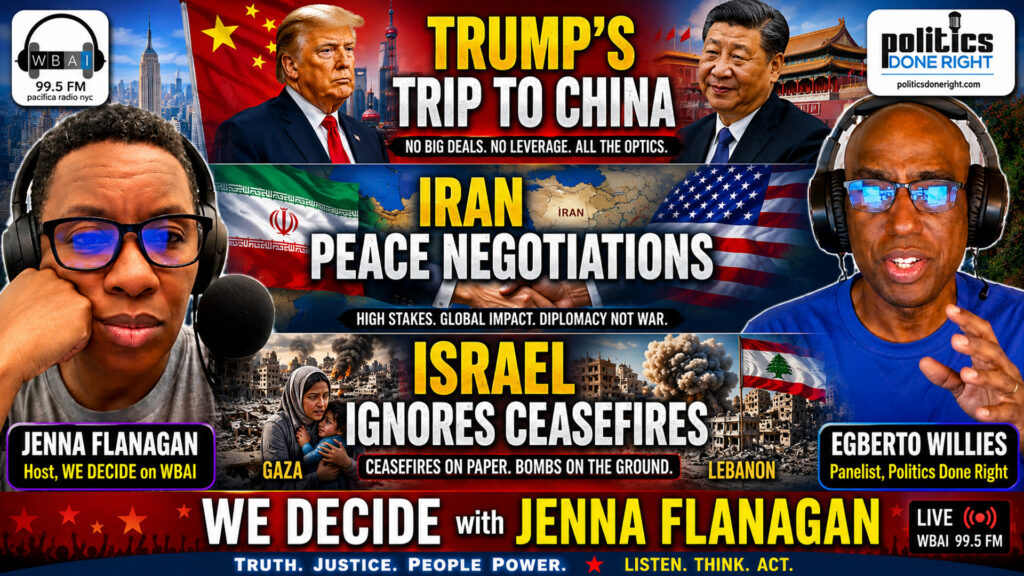
A WBAI panel with Jenna Flanagan discusses Trump leaving China with little to show, Iran peace talks remaining fragile, and Israel continued attacks in Gaza and Lebanon despite ceasefires.
Trump’s China Trip Flops

Watch Politics Done Right T.V. here.

Podcasts (Video — Audio)
The embedded video contains solely the questions that WBAI’s We Decide’s Jenna Flanagan asked me. The entire panel discussion can be viewed here (Episode: 2026-05-18). We Decide is a joint Pacifica Affiliate, WBAI production, and the We Decide: America at the Crossroads with Jenna Flanagan.
Summary
A world in flux. Trump’s trip to China exposed the United States’ weakening leverage as Beijing demonstrated the patience and strategic discipline that increasingly define the emerging global order. At the same time, fragile negotiations with Iran underscored how urgently the world needs competent diplomacy to avoid a catastrophic regional war and a global economic shock. Meanwhile, Israel continues military operations in Gaza and Lebanon despite ceasefire agreements and growing international condemnation. Together, these developments reveal the consequences of performative leadership, militarism, and the refusal to apply international law equally. The world is watching an American administration that prioritizes spectacle over substance while ordinary people everywhere bear the cost.
- Trump’s China visit produced headlines but no meaningful agreements, highlighting America’s declining negotiating power.
- China continues reducing its holdings of U.S. Treasury debt, signaling a gradual shift away from American financial dominance.
- Iran negotiations remain critical to preventing a broader Middle East war and protecting the global economy from oil shocks.
- Israel’s continued attacks in Gaza and Lebanon expose the weakness of ceasefire enforcement when powerful allies face no accountability.
- Working people worldwide ultimately pay the price for failed diplomacy and unchecked militarism.
Peace requires competent diplomacy, respect for international law, and leaders willing to prioritize human lives over political theater. Until governments are held accountable equally—whether in Washington, Tel Aviv, or Tehran—ordinary people will continue to suffer the consequences of elite failures.
Premium Content (Complimentary)
The world is witnessing a profound shift in global power, and recent events involving China, Iran, and Israel reveal how fragile and inconsistent American foreign policy has become.
Donald Trump’s trip to China was presented as a display of presidential strength. In reality, it highlighted the growing imbalance between an increasingly disciplined China and a United States whose foreign policy often seems driven by personal relationships and improvised decisions rather than coherent strategy. China, under Xi Jinping, projects patience and long-term planning. Beijing has steadily reduced its holdings of U.S. debt, signaling that it is preparing for a world in which the dollar no longer holds unquestioned supremacy.
This matters because America’s economic power has long rested not just on productivity, but on the privileged role of the dollar in global finance. As economists such as Richard Wolff have argued, privilege allowed the United States to consume more than it produced while exporting paper assets in exchange for real goods and labor. China and other nations increasingly seek alternatives to this arrangement.
Trump’s China trip yielded little of substance. No major trade agreements emerged. No significant strategic breakthrough occurred. What remained was the image of an American president trying to project dominance while confronting a nation that clearly understands its rising influence.
At the same time, indirect peace talks with Iran continue under intense pressure. The stakes could not be higher. Iran sits astride the Strait of Hormuz, through which roughly one-fifth of the world’s oil supply passes. Any escalation could disrupt global shipping, drive energy prices higher, and trigger inflation that would hit working families first and hardest.
Diplomacy with Iran requires experienced negotiators, clear objectives, and respect for international agreements. Instead, the current administration has often relied on political loyalists and informal envoys rather than seasoned diplomats. That approach turns peace into a branding exercise rather than a serious strategic effort.
Meanwhile, Israel continues military actions in both Gaza and Lebanon despite ceasefire agreements and repeated calls from the international community for restraint. In Gaza, humanitarian organizations have documented widespread civilian suffering, shortages of food and medicine, and the destruction of essential infrastructure. In Lebanon, repeated strikes risk drawing the region into a broader conflict.
The tragedy is not only the scale of the suffering, but the selective enforcement of international law. When powerful allies violate ceasefires without consequence, the global rules-based order loses credibility. International law must apply equally to every nation, not only to adversaries.
Progressives understand that militarism enriches contractors and political elites while ordinary people pay with their lives, livelihoods, and futures. Resources devoted to endless war could instead fund healthcare, education, clean energy, and economic security.
The broader lesson is simple: peace is not achieved through bombast, personal ego, or military impunity. It requires competent diplomacy, multilateral cooperation, and a consistent commitment to human rights.
China is demonstrating strategic patience. Iran is testing whether diplomacy can replace confrontation. Israel is exposing the consequences of unchecked power. And the United States must decide whether it will lead through justice and diplomacy or continue down a path of spectacle and instability.
The progressive response is clear. Demand diplomacy over war, accountability over impunity, and investment in people rather than conflict. The world needs serious leadership, not political theater.