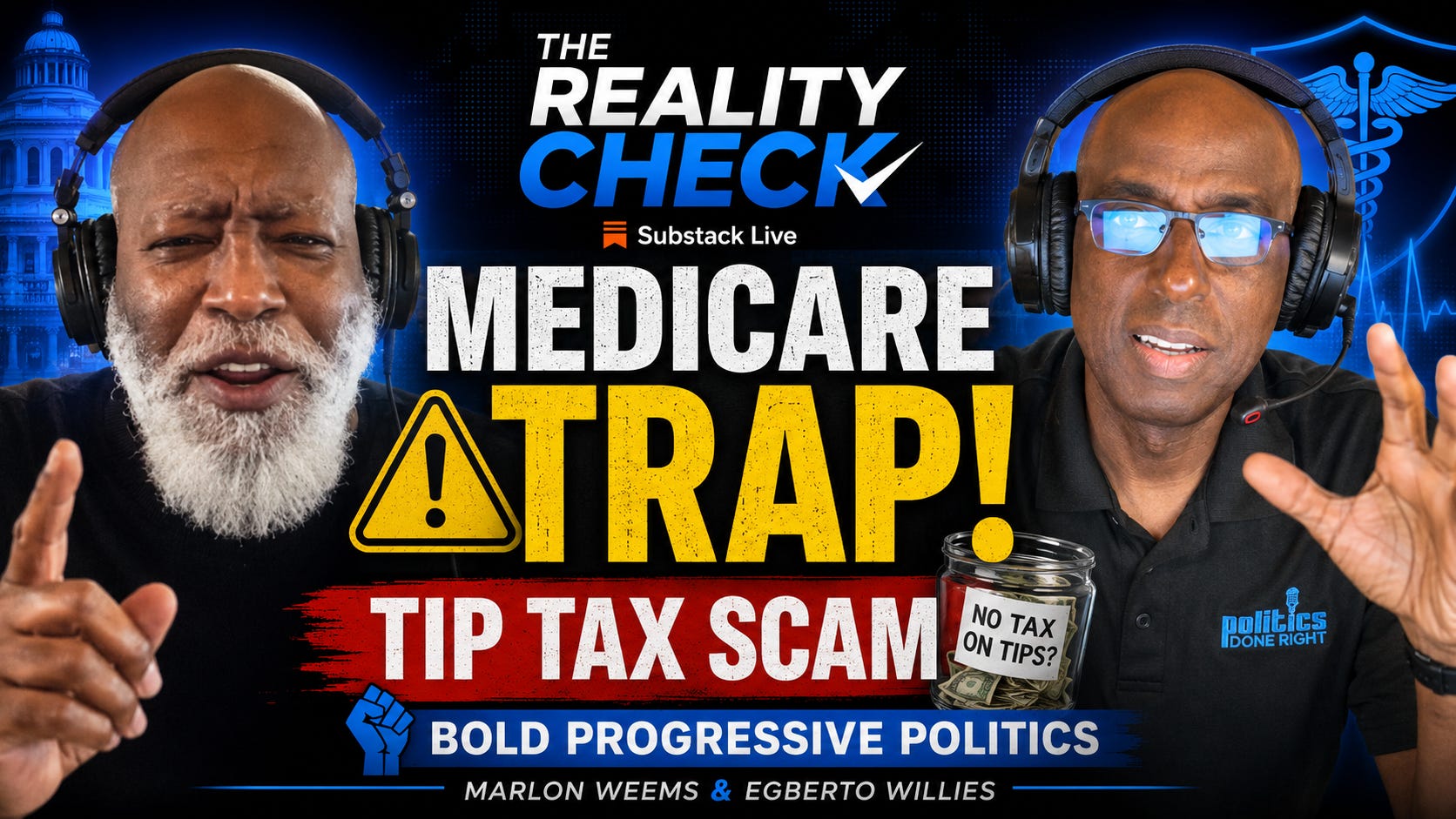
Medicare Advantage traps, Trump’s “no tax on tips” gimmick, and timid Democrats collide as The Reality Check exposes who profits—and why working people need bold progressive change.


Podcasts (Video — Audio)
This edition of The Reality Check connects the dots between America’s broken healthcare system, Trump-style political marketing, economic insecurity, corruption, and the Democratic Party’s continuing struggle to offer working people a sufficiently bold alternative. The conversation starts with a personal encounter with Medicare Advantage—where seemingly attractive benefits can look very different once serious medical care generates multiple bills—and expands into a larger argument: Americans need universal healthcare, economic policies that materially improve their lives, and politicians willing to confront concentrated corporate power rather than manage it.
- Medicare Advantage exposes the problem with profit-driven healthcare. A broken leg and subsequent treatment turned an abstract insurance debate into something tangible: separate providers, repeated bills, and hundreds of dollars in patient responsibility. The discussion argues that patients should not have to navigate this maze while recovering from illness or injury.
- Medicare for All remains the structural answer. Rather than blaming seniors who chose Medicare Advantage after aggressive marketing and attractive extras, the conversation directs the criticism toward a system that forces people to become insurance experts. The goal should be to treat healthcare as a public good rather than another opportunity for private extraction.
- Trump’s “no tax on tips” message is treated as political marketing rather than as a transformative working-class policy. The discussion challenges the claim that the slogan meaningfully changes the economic circumstances of tipped workers and contrasts the promotional spectacle with the far larger affordability problems confronting families.
- Trumpism represents more than one politician. The discussion argues that competent Republicans, business leaders, and institutional actors know better but continue enabling an administration driven by loyalty, corruption, and political expediency. That makes the crisis systemic rather than merely personal.
- Democrats cannot defeat right-wing politics by becoming “Republican light.” The progressive case is straightforward: candidates must explain concretely how their policies will improve wages, healthcare, education, retirement security, and family life. Voters need more than assurances that Democrats are less extreme than Republicans; they need a governing agenda worth voting for.
The reality check is that America’s problems are interconnected. Predatory healthcare financing, political gimmicks, economic insecurity, corruption, and timid Democratic politics all flourish when government stops challenging concentrated power. Progressives have an opening—but only if they offer voters something materially better than the status quo and then fight unapologetically to deliver it.