


When whiteness stops shielding people from state violence, the illusion collapses. A powerful conversation on fear, faith, and justice.
When Whiteness Stops Protecting You

Watch Politics Done Right T.V. here.

Podcasts (Video — Audio)
Summary
A reckoning arrives when whiteness stops protecting its own. This conversation confronts an uncomfortable truth in American life: racialized violence only becomes “real” to many white Americans when state brutality finally pierces the illusion of immunity. The discussion exposes how whiteness operates as a shield, how silence sustains cruelty, and why moral awakening often begins only after proximity to power collapses.
- Whiteness functions as social armor—until it suddenly doesn’t.
- State violence against immigrants and marginalized people persists through silence and normalization.
- White supremacy distorts Christianity and weaponizes faith against human dignity.
- Fear of losing community keeps many people complicit even when they know better.
- Real change begins when individuals choose moral courage over tribal comfort.
Progress does not come from elections alone. It comes when ordinary people reject silence, confront indoctrination, and decide to become forces of justice for good—especially when doing so costs them social safety. That is how systems crack. That is how liberation begins.
Premium Content (Complimentary)
America is a racialized society that insists on pretending otherwise. That contradiction shapes nearly every moral failure discussed in this conversation. Race is not biological, but racism is institutional, enforced, and deadly. The system does not merely privilege whiteness—it conditions people to believe that protection is permanent. The moment that illusion breaks, everything changes.
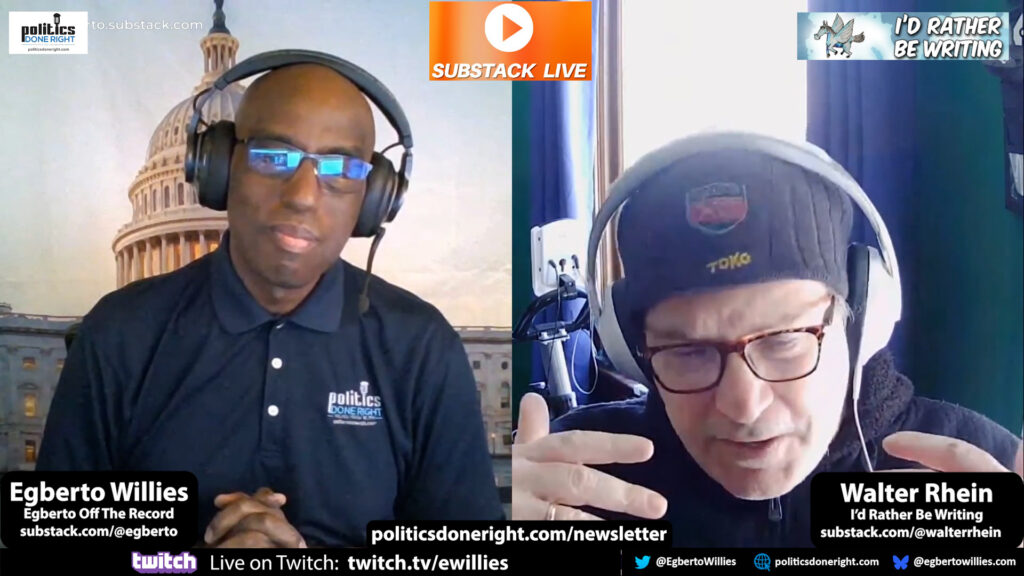
This discussion between Walter Rhein, publisher of I’d Rather Be Writing, and Egberto Willies, host of Politics Done Right and publisher of Egberto Off The Record centers on what happens when white Americans lose their assumed adjacency to whiteness—when state violence, long normalized against Black, Brown, immigrant, and poor bodies, suddenly touches someone the system once deemed “safe.” That moment of rupture is not accidental. It is the predictable outcome of a structure that requires hierarchy to function.
For generations, brutality carried out by law enforcement, border agencies, and the national security state has been rendered invisible through distance. Detention centers operate far from affluent suburbs. Deportations happen at dawn. Children suffer behind bureaucratic language. Deaths become statistics. The cruelty continues because most people do not believe it will reach them.
Until it does.
When violence pierces whiteness, attention follows. Media coverage intensifies. Moral outrage becomes socially acceptable. The same acts that were dismissed as policy suddenly become tragedies. This asymmetry is not a moral failure of individuals alone—it is the result of a society trained to value some lives more than others.
Silence plays a central role in sustaining this system. People sense the wrongness. They feel the discomfort. Yet fear keeps them compliant. Fear of social isolation. Fear of losing family, church, or community. Fear of being seen as disloyal to the tribe. That fear explains why conversations that happen privately disappear the moment others enter the room.
This is not ignorance. It is indoctrination.
White supremacy does not require overt hatred to survive. It only requires passivity. It requires people to accept narratives that justify cruelty—criminalization, dehumanization, national security myths—rather than confront the violence done in their name. The system trains people to rationalize abuse the way victims of long-term manipulation rationalize their abusers.
Religion, particularly Christianity in the United States, has been deeply corrupted in this process. White supremacy has hollowed out faith and repurposed it as a shield for power. Teachings centered on compassion, humility, and solidarity have been replaced with hierarchy, punishment, and exclusion. This is not faith—it is idolatry of dominance.
And yet, the conversation makes something clear: racism is taught. It is not inherent. That means it can be unlearned.
The process is difficult. Deprogramming always is. It requires distance from propaganda, exposure to truth, and permission to feel moral discomfort. Education matters—not sanitized history, but honest reckoning. Children must learn what was done, who benefited, and how those structures persist. Democracy cannot survive mythmaking.
There is also a warning embedded here. As whiteness loses its uncontested power, backlash intensifies. History shows this pattern clearly. When dominant groups feel cornered, they escalate. Detention camps, authoritarian rhetoric, and state violence increase not because power is strong, but because it is afraid.
Bullies behave this way. They project strength while revealing fragility. They rely on intimidation because they cannot create legitimacy. The moment people stop believing in the illusion, the structure begins to collapse.
What emerges from this conversation is not despair, but responsibility. Change does not begin in Washington alone. It begins in daily moral choices. Speaking when silence feels safer. Asking uncomfortable questions. Refusing to accept “lesser evil” politics that normalize harm. Demanding dignity as a baseline, not a reward.
Becoming a force of justice for good is not performative. It is personal. It means confronting internalized fear and choosing integrity anyway. It means understanding that progress depends not on purity, but on courage.
The turning point does not arrive fully formed. It must be sustained. Every generation decides whether it will protect comfort or pursue justice. The future depends on how many people choose to step out of the shadow of whiteness and stand openly for humanity—before the system decides for them.