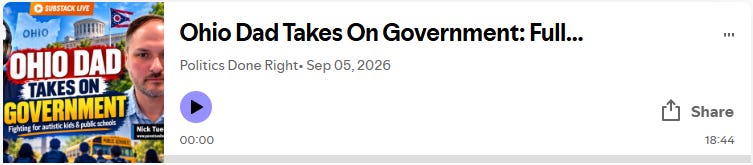
Politicians fund tax cuts and stadiums while schools struggle. Nick Tuell explains why parents of disabled children are fighting back locally and nationally.


Summary
Ohio parent and public-school organizer Nick Tuell turns his family’s experience with special education into a broader political challenge: government cannot proclaim that children with disabilities have rights while refusing to fund and enforce those rights. Tuell’s six-year-old son, Jackson, is autistic and non-speaking and relies on speech, occupational, behavioral, and classroom supports. His message is straightforward: when children receive the tools they need, they can flourish; when politicians underfund public education, families must organize and fight back.
- Parents are exhausted by a system that forces them to fight repeatedly for legally protected services. Tuell describes families encountering delays or denials of special-education services, disappearing aides, transportation problems, and uncertainty about federal protections.
- Collective organizing changes the balance of power. Parents United for Public Schools brings families together so they can understand IDEA, support one another in IEP meetings, and then carry that organizing into school boards, statehouses, and Congress.
- The federal government still has not fulfilled IDEA’s funding promise. Tuell backs H.R. 2598, the IDEA Full Funding Act. As of September 2026, the bill remains in the House Education and Workforce Committee; current tracking shows about 170 cosponsors, including Republicans and Democrats.
-
Budgets expose political priorities. Tuell points to Ohio’s 2025 budget, which included a 2.75% flat income-tax structure and $600 million for a new Cleveland Browns stadium while school-funding advocates argued that public schools remained hundreds of millions of dollars short of full implementation of the Fair School Funding Plan. Independent reporting confirms the $600 million stadium allocation and tax changes.
-
School vouchers do not automatically reproduce public-school disability protections. Federal guidance says a child placed by parents in a private school—including through a state voucher—does not have an individual entitlement to all the special-education services the child would receive in public school. That distinction makes the debate over privatization especially consequential for families with disabled children.
ConclusionTuell’s story strips away the abstractions surrounding education policy. Special education is not charity, and public education is not simply another consumer product. A democratic society either provides every child the resources necessary to participate fully or accepts inequality as policy. Tuell chooses organizing over resignation—and urges other parents and neighbors to do the same.
PLEASE BECOME A PAID SUBSCRIBER TODAY
Countering billionaires—and soon trillionaires—is hard, probing work. They flood the zone with propaganda, policy distortions, and economic fallacies rooted in the Powell Memo and financed by concentrated wealth. We work every day to answer that machinery with truth, context, and critical thinking. But independent media cannot survive on conviction alone. It needs support from people who understand the stakes. Please become a paid subscriber today. Your support keeps this work alive, expands its reach, and helps build a media ecosystem that serves people, not plutocrats. This is not charity. It is an investment in truth, democracy, and the public good.
Premium Content (Complimentary)
Nick Tuell Shows Why Fighting for Special Education Means Fighting for Democracy
Nick Tuell does not approach public education as an abstract ideological dispute. He approaches it as a father.
His six-year-old son Jackson is autistic and non-speaking. Jackson relies on speech therapy, occupational therapy, behavioral support, and substantial assistance inside and outside the classroom. Yet Tuell makes something equally important clear: Jackson is a child who loves his sister, Elmo, Moana, and the jungle gym. Given the right tools, he learns, communicates, spells, develops, and thrives.
That simple reality exposes the cruelty of chronic public-school underfunding.
Children with disabilities do not need pity. They need society to honor commitments already written into law. The Individuals with Disabilities Education Act guarantees critical educational rights, but rights without sufficient resources become promises that parents must constantly fight to redeem.
Tuell describes parents confronting delayed services, denied services, disappearing classroom aides, transportation problems, and exhausted school systems. Those failures do not occur in a vacuum. They reflect political choices.
And budgets always reveal priorities.
Ohio illustrated that principle dramatically in 2025. Republican Gov. Mike DeWine signed a state budget containing $600 million for a new Cleveland Browns stadium while lawmakers also approved a flatter income-tax structure benefiting high earners. At the same time, education advocates argued that lawmakers remained hundreds of millions short of what full implementation of Ohio’s Fair School Funding Plan required.
Government therefore cannot credibly tell parents that money simply does not exist. Money exists. The political system decides who gets it.
The same struggle continues federally. Tuell highlighted H.R. 2598, the IDEA Full Funding Act, legislation designed to increase federal special education funding to the level Congress originally envisioned. The bill remains pending in the House Education and Workforce Committee, although it has amassed substantial bipartisan support.
Meanwhile, the Trump administration’s fiscal 2027 proposal illustrates another danger. The White House proposes nearly $16 billion for IDEA programs and a nominal increase for IDEA state grants, but it simultaneously proposes eliminating or consolidating roughly $8.5 billion in other K-12 programs. The administration describes those changes as flexibility and reduced federal bureaucracy. Families like Tuell’s must evaluate the entire education ecosystem rather than accept one favorable headline number.
That matters because special education does not exist on an island. Transportation, staffing, teacher preparation, school funding, civil-rights enforcement, and support programs interact.
Tuell also challenges the seductive rhetoric surrounding vouchers. Advocates describe private-school choice as parental empowerment. But federal IDEA guidance contains a major caveat: when parents voluntarily place a disabled child in a private school—including through some voucher arrangements—that child does not retain an individual right to the same range of IDEA services available in public school.
That is not expanded freedom for every family. For some, it can mean fewer enforceable protections.
Tuell’s most powerful prescription is therefore collective action. He encourages parents to talk with neighbors, attend school-board meetings, understand school financing, question authority, and organize.
That approach transcends ideology. Rural families need good public schools. Urban families need them. Conservatives, liberals, independents, disabled children, gifted children, poor children, and middle-class children all benefit when their neighborhood school works.
Public education remains one of America’s most democratic institutions precisely because its moral premise is radical: every child matters.
The progressive response should defend that premise unapologetically. Fully fund IDEA. Strengthen enforcement. Invest in teachers and support professionals. Demand transparency from statehouses. Stop pretending billionaire subsidies represent fiscal responsibility while schools must plead poverty.
Most importantly, parents should never have to fight alone.
A society proves what it values not through slogans but through what it funds. Children like Jackson deserve more than promises. They deserve the resources necessary to thrive.