Ericka Ledferd discusses Texas public schools, vouchers, AI, curriculum and why the 2026 State Board of Education District 9 race deserves voters’ attention.



Summary
Ericka Ledferd presents the State Board of Education District 9 race as a consequential contest over who shapes Texas public education. A mother and educator with secondary and collegiate experience, she argues that public schools need investment, relevant curricula, and responsible preparation for artificial intelligence—not privatization.
- Ledferd opposes Texas’s education-savings-account program and says public dollars should strengthen public schools.
- She grounds her case in the Texas Constitution’s duty to support public education.
- She calls for stronger reading, mathematics, science, technology, and career education.
-
She wants the state to address artificial intelligence without weakening the foundational learning that develops future expertise.
-
She urges voters to scrutinize down-ballot State Board races because the board influences curriculum and instructional materials.
The interview frames education as both a public responsibility and a long-term investment. Ledferd’s argument asks voters to judge whether Texas will build an equitable public system for every child or increasingly route public resources into privately operated alternatives.
Progressive Candidates Need Your Support
To make changes in State Legislatures, the House of Representatives, and our local governments, our progressive candidates need your support. Please give directly to the candidate, not the party consultants. They know their districts and get minimal support.
Support Candidate Here: https://www.ledferd4texas.com/
Premium Content (Complimentary)
Public Education Is on the Ballot in Texas
Ericka Ledferd makes one point impossible to miss: the State Board of Education is not political background noise. Its decisions influence what Texas students learn, which instructional materials schools use, and how the state stewards education resources. That makes the District 9 contest a serious debate over public priorities.
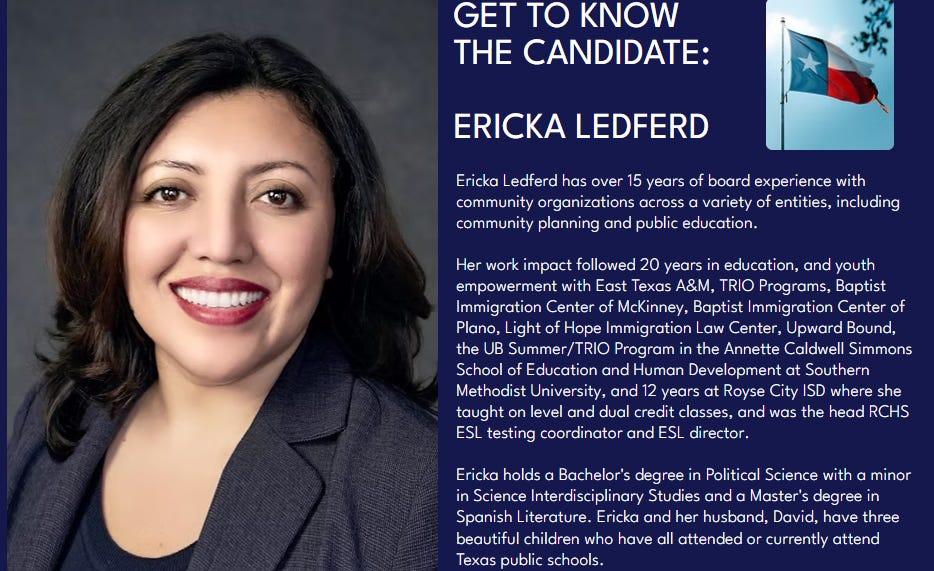
Ledferd enters that debate as a mother and educator. Her experience spans secondary and collegiate education, along with work in English-language learning and testing. In the interview, she connects that experience to three priorities: protecting public schools from privatization, guiding education responsibly through the age of artificial intelligence, and building curricula that create genuine opportunity.
Her opposition to vouchers anchors the conversation. Texas created its Education Freedom Accounts program in 2025 with a $1 billion first-year appropriation. The comptroller—not the State Board of Education—administers it. For 2026–27, an approved private-school student can receive $10,474; eligible students with disabilities can receive up to $30,000; and homeschool participants can receive up to $2,000. Those facts sharpen the policy question Ledferd raises: what should Texas prioritize when public schools already serve more than five million students?
That question deserves more than slogans. Voucher supporters describe the program as parental choice. Opponents argue that public money should reinforce the universal system obligated to educate every child. The first-year program’s scale makes oversight, transparency, access, and academic outcomes legitimate subjects for sustained public scrutiny.
Ledferd also understands that defending public education cannot mean defending the status quo. She calls for stronger instruction in reading, mathematics, science, technology, and career preparation. Her AI argument is especially timely. Schools must teach students how to use emerging tools critically while preserving the foundational work through which people learn to reason, create, and develop expertise. Technology should expand human capacity, not replace the learning process that produces capable adults.
The interview also exposes a civic blind spot. Voters often focus on high-profile offices and neglect the down-ballot bodies that make durable policy. Texas has a 15-member elected State Board of Education, and eight seats are up in 2026. District 9 is an open-seat contest between Ledferd and Republican Kason Huddleston, with the general election scheduled for November 3.
Voters should examine both candidates’ records, qualifications, funding priorities, and positions on curriculum, instructional materials, AI, testing, and the Permanent School Fund. Ledferd’s interview offers a clear account of her own program: public investment, responsible innovation, and opportunity-centered curriculum. The race will help determine how Texas translates those competing visions into policy for millions of children.