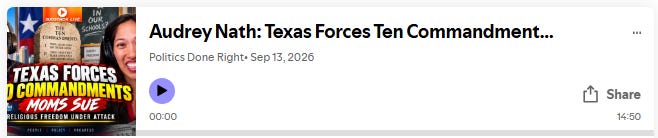
Texas calls it morality. Dr. Audrey Nath calls it government-backed religious favoritism. Three Houston moms are taking the state to court.


Summary
Texas calls Senate Bill 10 a defense of morality and American heritage. Audrey Nath sees something more fundamental: government choosing a religious text and placing it in front of every child in every public-school classroom. In the interview, Nath makes clear that her lawsuit is not an attack on Christianity or religion. It defends religious freedom, parental rights, pluralism, and the principle that public schools belong equally to families of every faith and no faith.
- SB 10 makes the religious message unavoidable. Nath notes that the law requires Ten Commandments displays in every classroom, visible to students rather than confined to a history lesson or comparative-religion setting.
- Three Houston-area mothers are challenging the law. Nath, Emily Roth, and Sanjam Kaur Sohal have taken Texas to court, arguing under state law that government cannot burden their families’ religious freedom or override their parental authority.
- The fight is about government favoritism, not hostility toward Christianity. Nath argues that posting one tradition’s scripture in a government classroom necessarily elevates that tradition above others and risks marginalizing children whose families believe differently.
-
Her own family illustrates what religious liberty protects. Nath describes a family touched by Hindu, Jain, Catholic, Jewish, and Quaker traditions. Her children have learned to appreciate that diversity rather than accept a state-designated “correct” faith.
-
The broader lesson is democratic resistance. Nath rejects the idea that families with resources should simply flee to private schools. She argues that citizens should defend public institutions for every child, not abandon them to ideological capture.
Religious freedom does not mean the majority gets to use government property to preach its scripture to everyone else’s children. It means government protects every family’s right to believe, worship, question, or abstain without state coercion. That is the constitutional and democratic principle at stake.
PLEASE BECOME A PAID SUBSCRIBER TODAY
Countering billionaires—and soon trillionaires—is hard, probing work. They flood the zone with propaganda, policy distortions, and economic fallacies rooted in the Powell Memo and financed by concentrated wealth. We work every day to answer that machinery with truth, context, and critical thinking. But independent media cannot survive on conviction alone. It needs support from people who understand the stakes. Please become a paid subscriber today. Your support keeps this work alive, expands its reach, and helps build a media ecosystem that serves people, not plutocrats. This is not charity. It is an investment in truth, democracy, and the public good.
Premium Content (Complimentary)
Texas Cannot Call Religious Coercion “Religious Freedom”
Texas politicians want Americans to believe that forcing the Ten Commandments onto the walls of every public-school classroom simply teaches morality. Audrey Nath exposes the flaw in that argument with devastating clarity: morality does not require government to select one religious tradition, one scriptural formulation, and one theological worldview for everybody else’s children.
Senate Bill 10 requires Texas public schools to display donated copies of a state-selected version of the Ten Commandments in classrooms. The Fifth Circuit upheld the law in April 2026 after a federal district court had previously blocked it in several districts. Families challenging SB 10 asked the U.S. Supreme Court on August 17 to review that ruling.
But Nath and two other Houston-area mothers opened another front. Their state-court lawsuit invokes the Texas Religious Freedom Restoration Act and Texas’ voter-approved parental-rights amendment. That is important because conservatives have spent years declaring parental rights sacred. These mothers are now asking Texas to live by its own rhetoric.
Nath’s argument is neither anti-Christian nor anti-religion. Quite the opposite. She understands religious liberty precisely because her family embodies it. She describes a family history that includes Jainism, Hinduism, Catholicism, Judaism, and Quakerism. Her children can encounter these traditions as family, history, culture, and faith without government telling them which one occupies the privileged position.
That distinction matters. Audrey’s Houston Chronicle opinion piece lays it out well.
A Christian parent has every right to teach a child the Ten Commandments. A Jewish parent has every right to teach them through a Jewish tradition. A Hindu family can teach Hindu scripture. An atheist family can reject all of it. The public school’s job is not to settle that theological debate. Its job is to educate every child without turning government authority into a missionary tool.
Nath also demolishes the claim that the display merely teaches universally accepted ethics. Some commandments address conduct already prohibited by secular law. Others are explicitly theological: worship no other god, reject idols, observe particular religious duties. Nath points out that her son once proudly brought a statue of Shiva to school. A government-mandated text telling him that such religious imagery violates the preferred divine order does not function as neutral civics. It signals whose faith the government validates.
That is precisely why compulsory religious displays carry consequences beyond the poster itself. Children notice who fits the dominant culture and who does not. Teachers must answer questions they should never be forced to answer about their own beliefs. Minority-faith and nonreligious students can receive the unmistakable message that government considers them outsiders.
Nath’s resistance carries another lesson. People with means often get told to escape failing or politicized public institutions. She refuses that bargain. She acknowledges that she could afford private school but says the fight is for her children and their classmates. That is what democratic citizenship looks like: not retreat, but organized resistance through peaceful, lawful means.
The latest clearly documented state-court development is that a Harris County judge denied the mothers’ emergency request for a temporary restraining order in early August while allowing the lawsuit to continue. Reporting at the time scheduled a later temporary-injunction hearing. Meanwhile, the separate federal SB 10 litigation has reached the Supreme Court petition stage.
The larger principle should not be complicated. Government does not protect religion by choosing a favored religion. It protects religion by refusing to choose one.
Texas can teach history. It can teach ethics. It can teach students about religions and their enormous influence on civilization. But when government places one religious creed over every child’s desk and commands that it remain there, it crosses from education into endorsement.
And parents have every right to fight back.