


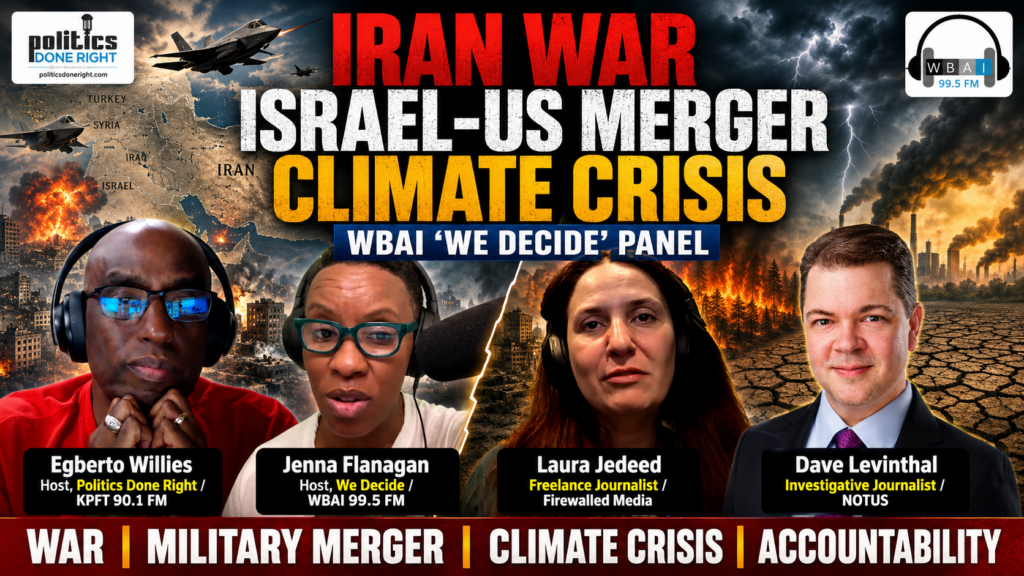
The Jenna Flanagan WBAI panel connects Trump’s Iran escalation, deeper U.S.-Israel military integration, and wildfire smoke to a political system that funds war while neglecting human needs.


The embedded video contains solely the questions that WBAI’s We Decide’s Jenna Flanagan asked me. The entire panel discussion can be viewed here (Episode: 2026-08-03). We Decide is a joint Pacifica Affiliate, WBAI production, and the We Decide: America at the Crossroads with Jenna Flanagan.
Summary
The WBAI “We Decide” panel confronted three crises that political leaders too often discuss as separate stories: the expanding Iran war, the deepening merger of the U.S. and Israeli military establishments, and climate-driven wildfire smoke choking communities far from the flames. Together, they reveal a governing system that readily funds domination abroad while resisting the public investments needed to protect life at home.
- The Trump administration continues a dangerous cycle of threatening devastating attacks, pausing them, and then claiming negotiations that Iranian officials deny are occurring.
- Every additional week of war increases the possibility that neighboring countries, military bases, oil facilities, and shipping lanes will become targets.
- Section 219 of the House defense bill would institutionalize deeper U.S.-Israeli defense-technology cooperation, further blurring the line between alliance and operational integration.
- Criticism of the Israeli government’s conduct must remain precise: opposing state violence and occupation does not constitute hostility toward Jewish people.
- Wildfire smoke spreading across the Midwest and Northeast demonstrates that climate change ignores borders, while conservative disinformation continues to delay meaningful action.
The country needs a foreign policy built around diplomacy and international law, not permanent escalation, and a domestic policy that treats climate protection as essential public infrastructure rather than an inconvenience to fossil-fuel profits.
PLEASE BECOME A PAID SUBSCRIBER TODAY
Countering billionaires—and soon trillionaires—is hard, probing work. They flood the zone with propaganda, policy distortions, and economic fallacies rooted in the Powell Memo and financed by concentrated wealth. We work every day to answer that machinery with truth, context, and critical thinking. But independent media cannot survive on conviction alone. It needs support from people who understand the stakes. Please become a paid subscriber today. Your support keeps this work alive, expands its reach, and helps build a media ecosystem that serves people, not plutocrats. This is not charity. It is an investment in truth, democracy, and the public good.
Premium Content (Complimentary)
War Abroad, Smoke at Home, and the Politics of Manufactured Power
The WBAI panel exposed a political reality that Washington works hard to disguise: militarism, climate neglect, and corporate power operate as parts of the same governing philosophy. Leaders who always find another trillion dollars for war suddenly become fiscal conservatives when communities need clean energy, resilient infrastructure, healthcare, or disaster protection.
The Iran conflict demonstrates the danger of governing through spectacle. Donald Trump repeatedly threatens overwhelming attacks, pauses military action, announces supposed negotiations, and then condemns Iran when Iranian officials deny that talks exist. Reuters reported on August 4 that the status of negotiations remained uncertain while tensions rose after a ship was struck near the Strait of Hormuz. Trump called the talks Iran’s “last chance,” while Tehran said no negotiations were scheduled.
That is not diplomacy. It is coercion wrapped in public relations.
The panel correctly described the pattern as repetitive but increasingly dangerous. Repetition does not make escalation safe. Every additional strike places more weapons, countries, military installations, and energy facilities into the conflict’s expanding orbit. Iran has threatened regional infrastructure in response to further American attacks, while disruption in the Strait of Hormuz continues to endanger global shipping and energy supplies.
Washington also continues to erase the distinction between defending Israel and underwriting every decision made by its government. The panel emphasized an essential moral distinction: condemnation of the Israeli government’s conduct must never become condemnation of Jewish people. That clarity strengthens the argument rather than weakening it. A government does not gain immunity from criticism because it claims to act in the name of a religion or an entire people.
Section 219 of the House defense legislation raises an additional concern. The provision, called the United States-Israel Defense Technology Cooperation Initiative, would formalize expanded collaboration involving military technology and defense systems. Supporters describe it as a way for the United States to benefit from Israeli innovation. Critics warn that it could grant Israel extraordinary access to Pentagon operations and further integrate the two countries’ military-industrial systems.
That debate cannot remain buried inside a massive defense bill. Congress must explain where cooperation ends and shared operational responsibility begins. When one government receives weapons, intelligence, technology, diplomatic cover, and institutional integration from another, the sponsoring government cannot credibly pretend it bears no responsibility for the consequences.
The panel then connected militarism to the yellow skies and toxic air that millions of Americans have experienced. Canadian wildfire smoke recently spread across Ontario, Quebec, the Midwest, and the Northeast, while another major smoke event threatened unhealthy air for roughly 115 million people across the Midwest, Northeast, and Mid-Atlantic.
Climate disruption is no longer an abstract forecast. It enters lungs, closes playgrounds, strains hospitals, raises insurance costs, and destroys livelihoods. Yet the political right continues turning scientific reality into a culture-war target because acknowledging the crisis would require regulating fossil-fuel corporations and investing publicly at a transformative scale.
Progressives must stop presenting these truths defensively. They should state the case plainly: endless war does not create security, military integration does not erase accountability, and climate denial does not stop smoke from crossing a border. The public needs leaders and journalists willing to connect the dots.
America can choose diplomacy over domination, democratic accountability over blank checks, and climate investment over corporate obstruction. But that choice begins with telling the truth aggressively enough to compete with the lies.


