Trump’s rage, the Iran war, and the White House UFC spectacle reveal a nation that must choose democracy over authoritarian pageantry.

Summary


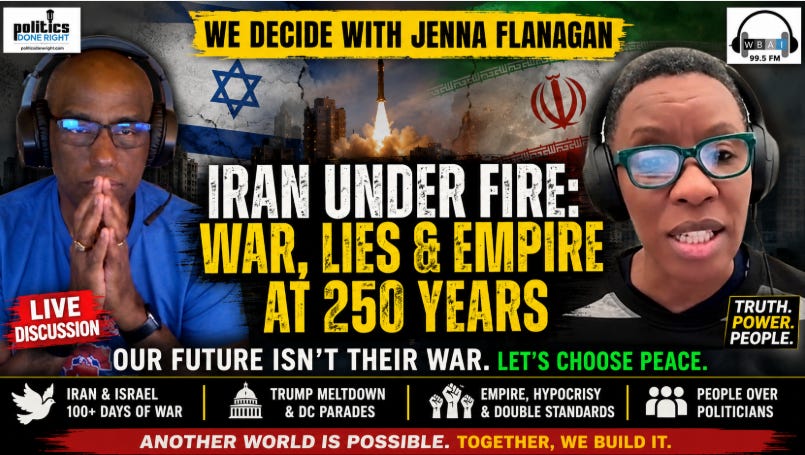
The embedded video contains solely the questions that WBAI’s We Decide’s Jenna Flanagan asked me. The entire panel discussion can be viewed here (Episode: 2026-06-01). We Decide is a joint Pacifica Affiliate, WBAI production, and the We Decide: America at the Crossroads with Jenna Flanagan.
America must stop confusing spectacle with strength.
The WBAI “We Decide” panel used the expanding Iran crisis, Trump’s 250th-anniversary pageantry, and his televised confrontation with a Black woman journalist to expose a deeper truth: the country cannot celebrate democracy while normalizing militarism, empire, authoritarian theatrics, and public disrespect for the very people who force power to answer questions. The discussion rejected the lazy establishment script that treats America’s violence abroad as noble and everyone else’s resistance as irrational. It also made clear that Trump’s White House pageantry, including the UFC spectacle, does not represent democratic renewal. It represents a politics of domination that progressives must confront directly.
- The Iran war discussion challenged the bipartisan foreign-policy reflex that treats American and Israeli escalation as stability while casting Iran only as a caricature.
- The panel argued that America’s 250th anniversary should demand honesty, atonement, and expansion of freedom, not patriotic branding over unresolved injustice.
- Trump’s UFC-on-the-White-House-lawn symbolism exposed a governing style rooted in spectacle, violence, masculinity, and authoritarian theater.
-
The Meet the Press exchange showed how Trump reacts when a Black woman journalist holds power accountable in real time.
-
The progressive path forward requires telling the truth about empire, racism, militarism, and the unfinished promise of American democracy.
The segment landed where serious journalism should land: America cannot move forward by pretending its myths are history. The country must tell the truth, repair the damage, and build a multiracial democracy worthy of the ideals it has always advertised but too often denied.
Premium Content (Complimentary)
The WBAI “We Decide” panel discussion cut through the fog that too often surrounds American political discourse. It did not treat the Iran crisis, Trump’s anniversary spectacle, and his televised anger as isolated events. It connected them as symptoms of the same disease: a nation that still struggles to distinguish democratic strength from imperial dominance, accountability from humiliation, patriotism from propaganda, and leadership from performance.
The conversation began with the war involving the United States, Israel, and Iran passing the 100-day mark, with ceasefire prospects in jeopardy and the danger of regional spillover growing. That matters because American media too often frames foreign policy as a contest between “good” American power and “bad” foreign resistance. That framing does not educate the public. It manufactures consent. It tells Americans to support escalation first and ask questions later. It pretends that bombing, sanctions, threats, occupations, and proxy wars occur in a vacuum.
A progressive analysis refuses that nonsense. It recognizes that Iran’s government has authoritarian features and real human-rights problems. But it also rejects the caricature that Iranians are irrational people who do not love their children, protect their families, or seek dignity. The panel challenged that dehumanizing habit directly. That challenge matters because dehumanization always precedes war. Before bombs fall, politicians and pundits teach the public that the targets are less human, less reasonable, less deserving of sovereignty, and less entitled to the fear and grief that Americans claim for themselves.
The discussion also raised a provocative point about nuclear deterrence and regional balance. Many in the U.S. foreign-policy establishment insist that a nuclear Iran would automatically destabilize the Middle East. The argument on the panel pushed in the opposite direction: when one regional power operates with impunity and enjoys the backing of the United States, imbalance itself becomes destabilizing. One does not have to endorse nuclear proliferation to understand the point. Real stability does not come from one nation’s unchecked military superiority. It comes from diplomacy, mutual restraint, regional security agreements, and an end to the fantasy that U.S. and Israeli force can permanently discipline the Middle East into submission.
That same imperial mindset shaped the conversation about America’s 250th anniversary. The country should mark that anniversary with moral seriousness. It should tell the truth about slavery, Indigenous genocide, labor exploitation, imperial interventions, civil-rights struggles, and the people’s movements that forced the nation to expand democracy. Instead, Trump’s politics reduces the milestone to spectacle. He wraps nationalism in entertainment, militarism, grievance, and self-glorification.
The UFC event on the White House lawn captured that decline perfectly. A sport can exist as sport. But when a president stages combat spectacle on the symbolic grounds of democratic government, he sends a message. He tells the country that power belongs to those who dominate, punish, posture, and perform toughness. He turns the people’s house into a coliseum. That is not patriotism. That is authoritarian branding.
The panel’s discussion of Trump’s Meet the Press confrontation sharpened the point. Trump’s agitation under questioning did not simply reflect a bad interview. It exposed a deeper contempt for accountability, especially when that accountability comes from a Black woman journalist who refuses to bend. The disrespect matters. It connects to a broader pattern in which Black women in government, journalism, academia, and public life face disproportionate hostility when they assert authority. Trump’s reaction illustrated the fragility underneath the strongman act. He can perform toughness before adoring crowds, but serious questioning reveals the insecurity of a man who confuses scrutiny with attack.
That is why the segment mattered. It did not chase the spectacle. It decoded it. Trump wants the public to see fireworks, fights, flags, and rage. Progressives must force the public to see the machinery underneath: empire abroad, cruelty at home, racial resentment in public life, and entertainment used as political anesthesia.
The 250th anniversary should not belong to Trump, billionaires, war planners, or media consultants. It should belong to the people who made every democratic advance possible: abolitionists, workers, suffragists, civil-rights organizers, immigrants, antiwar activists, LGBTQ activists, disability-rights leaders, Indigenous defenders, students, teachers, nurses, union members, and everyday people who refused to accept the country as it was.
America has always contained two competing projects. One project protects hierarchy and calls it order. The other expands freedom and calls it democracy. Trump represents the first project in its loudest, crudest, most theatrical form. Progressives must represent the second with clarity, discipline, and courage.
The task ahead is not to abandon American ideals. The task is to stop letting authoritarians define them. Freedom does not mean the freedom of the powerful to bomb, bully, deport, exploit, and humiliate. Freedom means the right of all people to live with dignity, vote without obstruction, speak without fear, work for living wages, receive healthcare, breathe clean air, and challenge government without being treated as enemies.
That is the fight. Not spectacle. Not pageantry. Not coliseum politics. Democracy requires truth, and truth requires moral courage. This panel delivered both.