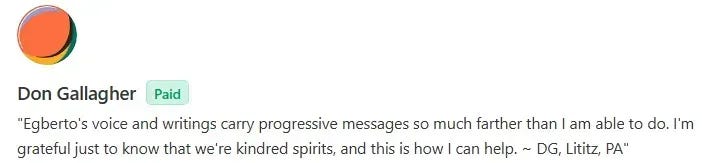
Jenna Flanagan’s panel tackles Iran talks, Israel in Lebanon, Trump threats, and how war profits keep undermining real peace.

Summary

The embedded video contains solely the questions that WBAI’s We Decide’s Jenna Flanagan asked me. The entire panel discussion can be viewed here (Episode: 2026-06-22). We Decide is a joint Pacifica Affiliate, WBAI production, and the We Decide: America at the Crossroads with Jenna Flanagan.
Diplomacy cannot work when war profiteers keep pulling the fire alarm.
Jenna Flanagan’s panel confronted the obvious contradiction in the Iran-Israel-Lebanon-Trump crisis: leaders talk peace in Switzerland while military escalation, threats, and regional power plays keep undermining any real settlement. The conversation challenged the sanitized media narrative that treats Israel’s actions in Lebanon, Trump’s threats against Iran, and U.S. militarism as isolated incidents instead of parts of the same destabilizing system. The core argument landed clearly: diplomacy will fail when the United States lets the military-industrial complex, oil interests, plutocrats, and Netanyahu’s expansionist government shape the terms of peace. alks created the appearance of progress, but the panel warned that America’s history of breaking treaties makes any agreement fragile.
- Israel’s attacks in Lebanon threatened the peace process and exposed how regional escalation can sabotage diplomacy.
- The discussion separated criticism of Israel’s government from antisemitism, making clear that policy critique must never become bigotry.
- The panel rejected the simplistic claim that Hezbollah alone explains Israel’s actions in Lebanon.
-
The conversation connected war, oil prices, fracking economics, weapons profits, and geopolitical instability into one capitalist war economy.
The conclusion was blunt: peace will not come from photo-ops, threats, or managed chaos. It will come only when the United States stops acting as the enforcer for militarized capitalism and starts respecting international law, regional sovereignty, and human life.
Premium Content (Complimentary)
Jenna Flanagan’s panel discussion on Iran, Israel, Lebanon, and Trump exposed the fraud at the center of America’s Middle East policy. The public hears “peace talks.” The public sees high-level negotiators in Switzerland. The public is told that serious people are working hard to de-escalate the situation in the region. But the lived reality tells another story: bombs fall, leaders posture, oil markets tremble, weapons contractors win, and civilians pay the price.
That contradiction sits at the heart of this conversation. Negotiators can sit in Switzerland all they want, but diplomacy cannot survive when the same power structure that claims to want peace keeps enabling war. According to Reuters, Vice President JD Vance said the U.S.-Iran talks in Switzerland laid a “good foundation” for a final peace deal, while Iran disputed whether nuclear-program talks had actually begun. Reuters also reported that the conflict and Israeli strikes in Lebanon had killed thousands, displaced millions, rattled markets, and pushed oil prices higher before progress reports calmed them.
That is not a stable peace process. That is managed chaos.
The panel correctly challenged the fantasy that American power automatically produces order. The United States has a long record of treating agreements as temporary tools when they serve Washington’s immediate interests and as disposable paper when they do not. The Trump administration abandoned the Iran nuclear deal in 2018. The U.S. has also exited or tried to undermine other major agreements when domestic politics or corporate interests demanded it. So when America lectures Iran, Lebanon, or any other country about compliance, the world hears a superpower asking others to respect rules that it reserves the right to break.
That does not mean Iran’s government deserves a pass. No government does. But it does mean serious analysis must reject the childish framework that America and Israel represent order, while everyone else represents chaos. The region has endured decades of interventions, coups, sanctions, occupations, proxy wars, and political manipulation. The U.S. and its allies helped build the instability they now claim only more militarism can fix.
The Lebanon question made that hypocrisy even clearer. Israel claims it must act to secure its border against Hezbollah. Any state has a right to protect civilians. But that right does not become a blank check for permanent military pressure, territorial ambition, or collective punishment. U.N. Security Council Resolution 1701 called for a cessation of hostilities, the withdrawal of Israeli forces from Lebanon, and an area between the Blue Line and Litani River free of armed personnel other than the Lebanese army and U.N. peacekeepers. That framework recognizes a basic truth: security cannot come from domination. It requires mutual restraint and enforceable rules.
The panel also made an important moral distinction. Criticizing Benjamin Netanyahu’s government is not antisemitism. Criticizing Israeli state policy is not an attack on Jewish people. In fact, blurring that distinction helps extremists. It shields abusive policy from accountability and makes honest debate harder. A humane politics must defend Jewish safety, Palestinian rights, Lebanese sovereignty, Iranian civilians, and regional peace at the same time. The moral universe does not require choosing one people’s humanity over another’s.
The nuclear issue adds another layer of absurdity. The public is often asked to believe that bombing can solve the problem of nuclear material in a large, advanced country. That claim insults basic intelligence. Reuters reported that the IAEA had been unable to return to Iranian nuclear sites bombed by Israel and the United States and that Iran had not informed the agency about the fate of stocks of enriched uranium, including uranium enriched up to 60 percent, near the threshold often discussed in weapons contexts. That fact does not justify war. It proves the opposite. Bombing can reduce visibility, destroy monitoring capacity, harden nationalist politics, and scatter risks into darker corners.
Real diplomacy requires inspection, verification, sanctions relief tied to compliance, and regional de-escalation. It does not require Trump threatening to hit Iran “very hard again.” Reuters reported that Trump threatened to resume attacks if Iran did not restrain Hezbollah allies, even as Vance led peace talks. That is not disciplined diplomacy. That is arson with a press release.
The economic dimension matters because war does not happen in a vacuum. The panel’s point about oil and fracking cuts to the bone. Instability keeps energy markets nervous. It keeps fossil fuel interests relevant. It keeps defense contractors flush. It gives politicians an excuse to posture as strong while doing nothing to improve working people’s lives. Permanent crisis creates permanent profit.
That is why this discussion matters beyond foreign policy. It exposes how militarized capitalism works. It turns fear into contracts. It turns insecurity into campaign rhetoric. It turns human beings into collateral damage. It turns peace into a slogan while the machinery of war keeps humming.
A progressive foreign policy must reject that machinery. It must demand a ceasefire in Lebanon. It must insist on nuclear inspections and diplomacy with Iran. It must stop giving Netanyahu’s government automatic cover. It must treat Palestinian, Israeli, Lebanese, Iranian, and American lives as equally valuable. It must confront the defense industry, fossil fuel interests, and political donors who profit when diplomacy fails.
The answer is not isolationism. The answer is internationalism rooted in law, restraint, and human dignity. America must stop acting like the world’s sheriff and start acting like one nation among nations. That shift will not come from plutocrats, generals, or cable-news panels that sanitize empire. It will come from citizens who refuse to let their government wage war in their name while schools crumble, hospitals close, wages stagnate, and billionaires cash the checks.
Peace is not weak. Peace is disciplined. Peace is strategic. Peace is moral. And peace requires the courage to say that the biggest threat to diplomacy is not merely “the enemy over there.” It is the empire right here that keeps finding profit in every war it claims to regret.
Independent Media needs you
If you like what we do, please do the following!
- Become Patreon here.
- SUBSCRIBE to our YouTube Channel here.
- SUBSCRIBE to our Facebook Page here.
- SUBSCRIBE to our Podcast here.
- Support our GoFundMe equipment fund here.
- Share our blogs, podcasts, and videos.
- Consider contributing here.