Progressives win the policy argument but must win the messaging war. Anthony Robinson explains how Netroots Nation can help build the next movement.




Summary
Anthony Robinson made the mission plain: Netroots Nation must move from convening to coordinated power.
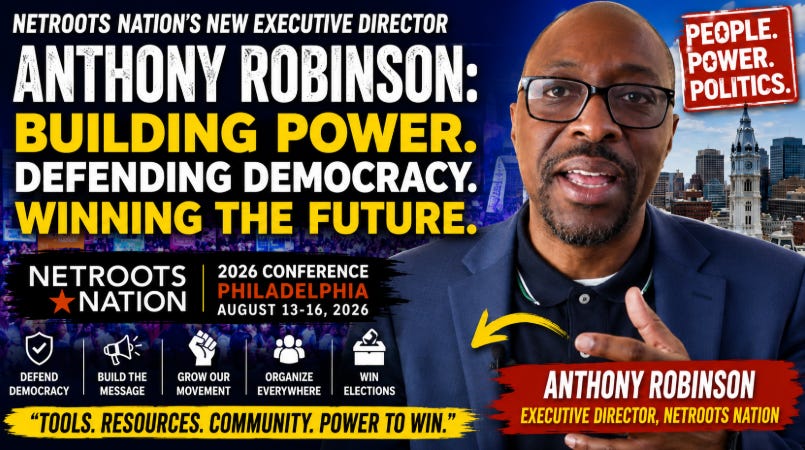
In this interview, Anthony Robinson, Netroots Nation’s new executive director, described a movement at an inflection point. He brought an unconventional background to the job: Marine Corps veteran, former science teacher, White House staffer under Obama and Biden, radio veteran, and longtime Netroots board member. He argued that progressives cannot afford to gather merely for inspiration; they must leave with tools, relationships, discipline, and immediate action. Robinson framed the 2026 Philadelphia conference as more than another annual meeting. He sees it as a launchpad for long-term progressive power, narrative ownership, media expansion, youth leadership, voting-rights defense, and community-level organizing that outlasts the next election cycle.
- Robinson said Netroots must deepen its infrastructure so activists can return home with practical tools, not just good feelings.
- He rejected the idea that progressives should focus only on the 2026 midterms, insisting the movement must build toward 2027, 2028, and even a 2040 governing vision.
- He emphasized that progressives already win the policy argument but must own the narrative, especially against right-wing gaslighting and disinformation.
-
He said Netroots must “open the aperture” by bringing in more youth voices, student organizers, podcasters, content creators, independent media, and fresh messengers.
-
He insisted that elected officials work for the people and that activists must keep pushing, even after partial wins.
Robinson’s message should energize every progressive who understands that democracy will not save itself. Netroots Nation, under his leadership, appears ready to become a sharper, more disciplined, more action-oriented movement hub. The challenge now is simple: activists, media makers, unions, organizers, and elected officials must leave Philadelphia prepared to build power, challenge timid institutions, defend democracy, and fight for working people every day.
Premium Content (Complimentary)
Anthony Robinson’s interview offered more than a personnel introduction. It offered a field manual for a progressive movement that cannot afford drift, nostalgia, or performative resistance. As the new executive director of Netroots Nation, Robinson stepped into one of the most important organizing spaces in American progressive politics at precisely the moment when the country needs discipline, narrative clarity, and movement infrastructure.
Robinson’s background matters because it explains the leadership style he brings to the organization. He is not a conventional nonprofit operator who wandered into progressive politics through a narrow professional pipeline. He is a Marine Corps veteran, a former science teacher, a former Obama and Biden White House staffer, a radio veteran, and a longtime Netroots community member. That combination gives him something many movements desperately need: structure without rigidity, urgency without panic, and mission without ego.
The interview made clear that Robinson does not see Netroots Nation as a conference for conference’s sake. He rejected the old model of progressives gathering, applauding one another, collecting business cards, and returning home without a plan. His phrase “a party with a purpose” captured the core mission. A gathering means little if it does not produce action. A panel means little if it does not equip somebody to knock doors, build a coalition, launch a media project, confront a local official, organize workers, or defend voting rights.
That distinction matters in the present political climate. The right has spent decades building a media machine, a legal machine, a donor machine, a judicial machine, and a local organizing pipeline. Progressives often possess better policy, better moral arguments, and better solutions for working people, but they too often fail to convert those advantages into durable power. Robinson named that problem directly. He said progressives must own the narrative and stop allowing opponents to gaslight them into powerlessness.
Netroots Nation’s 2026 conference in Philadelphia carries symbolic and practical weight. The official conference site lists Netroots Nation 2026 for June 4-6 in Philadelphia, and the organization describes itself as the largest annual conference for progressives since 2006. Netroots also notes that the 2026 agenda includes panels and trainings in Philadelphia, reinforcing Robinson’s point that the conference must deliver usable tools, not just speeches. The Pennsylvania Convention Center setting places the movement in a city loaded with democratic symbolism, labor history, Black political struggle, immigrant history, and constitutional mythology. Robinson smartly framed Philadelphia not as a patriotic backdrop but as a reminder that the American democratic experiment remains unfinished.
That unfinished experiment now faces direct attack. Robinson referenced immigration, authoritarianism, and the gutting of the Voting Rights Act. That warning aligns with current events. Louisiana Republicans approved a new congressional map on May 29, 2026, eliminating a majority-Black Democratic-held district after a Supreme Court ruling weakened protections tied to the Voting Rights Act. The Brennan Center has warned that Supreme Court redistricting rulings have undermined voters of color and altered the rules of American elections in ways that harm representation. These are not abstract legal fights. They are power grabs designed to decide who gets heard, who gets represented, and whose communities count.
That is why Robinson’s emphasis on long-term progressive power is essential. He pushed back against the idea that Netroots should focus only on the midterms. The midterms matter. Every election matters. But movements that organize only around the next election live in a constant state of emergency and burnout. The right understood long-term infrastructure. It invested in school boards, courts, state legislatures, media ecosystems, think tanks, churches, donor networks, and candidate pipelines. Progressives must respond with the same seriousness, but with democratic values and working-class solidarity at the center.
Robinson also identified one of the movement’s biggest weaknesses: communications. Progressives often win the policy argument. They can defend healthcare, unions, public education, clean energy, reproductive freedom, voting rights, immigrant justice, and economic fairness. But too often they explain those policies in language that sounds like a white paper instead of a kitchen-table conversation. Working people do not need another consultant-approved slogan. They need a story that connects their rent, wages, healthcare, schools, grocery bills, climate disasters, and democracy into one moral narrative: the system has been rigged by the wealthy few, and organized people can unrig it.
That is where independent media becomes indispensable. Robinson said Netroots must expand the aperture by bringing in more youth voices, student organizers, podcasters, content creators, and independent journalists. That is not a side project. It is a survival strategy. The right floods the zone with disinformation while corporate media too often treats democracy’s arsonists and firefighters as equivalent factions. Progressive media must therefore do what establishment media refuses to do consistently: name power, follow money, expose cruelty, explain policy in plain language, and connect national decisions to local pain.
The public mood supports this urgency. Pew Research Center reported in April 2026 that 68% of Americans said U.S. democracy used to be a good example for other countries but has not been in recent years. Pew also reported that 62% of Americans were dissatisfied with the way democracy was working in a spring 2025 survey. Those numbers reflect danger, but they also reflect opportunity. People know something is wrong. The question is whether progressives can organize that dissatisfaction into democratic power rather than allowing authoritarians to weaponize it into resentment.
Robinson’s most important point may be his insistence that people leave Netroots ready to act Monday morning. That is the test. Did the activist meet someone doing similar work in another state? Did the local organizer learn a new canvassing tool? Did the podcaster find new voices? Did the union member connect with a voting-rights attorney? Did the elected official hear from constituents who refuse to be managed, ignored, or pacified? Did people leave with contact lists, assignments, deadlines, and accountability?
Progressives do not need another symbolic gathering. They need infrastructure. They need repetition. They need message discipline. They need working-class language. They need media investment. They need young leaders. They need elders who know when to mentor and when to move aside. They need elected officials who understand that grassroots activists are not props for campaigns but the source of democratic legitimacy.
Anthony Robinson appears to understand that charge. He brings a teacher’s commitment to learning, a veteran’s commitment to mission, a communicator’s respect for narrative, and an organizer’s insistence on action. If Netroots Nation under his leadership helps progressives move from inspiration to implementation, Philadelphia 2026 could become more than a conference. It could become a turning point in the fight to build durable progressive power.