


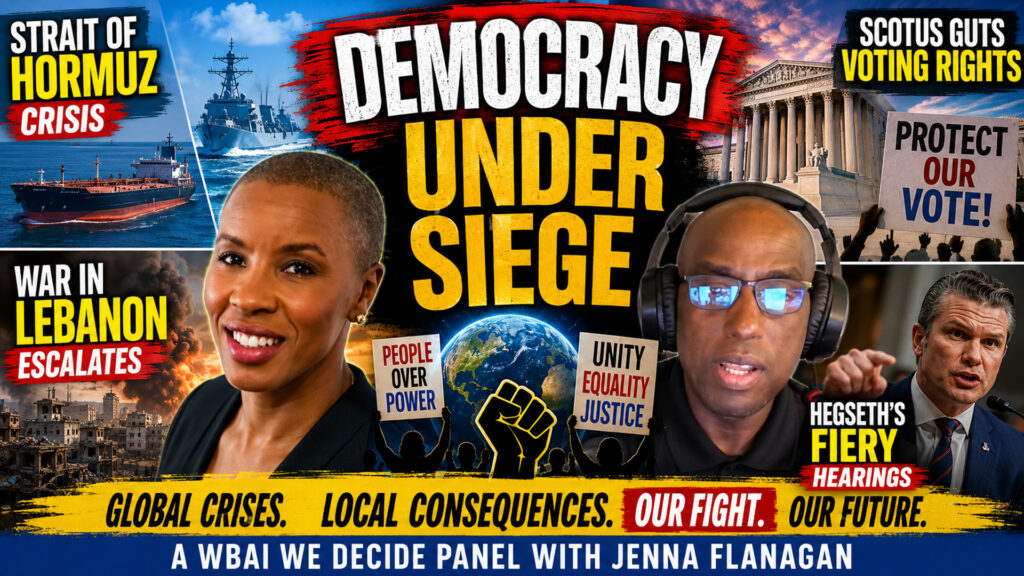
A powerful WBAI panel with Jenna Flanagan explores the Strait of Hormuz crisis, Supreme Court attacks on voting rights, the escalation of the war in Lebanon, and Pete Hegseth’s troubling testimony.
WBAI Panel Exposes Strait of Hormuz Crisis

Watch Politics Done Right T.V. here.

Podcasts (Video — Audio)
The embedded video contains solely the questions that WBAI’s We Decide’s Jenna Flanagan asked me. The entire panel discussion can be viewed here (Episode: 2026-05-04). We Decide is a joint Pacifica Affiliate, WBAI production, and the We Decide: America at the Crossroads with Jenna Flanagan.
Summary
A revealing conversation.
On WBAI’s We Decide with Jenna Flanagan, the panel tackled four crises that expose the fragility of American democracy and the dangers of authoritarian politics: the U.S. response to the Strait of Hormuz blockade, the Supreme Court’s continued dismantling of the Voting Rights Act, escalating war in Lebanon, and Defense Secretary Pete Hegseth’s combative congressional hearings. The discussion made one truth unmistakably clear: concentrated power—whether in the courts, the military, or the executive branch—threatens both domestic democracy and global stability. Yet it also underscored that organized coalitions of working people remain the most potent force capable of reversing these assaults.
- The Strait of Hormuz crisis demonstrates how reckless foreign policy and ego-driven leadership can destabilize the global economy and punish nations far beyond the United States and Iran.
- The Supreme Court’s weakening of the Voting Rights Act removes a critical safeguard, but it also creates an opportunity to build multiracial and working-class coalitions stronger than racial gerrymandering.
- Escalating conflict in Lebanon illustrates how militarism continues to devastate civilians while enriching defense contractors.
- Pete Hegseth’s congressional performances expose the danger of ideological loyalty replacing competence in government.
- Diversity, equity, and inclusion remain essential because they expand the talent pool and strengthen democratic institutions.
The path forward does not lie in despair. It lies in solidarity. When voters understand that attacks on democracy, social justice, and peace are all connected to the same concentration of power, they can build the alliances necessary to reclaim both the ballot box and the future.
Premium Content (Complimentary)
The panel discussion on WBAI’s We Decide with Jenna Flanagan offered a sweeping look at the crises shaping this political moment. From the Strait of Hormuz to the Supreme Court’s assault on voting rights, from the war in Lebanon to Pete Hegseth’s ideological grandstanding, each issue reflected the same underlying struggle: whether democracy will serve ordinary people or continue to bow to concentrated wealth and authoritarian power.
The conversation began with the administration’s announcement that the United States would guide ships through the Strait of Hormuz, one of the world’s most important energy chokepoints. Roughly one-fifth of global petroleum consumption passes through this narrow waterway, according to the U.S. Energy Information Administration. Any prolonged disruption threatens supply chains, fuel prices, and food costs worldwide.
The critical point is that these consequences do not stop at America’s borders. Nations in Africa, Asia, and the Pacific suffer when global trade stalls. Yet much of the mainstream media treats these crises as if they were geopolitical chess matches rather than human catastrophes. Ordinary workers bear the costs while political leaders focus on preserving their reputations.
That same pattern appears in the Supreme Court’s continued dismantling of the Voting Rights Act of 1965, one of the most transformative civil rights laws in U.S. history. The Court’s decisions have weakened protections against racial discrimination and gerrymandering. This erosion threatens fair representation, especially in states such as Texas.
Yet there is another way to view this setback. Many members of the Congressional Black Caucus and other leaders of color win in districts that are not majority-minority. That fact proves that voters can transcend narrow demographic boundaries when they organize around shared interests. Economic insecurity, healthcare access, voting rights, and workers’ rights affect people across racial and geographic lines.
The demise of federal protections, therefore, demands a new organizing strategy. Rather than relying solely on legal remedies, communities must build broad coalitions rooted in common material concerns. The same economic system that marginalizes Black and Brown communities also exploits working-class white communities. When those realities become clear, powerful alliances emerge.
The panel also addressed the escalating conflict in Lebanon. Wars in the Middle East continue to produce immense human suffering while enriching the military-industrial complex — a staggering financial and human toll of endless conflict. Civilians pay with their lives, while contractors profit.
Defense Secretary Pete Hegseth’s fiery congressional testimony highlighted another danger: ideological loyalty replacing competence. Public institutions function best when they draw from the widest possible range of talent. Diversity, equity, and inclusion are not symbolic exercises; they are practical tools for ensuring that government reflects and benefits from the nation’s full reservoir of expertise.
When administrations prioritize loyalty over qualifications, incompetence follows. History repeatedly shows that narrow, exclusionary leadership undermines effective governance. Inclusive institutions are stronger, more innovative, and more responsive to the public.
These stories may appear unrelated, but they all reveal the same conflict. A small group of elites seeks to consolidate power through militarism, voter suppression, and ideological control. Against them stands the possibility of a multiracial, working-class coalition committed to peace, justice, and democracy.
That coalition remains the country’s greatest hope. The weakening of the Voting Rights Act is not the end of democratic participation; it is a call to organize more broadly and more deeply. Foreign policy failures are not inevitable; they are the result of choices made by leaders insulated from accountability. Government incompetence is not destiny; it is what happens when ideology displaces merit.
Democracy has always advanced when ordinary people refuse to accept concentrated power as permanent. The answer is the same today as it has always been: build coalitions, tell the truth, and organize relentlessly until institutions once again serve the many rather than the privileged few.