


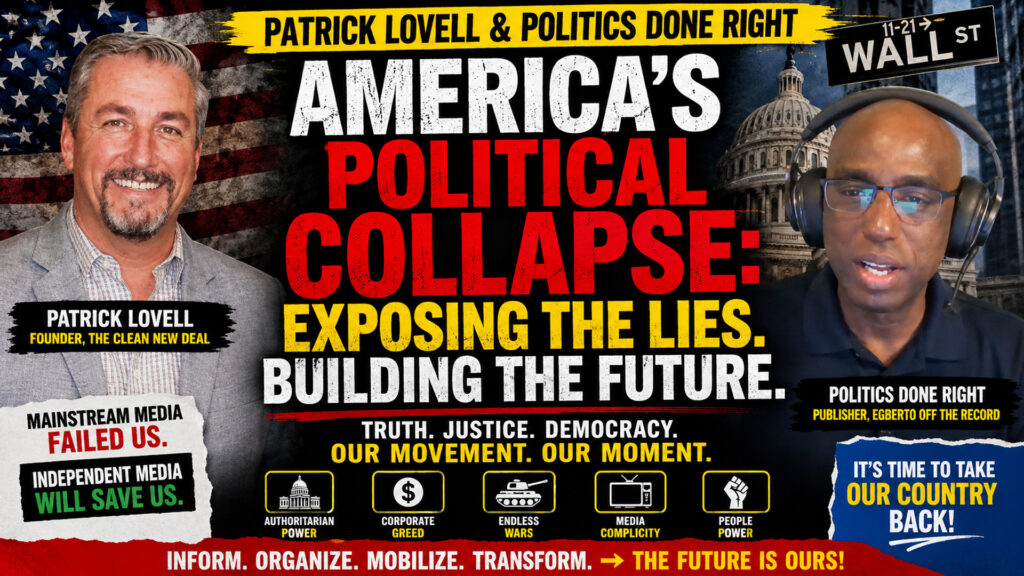
The Clean New Deal conversation reveals how oligarchs and authoritarian politics threaten America and what citizens can do to rebuild democracy.
The Clean New Deal

Watch Politics Done Right T.V. here.

Podcasts (Video — Audio)
Summary
Patrick Lovell, filmmaker/producer/writer of The Con, & founder of The Clean New Deal, and Egberto Willies, the publisher of Egberto Off The Record & host of Politics Done Right, deliver an urgent and deeply revealing conversation about the unraveling of American democracy. They connect Donald Trump’s authoritarian behavior, Benjamin Netanyahu’s militarism, Wall Street corruption, Federal Reserve abuse, media consolidation, and the rise of techno-feudal billionaires into one coherent picture of a political and economic system that serves capital over humanity. Both argue that mainstream media has abandoned investigative journalism and normalized dangerous leaders, while independent media struggles to educate the public. The discussion makes clear that ordinary Americans still have the power to reclaim democracy if they organize, support independent journalism, and demand an economic system that prioritizes people over oligarchs.
- Trump’s erratic leadership and congressional complicity have amplified global instability and economic uncertainty.
- Billionaires and financial institutions have captured both political parties and distorted democratic accountability.
- Corporate media has become a propaganda system that protects concentrated wealth and power.
- The New Deal remains a blueprint for combining markets with strong public institutions.
- Independent media and citizen education are essential to defeating authoritarianism.
This conversation exposes the central conflict of our time: humanity versus unchecked capital. Oligarchs have accumulated enormous wealth by manipulating institutions while ordinary people bear the costs of war, debt, and insecurity. Yet the discussion also offers hope. When citizens understand how the system works and commit to collective action, they can rebuild a democracy that values truth, justice, and shared prosperity.
Premium Content (Complimentary)
Patrick Lovell and Egberto Willies reveal why America must choose humanity over oligarchy. America stands at a historic crossroads.
The institutions that once promised accountability and democratic participation increasingly serve concentrated wealth rather than the public interest. In a profound and urgent conversation, Patrick Lovell, founder of The Clean New Deal, and Egberto Willies, publisher of Egberto Off The Record, examine how the United States reached this dangerous moment and what citizens must do to reclaim their democracy.
The discussion begins with a sobering recognition: the political crisis is not limited to a single election cycle or a single controversial leader. Donald Trump represents a symptom of a much deeper structural problem. When institutions permit narcissism, corruption, and authoritarian impulses to flourish unchecked, democracy becomes vulnerable to capture by those who view government as a tool for personal and financial gain.
The conversation also places America’s domestic crisis within a global context. Wars in the Middle East, economic instability, and the increasing influence of militarized nationalism demonstrate how concentrated power destabilizes not only the United States but the entire world. The interview argues that political leaders such as Trump and Benjamin Netanyahu exploit fear and conflict, while media institutions often fail to ask the questions that democratic societies require.
This critique extends to corporate journalism. Once-respected outlets too often normalize extremism and protect elites rather than investigate them. Media consolidation has concentrated ownership into the hands of a few billionaires and corporations, reducing the diversity of viewpoints available to the public. According to research from organizations such as the Pew Research Center, trust in traditional media has eroded substantially. That decline reflects a growing public awareness that corporate incentives shape news coverage.
The economic analysis offered in the discussion is equally compelling. Lovell argues that the Federal Reserve and financial institutions have directed trillions of dollars toward the billionaire class while ordinary Americans struggle with healthcare costs, housing insecurity, and stagnant wages. The Economic Policy Institute has documented how productivity gains have increasingly flowed to executives and shareholders rather than workers. Meanwhile, the Federal Reserve has repeatedly intervened to stabilize financial markets, often benefiting asset holders more than working families.
Yet the conversation does not descend into cynicism. Both participants emphasize that a better model already exists. Franklin Roosevelt’s New Deal demonstrated that government can act boldly to regulate markets, protect workers, and expand economic opportunity. The lesson is not that markets should disappear, but that they must function as tools rather than as untouchable ideologies.
This hybrid vision—public investment alongside responsible private enterprise—could finance universal healthcare, strengthen public education, accelerate renewable energy, and rebuild the middle class. Countries with stronger social safety nets routinely achieve better health outcomes and greater economic security at lower overall cost.
Most importantly, the discussion underscores the indispensable role of independent media. Corporate outlets may possess vast resources, but independent journalists possess something more powerful: accountability to their audiences rather than to advertisers and shareholders. By educating citizens and exposing corruption, independent media creates the foundation for democratic renewal.
The ultimate message is both stark and hopeful. Oligarchs have amassed extraordinary power, but they remain dependent on public acquiescence. When citizens understand the mechanisms of corruption and organize around the truth, they become a force that money alone cannot defeat.
Democracy will survive only if ordinary people insist that the government serve humanity instead of capital. This conversation serves as a call to action. The truth is available. The path forward is visible. What remains is the collective courage to act.