


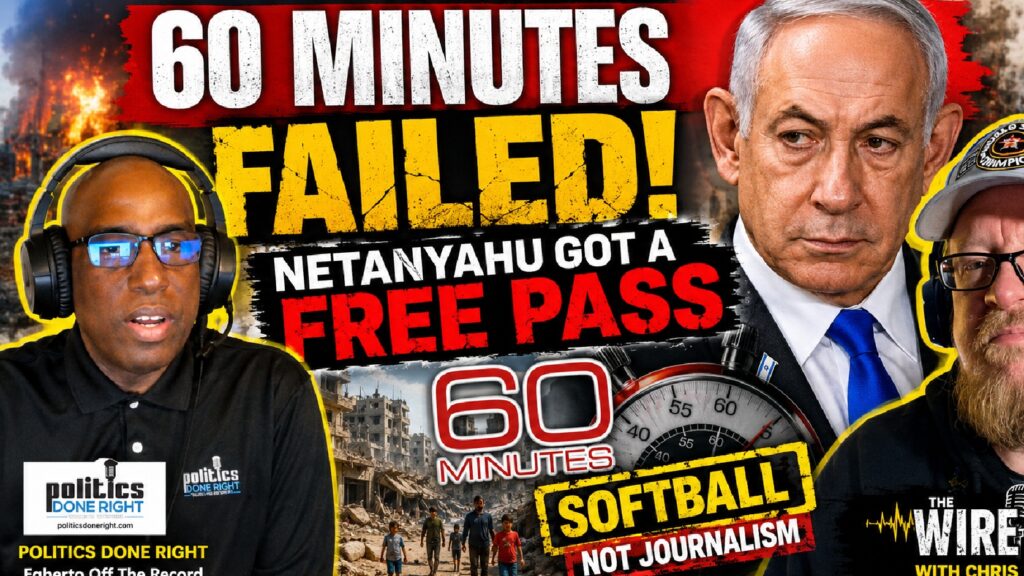
Chris Sampson and Politics Done Right expose how 60 Minutes gave Netanyahu a free pass, ignoring Gaza deaths, Iran escalation, West Bank violence, and the media’s role in normalizing war.
60 Minutes Failed: Softball to Netanyahu

Watch Politics Done Right T.V. here.

Podcasts (Video — Audio)
Summary
Media malpractice. The 60 Minutes interview with Benjamin Netanyahu did not function as journalism. It functioned as image rehabilitation. Instead of confronting Netanyahu with hard questions about the catastrophic death toll in Gaza, attacks on hospitals and journalists, settler violence in the West Bank, and the broader regional escalation with Iran and Lebanon, CBS allowed him to repeat familiar talking points largely unchallenged. In this discussion, Chris Sampson of The Wire Tap and Politics Done Right dissects how corporate media often sanitizes state violence and marginalizes the voices that expose it. They argue that independent media remains essential because it asks the questions establishment outlets refuse to ask and centers the humanity of Palestinians, Israelis, Iranians, and all civilians trapped by militarism.
- 60 Minutes failed to challenge Netanyahu on Gaza’s massive civilian casualties and humanitarian destruction.
- The interview ignored Israel’s undeclared nuclear arsenal while amplifying fears about Iran’s nuclear program.
- Settler attacks against Palestinians and Christians in the West Bank went unmentioned.
- Independent media exposed the historical context, including the 1953 U.S.-backed coup in Iran.
- Corporate journalism too often normalizes war by treating powerful officials as credible narrators instead of accountable actors.
When journalism protects power instead of interrogating it, democracy suffers, and innocent people pay the price. Progressive media must continue to expose the realities hidden behind polished interviews and remind the public that peace requires truth, accountability, and equal human dignity for all people.
Premium Content (Complimentary)
The 60 Minutes interview with Benjamin Netanyahu failed because it treated a powerful head of state as a narrator of events instead of an accountable actor in them. That matters. When a major American news institution gives Netanyahu a national platform and fails to confront him with the most obvious questions about Gaza, the West Bank, Iran, Lebanon, Israeli nuclear ambiguity, and the mass death of civilians, it does more than miss a journalistic opportunity. It helps manufacture consent.
The discussion with Chris Sampson of The Wire Tap cut through that failure with the clarity corporate media too often avoids. The problem was not that Netanyahu appeared on 60 Minutes. Powerful leaders should face questioning. The problem was that the questions did not meet the scale of the crisis. A real interview would have asked why Israel’s government continues to defend policies that have produced mass death, hunger, displacement, infrastructure collapse, and global outrage in Gaza. A real interview would have asked why Palestinian civilians must keep paying the price for decisions made by Hamas, Netanyahu, and the broader machinery of occupation and war. A real interview would have asked whether endless bombardment creates security or simply guarantees the next generation of rage.
Instead, Netanyahu received the familiar treatment granted to U.S.-aligned power: a presumption of legitimacy, a soft runway for talking points, and little sustained pressure on the contradictions at the center of his argument. Amnesty International concluded in December 2024 that Israel has committed genocide against Palestinians in Gaza, citing killings, serious bodily and mental harm, destruction of civilian infrastructure, forced displacement, and restrictions on life-sustaining aid and services. Human Rights Watch has also documented severe abuses by Israeli authorities, including arbitrary detention, torture, denial of adequate food and medical care to detainees, and escalating repression in the West Bank. A journalist interviewing Netanyahu in this moment should not dance around those facts. A journalist should put them on the table and demand answers.
The interview also exposed the hypocrisy of how corporate media frames nuclear danger. Netanyahu can suggest aggressive action against Iran’s nuclear material, yet the interviewer does not seriously force the obvious question: What about Israel’s own undeclared nuclear capability? What gives one state the moral authority to demand absolute regional control while refusing transparency about its own arsenal? This is the kind of omission that turns journalism into stenography. It tells the audience which fears deserve amplification and which realities must remain invisible.
The same failure applies to the West Bank. Netanyahu’s defenders often blame criticism of Israel on social media, as if TikTok, X, Instagram, or independent journalists invented the suffering. But social media did not invent settler violence. It revealed it. OCHA has documented rising settler violence and displacement in the occupied West Bank, including attacks on Palestinians and their property. Human Rights Watch reported that Israeli forces and policies have intensified repression in the West Bank alongside settlement expansion, home demolitions, movement restrictions, settler violence, and detainee abuse. A serious journalist would have asked Netanyahu why the world should ignore what victims can now record with their phones.
That is why independent media matters. Corporate outlets often see access as the prize. Independent media sees accountability as the job. The conversation with Chris Sampson made that distinction plain. When establishment journalists fail to ask about hospitals, journalists, dead children, settler attacks, Christians harassed in occupied territory, and the long history of U.S. intervention in Iran, independent voices must fill the vacuum. They must remind the public that history did not begin on October 7, that civilian suffering does not become acceptable because a government invokes security, and that every human life deserves equal moral weight.
The Iran discussion was especially important because American audiences have heard this script before. First comes the fear campaign. Then comes the selective intelligence. Then comes the demand that Americans accept escalation as necessary. The United States already paid a catastrophic price for that logic in Iraq. Iran is not Iraq, and reckless escalation with Iran would carry regional and global consequences that cannot be contained by television rhetoric. A responsible interview would have challenged Netanyahu’s premise instead of letting him normalize it.
The International Court of Justice has already ordered provisional measures in South Africa’s genocide case against Israel, making clear that the legal questions surrounding Gaza are grave and internationally recognized. That does not mean every legal question has reached a final judgment. It does mean no responsible journalist should treat Netanyahu’s narrative as just another policy view. The world’s highest court has engaged the issue. Human rights organizations have documented patterns of abuse. United Nations agencies continue to track humanitarian collapse and settler violence. The evidence demands interrogation.
The larger point is simple: journalism that cannot confront power becomes propaganda with better lighting. It can still have a famous stopwatch. It can still have a legacy brand. It can still have dramatic music and polished editing. But if it refuses to ask the questions ordinary people are screaming at their screens, it fails the public.
This is why independent media must grow stronger. It must challenge corporate framing on Gaza, Iran, Lebanon, the West Bank, economics, climate, and every arena where concentrated power benefits from public confusion. It must reject the false neutrality that equates the occupied with the occupier, the bombed with the bomber, and the dispossessed with the state that controls their movement, land, water, airspace, and future.
The 60 Minutes interview should have been a reckoning. Instead, it became a warning. It showed how easily elite media can launder militarism when the guest represents an allied government. It showed why Americans must stop outsourcing their moral judgment to institutions that too often protect access over truth. And it showed why progressive independent journalism must keep doing what corporate media refuses to do: ask the hard questions, follow the evidence, center the victims, and demand accountability from every leader who treats human beings as expendable.