


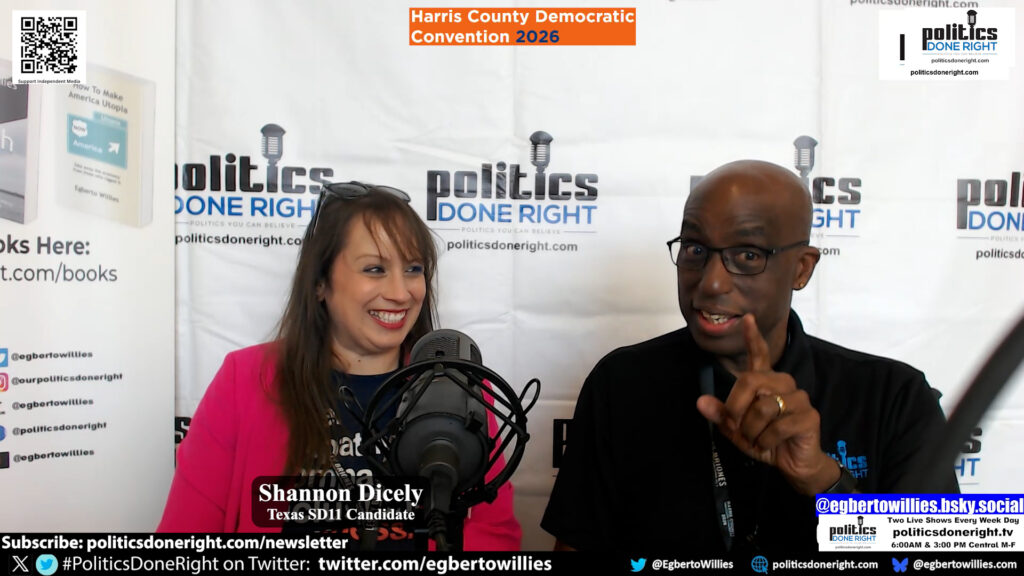
Texas Senate candidate, Shannon Dicely, shares survival story to highlight healthcare inequality, low teacher pay, and voting rights barriers in a district ready for change.
Shannon Dicely


Podcasts (Video — Audio)
Summary
A candidacy born from lived experience and moral urgency emerges in a district ready for change. A breast cancer survivor, Shannon Dicely, steps forward, connecting personal survival with public policy failure, making clear that healthcare inequity is not abstract—it is life or death.
- A survivor’s story exposes how access to insurance determined survival, highlighting systemic inequality in Texas healthcare.
- The refusal to expand Medicaid leaves over a million Texans uninsured despite available federal funding.
- Public education suffers as teachers lack fair pay and even basic benefits like paid family leave.
- Voting rights remain central, with suppression and gerrymandering identified as barriers to progress.
- The district has shifted from safely conservative to competitive, signaling political awakening and opportunity.
This campaign reframes politics as a fight for dignity. It insists that policy choices—healthcare access, education funding, and voting rights—are moral decisions. The argument is clear: Texas does not lack resources; it lacks political will aligned with the people.
Premium Content (Complimentary)
A political awakening often begins not in ideology, but in survival. That reality drives this campaign for Texas Senate District 11, where a breast cancer survivor, Shannon Dicely, transforms personal struggle into public purpose. The story cuts through political abstraction and exposes a brutal truth: in Texas, survival too often depends on privilege rather than policy.
The candidate’s experience during the COVID-19 pandemic reveals the stark inequities embedded in the healthcare system. With insurance, early detection and treatment were possible. Without it, the outcome could have been catastrophic. That contrast does not exist in a vacuum. It reflects a systemic failure rooted in the state’s refusal to expand Medicaid under the Affordable Care Act—a decision that has left more than a million Texans trapped in the coverage gap.
According to research from the Kaiser Family Foundation, Medicaid expansion states have significantly lower uninsured rates and improved health outcomes. Texas, by contrast, maintains one of the highest uninsured rates in the nation. This is not a matter of fiscal constraint. The federal government covers 90% of expansion costs, a fact repeatedly confirmed by the Congressional Budget Office. The refusal to act, then, becomes ideological rather than economic—a political choice that sacrifices lives.
The campaign does not stop at healthcare. It broadens the critique to education, exposing how Texas undervalues the very people responsible for shaping its future. Teachers, tasked with educating over five million students, lack not only competitive salaries but even basic protections such as paid family leave.
This contradiction lays bare a deeper hypocrisy: a political establishment that proclaims “family values” while denying workers the ability to care for their own families.
Teacher pay has stagnated relative to similarly educated professionals, contributing to shortages and declining morale. The result is predictable—underfunded schools, overburdened educators, and students left behind. Addressing this crisis requires more than rhetoric; it demands a redistribution of priorities toward people rather than profits.
Yet the campaign identifies an even more fundamental barrier: democracy itself. Voting rights stand at the center of the platform because, without them, no reform can take root. The argument challenges the conventional narrative that Texas is a deeply conservative state. Instead, it frames Texas as a “non-voting state,” where suppression tactics and gerrymandered districts distort representation.
This perspective aligns with findings from the Brennan Center for Justice, which documents how restrictive voting laws disproportionately impact marginalized communities. When access to the ballot is limited, policy outcomes reflect the interests of a narrow electorate rather than the broader population.
What makes this candidacy compelling is not just the critique but the convergence of issues—healthcare, education, housing affordability, and voting rights—all tied to a single principle: equity. Coastal concerns such as rising insurance costs and climate vulnerability further underscore the need for responsive governance that reflects lived realities rather than partisan talking points.
The district itself tells a story of transformation. Once a reliably conservative stronghold, it has shifted toward parity, with recent elections nearly evenly split.
That shift signals something deeper than demographic change; it reflects growing dissatisfaction with a status quo that fails to deliver for working families.
At its core, this campaign reframes politics as a moral endeavor. It argues that public policy should not determine who lives, who learns, or who participates in democracy based on income or circumstance. Instead, it calls for a system that recognizes healthcare as a right, education as an investment, and voting as the foundation of all progress.
The message resonates because it speaks plainly: Texas has the resources, the institutions, and the capacity to lead. What it lacks is leadership willing to align policy with people. That gap—between what is possible and what is practiced—is where this campaign positions itself, offering not just representation, but accountability.