


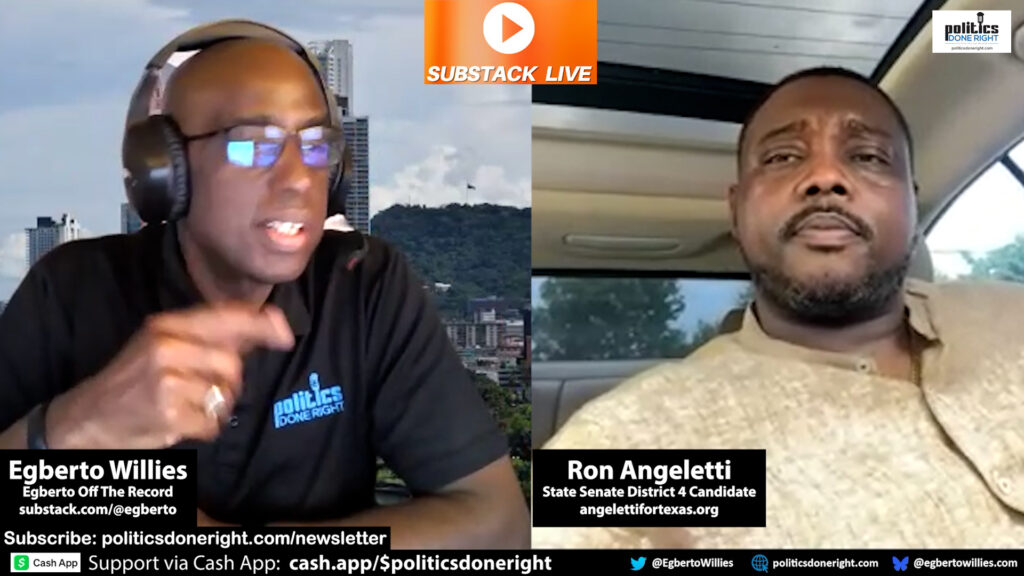
Ron Angeletti explains how he plans to win Texas SD4 by focusing on people, not party, tackling infrastructure, education, and polarization head-on.
Ron Angeletti, TX Senate District 4


Podcasts (Video — Audio)
Summary
A grassroots educator steps into a red district race with a message that cuts through polarization: people over politics.
Ron Angeletti, a Democratic candidate for Texas Senate District 4, presents a campaign rooted in lived experience as an educator, father, and community advocate. He rejects partisan rigidity and instead focuses on shared human needs—education, infrastructure, and honest governance—arguing that voters must move beyond political habits and vote their convictions.
- Angeletti enters politics not out of ambition but out of a call to serve and advocate for change.
- He emphasizes that even in a “deep red” district, shared values can bridge partisan divides.
- His campaign centers on infrastructure failures, environmental concerns, and public education funding.
- He strongly opposes school voucher programs as unaccountable transfers of public funds to private interests.
- He calls for civic engagement, urging voters to reject habit voting and instead make informed, conviction-based decisions.
This campaign reflects a broader progressive insight: the path to transforming even the most conservative districts lies not in abandoning them, but in organizing them—conversation by conversation, neighbor by neighbor.
Premium Content (Complimentary)
The interview reveals a fundamental truth that is often lost amid the noise of modern politics: people are not nearly as divided as the political system suggests. Ron Angeletti’s candidacy in Texas Senate District 4 challenges the dominant narrative that so-called “red districts” are permanently locked into conservative ideology. Instead, it demonstrates that what many interpret as ideological rigidity is often the product of habit, misinformation, and lack of engagement.
Angeletti enters the race not as a career politician but as an educator—arguably one of the most critical perspectives missing from legislative bodies. His background grounds his worldview in service, not power. He speaks less about partisan victories and more about meeting human needs. That distinction matters. When he says “people over politics,” he does not present it as a slogan but as a governing philosophy rooted in real-world experience.
His emphasis on infrastructure exposes one of the most glaring failures of governance in Texas. Flooding, water systems, and environmental degradation do not respect party affiliation. They affect working families across racial and ideological lines. The U.S. infrastructure suffers from chronic underinvestment, disproportionately harming lower-income communities. Angeletti recognizes that ignoring these issues for ideological reasons is not just ineffective—it is dangerous.
Equally important is his critique of school vouchers. He frames them not as a neutral policy choice but as a redistribution of public wealth into private hands without accountability. Privatization efforts often undermine public institutions while failing to deliver equitable outcomes. In Texas, where public schools already face funding challenges, such policies threaten to deepen inequality.
What makes this campaign especially compelling is its approach to political division. Angeletti recounts a moment with a Republican neighbor who supported him based on shared values rather than party affiliation. That anecdote captures a larger reality: many Americans agree on core issues—education, healthcare, economic stability—but are conditioned to see each other as adversaries. Partisan polarization is often driven more by perception than by actual policy disagreement.
The campaign also highlights structural barriers, including voter suppression tactics and limited polling access. These challenges are not incidental; they are part of a broader pattern documented by the Brennan Center for Justice, which has tracked how restrictive voting measures disproportionately impact marginalized communities. Angeletti’s call for grassroots mobilization directly confronts this reality, emphasizing collective action as the only effective counterweight.
Ultimately, this race is not just about one district. It represents a strategic blueprint for progressive politics in hostile terrain. Instead of conceding ground, it insists on contesting every race. Instead of writing off voters, it engages them. Instead of leaning on party identity, it appeals to shared humanity.
The deeper lesson is clear: democracy does not function when large swaths of the population are abandoned because they are deemed unwinnable. Change requires presence, persistence, and a willingness to challenge assumptions. Angeletti’s campaign embodies that approach. It argues, implicitly and explicitly, that the working-class majority—regardless of political label—holds the power to reshape the political landscape if it chooses to act.