


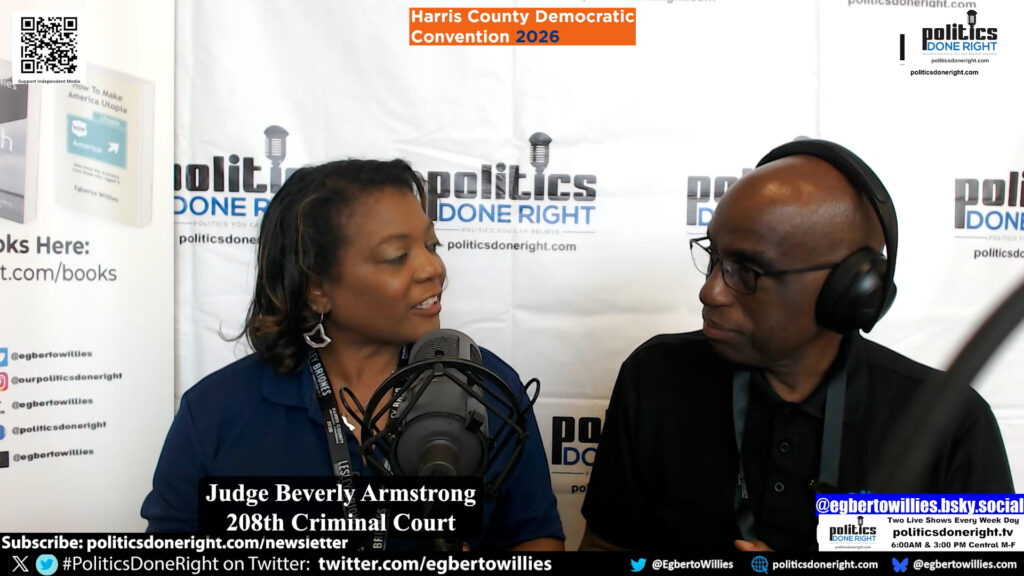
Are judges to blame? Judge Armstrong explains bail laws, fairness, and how misinformation fuels attacks on the courts.
Judge Armstrong: Courts Follow The Law

Watch Politics Done Right T.V. here.

Podcasts (Video — Audio)
Summary
Judge Beverly Armstrong lays out a clear truth: judges are doing their jobs, following the law, and delivering justice despite coordinated political attacks and misinformation campaigns.
- Judges are clearing massive case backlogs, some dating back eight years, restoring lives delayed by the justice system.
- Courts must follow the law as written by the legislature—not political narratives or media distortions.
- Bond decisions are dictated by law, including affordability requirements—not arbitrary judicial discretion.
- Specialized courts (mental health, veterans, drug courts) aim to rehabilitate while maintaining accountability.
- Voter participation, especially down-ballot voting, is essential to protect fair and functioning courts.
This is not just about one judge or one race. It is about whether the justice system serves people fairly or becomes a political weapon. The path forward requires rejecting fear-based narratives, supporting judges who follow the law, and voting to defend a system rooted in fairness, not profit or misinformation.
Premium Content (Complimentary)
The conversation with Judge Beverly Armstrong exposes a reality that corporate media and political operatives too often obscure: the justice system is under attack not because it fails to follow the law, but because it does.
The discussion makes one principle unmistakably clear. Judges do not write laws. They interpret and apply them. That distinction matters, and it has been intentionally blurred. When critics attack judges over bail decisions, they conveniently ignore that the law—crafted in state legislatures like Texas—requires judges to grant bond and to set it at a level defendants can reasonably meet.
This is not judicial activism. It is constitutional compliance.
Research from organizations such as the Brennan Center for Justice has repeatedly shown that bail systems across the United States often criminalize poverty rather than enhance safety. Cash bail disproportionately harms low-income individuals, many of whom remain jailed pretrial simply because they cannot afford release. That reality aligns directly with what Judge Armstrong explains: setting impossibly high bonds is illegal because it effectively amounts to pretrial punishment without a conviction.
The political attack on judges, therefore, is not about safety—it is about control and profit. As noted in the discussion, the bail bond industry benefits from a system that monetizes freedom. When people are forced to pay for release, private actors profit. When something goes wrong, those same actors and their political allies deflect blame onto judges.
This is a classic example of privatized gain and socialized blame.
Judge Armstrong also highlights another critical issue: the backlog of cases that have devastated lives. Imagine waiting eight years for a resolution. That delay is not just bureaucratic inefficiency—it is economic and emotional destruction. People lose jobs, homes, and families while waiting for justice.
The effort to clear these backlogs is, therefore, an act of justice itself. In her capacity, she has done just that.
Judge Armstrong’s emphasis on specialized courts—mental health courts, veterans courts, and drug courts—reflects a modern, evidence-based approach to justice. Studies from institutions like the National Institute of Justice show that problem-solving courts reduce recidivism by addressing root causes such as addiction and mental illness. These courts do not eliminate accountability; they make accountability meaningful by coupling it with rehabilitation.
This is what a humane justice system looks like.
Yet, as the conversation underscores, judges operate under strict ethical constraints. They cannot publicly defend themselves against misinformation or explain rulings in ongoing cases. That silence becomes a vulnerability, exploited by political actors and amplified by a media ecosystem that often prioritizes sensationalism over accuracy.
The result is a dangerous feedback loop: misinformation fuels fear, fear suppresses voter turnout, and suppressed turnout enables further attacks on the judiciary.
Judge Armstrong’s call to “vote all the way down the ballot” is therefore not a cliché—it is a democratic necessity. Judicial races are often overlooked, yet they shape everyday life in profound ways. From pretrial freedom to sentencing outcomes, judges influence whether the justice system operates fairly or punitively.
This moment demands clarity. If the public wants different outcomes—whether stricter bail laws or alternative policies—the solution lies in legislative change, not judicial scapegoating. Blaming judges for following the law is not just misleading; it is an attempt to undermine the rule of law itself.
Independent media plays a crucial role here. As highlighted in the closing remarks, corporate media frequently fail to provide the context necessary for informed citizenship. That failure leaves a vacuum filled by narratives that serve power rather than people.
The antidote is engagement—staying informed, questioning narratives, and participating in elections at every level.
Judge Beverly Armstrong’s message ultimately transcends her candidacy. It is a defense of a justice system grounded in fairness, legality, and humanity. The choice before voters is stark: support a system that follows the law and seeks to improve lives, or allow fear and misinformation to erode one of democracy’s most essential institutions.