


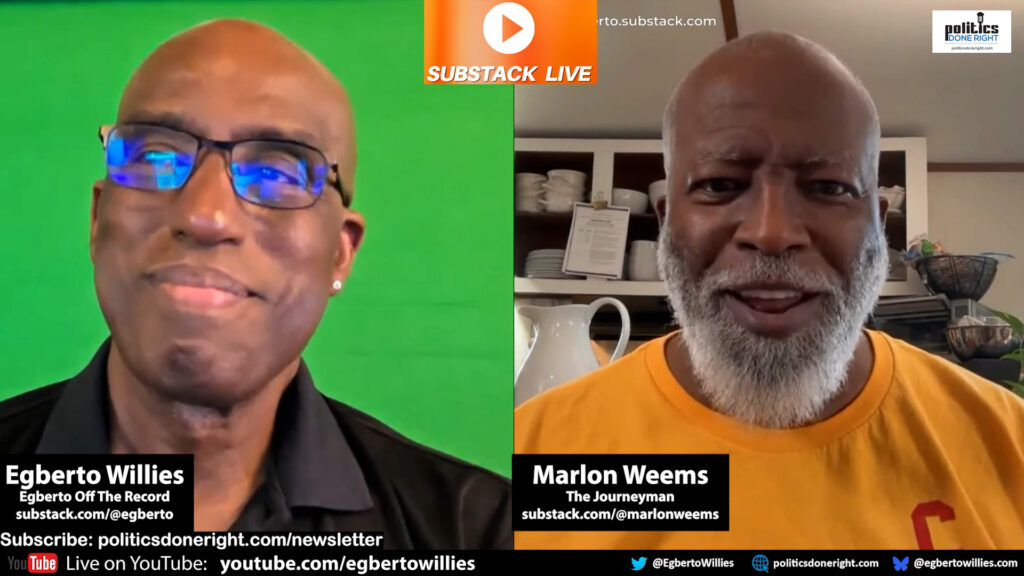
This conversation with Marlon Weems, publisher of The Journeyman newsletter, exposes how propaganda, oil markets, and bad policy push the U.S. toward conflict with Iran.
Iran War Exposed

Watch Politics Done Right T.V. here.

Podcasts (Video — Audio)
Summary
A candid and urgent conversation between the publisher of The Journeyman. , Marlon Weems, and the publisher of Egberto Off The Record & producer/host of Politics Done Right, Egberto Willies, exposes the truth behind the Iran conflict: this is not about security—it is about power, profit, and propaganda.
The discussion lays bare how decades of U.S. intervention, media manipulation, and economic incentives have created a dangerous escalation with Iran. It highlights how policymakers ignore predictable consequences—rising oil prices, global instability, and human suffering—while ordinary Americans are left to bear the cost. The conversation challenges the dominant narrative and forces a necessary reckoning with history, accountability, and misplaced priorities.
- The Strait of Hormuz, which carries roughly 20% of global oil, becomes a central vulnerability, guaranteeing economic shock.
- Iran’s asymmetric capabilities—drones, mines, and dispersed missile systems—make military dominance ineffective.
- U.S. foreign policy decisions ignore historical context, including decades of intervention dating back to 1953.
- Media narratives amplify fear and misinformation while failing to demand evidence or accountability.
- War spending diverts resources from healthcare, childcare, and domestic needs, revealing distorted national priorities.
This conversation dismantles the illusion of inevitability. War with Iran is not destiny—it is a choice shaped by profit motives, geopolitical arrogance, and a failure to learn from history. A progressive lens makes clear that real security comes not from bombs, but from investing in people and rejecting the machinery of endless war.
Premium Content (Complimentary)
One does not stumble into a war with Iran. One engineers it. The discussion makes that point unmistakably clear. What unfolds is not a spontaneous response to imminent danger but the culmination of decades of policy choices, economic incentives, and a deeply entrenched narrative that paints Iran as a perpetual enemy. The claim that Iran has been an “imminent threat” for nearly half a century collapses under its own absurdity. An imminent threat does not last 47 years. That language serves a purpose—it conditions the public to accept escalation as necessary rather than optional.
The conversation highlights a critical strategic truth that policymakers either ignore or exploit: Iran does not need to defeat the United States militarily to create chaos. It only needs to disrupt the global economy. The Strait of Hormuz becomes the linchpin. Roughly one-fifth of the world’s oil passes through that narrow corridor. It does not have to close completely to trigger an economic shock. Insurance markets, shipping risks, and speculative trading alone can drive prices upward. That means Americans will feel the consequences not on distant battlefields, but at the gas pump and grocery store.
This is not accidental. Analysts at institutions like the U.S. Energy Information Administration have repeatedly confirmed the strategic vulnerability of the Strait of Hormuz, noting that even perceived threats can spike oil prices and destabilize markets. Similarly, research from the Center for Strategic and International Studies (CSIS) shows that modern warfare increasingly relies on asymmetric tactics—drones, cyber operations, and economic disruption—rather than conventional military dominance. Iran has invested heavily in precisely those capabilities.
The discussion underscores another uncomfortable truth: the United States consistently underestimates its adversaries. Iran’s drone technology, missile dispersion, and engineering capacity challenge the outdated notion that technological superiority belongs exclusively to the West. This blind spot reflects a deeper issue—an unwillingness to acknowledge that other nations possess both capability and agency.
But perhaps the most important insight emerges from the historical context. The tension between the United States and Iran did not begin with recent events. It traces back to the 1953 coup, when the U.S. and the United Kingdom overthrew Iran’s democratically elected Prime Minister, Mohammad Mossadegh, after he nationalized oil resources. That intervention installed the Shah, whose regime ruled with repression and fueled resentment that eventually led to the 1979 revolution.
Historians and organizations such as the National Security Archive have documented this extensively, confirming that foreign intervention played a decisive role in shaping Iran’s modern political trajectory. Ignoring this history allows policymakers to present the conflict as irrational hostility rather than a predictable response to decades of interference.
The conversation also takes aim at the role of media. When narratives go unchallenged, misinformation becomes policy. Claims about casualties, threats, and motivations circulate without verification, creating a feedback loop that justifies further escalation. The failure to demand evidence is not a neutral act—it is complicity.
Meanwhile, the economic dimension cannot be ignored. War is profitable. Rising oil prices benefit energy companies. Defense contracts surge. Market volatility creates opportunities for financial actors to extract wealth. The discussion raises a provocative but necessary question: who benefits from instability? The answer rarely includes ordinary Americans.
Data from Brown University’s Costs of War Project reveal that post-9/11 conflicts have cost the United States over $8 trillion, with little to show for long-term stability. That money could have funded universal healthcare, affordable housing, or education—investments that would strengthen the nation far more than any military campaign.
The conversation ultimately reframes the issue. It is not about choosing between strength and weakness. It is about redefining what strength means. True strength lies in restraint, accountability, and a willingness to confront uncomfortable truths about past actions.
War with Iran is not inevitable. It is the result of decisions made by people who prioritize power and profit over human well-being. Recognizing that is the first step toward changing course.