


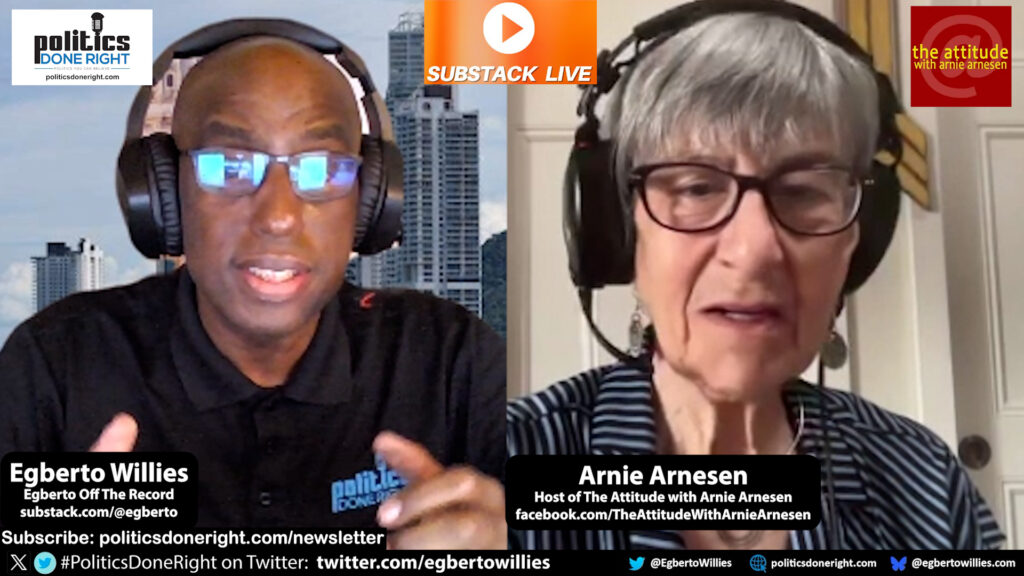
Arnie Arnesen and Egberto discuss Texas politics heating up as Talarico surges, Latinos shift, and Paxton and Cornyn battle for power in a changing electorate.
Arnie Arnesen: Texas Politics Explodes


Podcasts (Video — Audio)
Summary
The conversation cuts straight through the noise: democracy only works when people show up and demand it.
- Arnie Arnesen frames politics as a moral responsibility, not a spectator sport, stressing that disengagement enables authoritarian drift.
- The discussion highlights how James Talarico embodies a bridge-building politics that refuses to demonize opponents while mobilizing grassroots energy.
- Texas power struggles—featuring figures like Ken Paxton and John Cornyn—reflect deeper national fractures driven by inequality and ideological extremism.
- The role of race and immigration emerges as a deliberate economic and political tool, not an accident, used to divide working people and suppress collective power.
- Latino voters, once courted through cultural signaling, now confront policies that undermine their communities, revealing contradictions in right-wing outreach.
The discussion insists that the path forward lies in rejecting division, embracing community, and recognizing that economic justice—not identity manipulation—defines real political change. Democracy demands participation, solidarity, and a willingness to confront power directly.
Premium Content (Complimentary)
The conversation delivers a clear and urgent thesis: democracy is not failing by accident; it is failing because too many people have been conditioned to disengage from it. That disengagement, as it reveals, creates the very vacuum that allows concentrated power to flourish. The result is a political system that appears chaotic on the surface but operates with ruthless precision underneath—benefiting those who exploit division while ordinary people fight among themselves.
At the center of the discussion stands the evolving political landscape in Texas, a state that increasingly reflects the broader contradictions of the United States. Figures like Ken Paxton and John Cornyn symbolize entrenched power structures that rely on cultural wedge issues while advancing policies that concentrate wealth and weaken public institutions. These leaders operate within a system that prioritizes ideological loyalty over material outcomes, even as working families struggle with rising costs, stagnant wages, and diminishing access to essential services.
Against this backdrop, James Talarico emerges as a compelling counterpoint. His political style—grounded in empathy, faith, and inclusive rhetoric—demonstrates that progressive politics need not alienate potential allies. Instead, it can invite participation by recognizing shared humanity. His fundraising success, driven largely by small-dollar contributions, signals a deeper shift: people are hungry for a politics that feels authentic and responsive rather than transactional and detached.
Economic inequality has widened over the decades, even as productivity has risen. That disconnect exposes a system designed to extract value from workers while limiting their political influence. At the same time, trust in government declines as citizens feel their voices do not matter. The conversation underscores both realities: economic injustice and political alienation reinforce each other.
The discussion also tackles one of the most sensitive and consequential dynamics in American politics: race and immigration. It argues that these issues are not simply cultural flashpoints but strategic tools. By framing immigrants—particularly Latinos—as threats, political actors create divisions within the working class. This strategy allows economic elites to maintain control while redirecting public anger away from systemic inequities.
Yet this approach carries risks. Latino voters, who were once courted through appeals to faith and family values, now face policies that directly harm their communities. The contradiction becomes impossible to ignore. As enforcement intensifies and rhetoric hardens, many begin to reassess political loyalties. This shift reflects a broader pattern: when policies contradict lived experience, ideological narratives lose their power.
The conversation further explores the concept of “rugged individualism,” contrasting it with a more community-oriented model seen in countries like Canada. The critique is sharp: an overemphasis on individualism undermines collective solutions to shared problems. Climate change, healthcare, and economic inequality cannot be solved by isolated individuals; they require coordinated action. The insistence on individualism, therefore, becomes not just a cultural preference but a structural barrier to progress.
Importantly, the dialogue does not romanticize politics. It acknowledges the necessity of conflict and the value of a multiparty system. However, it distinguishes between healthy competition and destructive polarization. When parties serve as checks on each other, democracy thrives. When they become vehicles for entrenching power and suppressing dissent, democracy erodes.
The underlying message is both sobering and empowering. The system reflects the choices of its participants. When people disengage, they cede power. When they organize, vote, and demand accountability, they can reshape the political landscape. This is not theoretical; history offers numerous examples of sudden shifts when public frustration reaches a tipping point.
Ultimately, the conversation reframes politics as a lived experience rather than an abstract debate. Policies determine whether people can afford housing, access healthcare, and secure stable employment. These are not partisan concerns; they are human ones. By centering these realities, the discussion challenges the audience to move beyond identity-based divisions and focus on shared material interests.
The conclusion is unavoidable: democracy requires more than belief—it requires action. Participation is not optional; it is the foundation of the system. When people recognize their collective power and act on it, they can dismantle the structures that divide them and build a politics that truly serves the many rather than the few.