


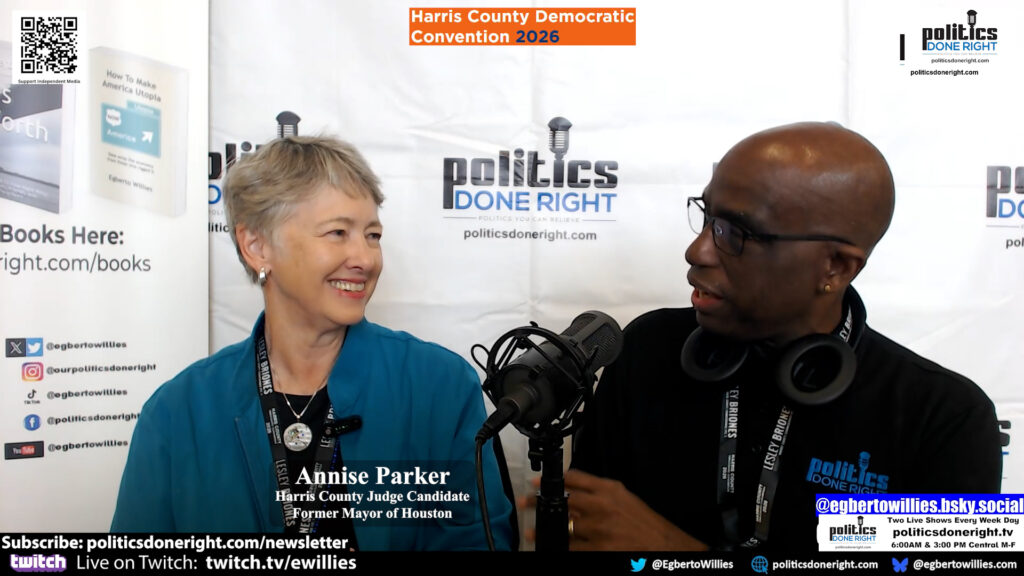
Former Houston Mayor Annise Parker discusses her Harris County Judge run, focusing on unity, flood control, housing, and economic relief in this in-depth interview.
Annise Parker Interview

Watch Politics Done Right T.V. here.

Podcasts (Video — Audio)
Summary
A direct, candid conversation with a seasoned public servant about leadership, values, and what Harris County needs now. In this interview, former Mayor of Houston Annise Parker speaks plainly about her campaign for Harris County Judge, grounding her case in experience, coalition-building, and practical governance. She reflects on a strong primary showing, outlines a strategy to expand voter engagement, and centers the conversation on real issues—economic stress, housing affordability, flooding, and government dysfunction—while rejecting rigid ideological labels in favor of shared values and effective leadership.
- Parker explains her near-majority primary result and the path to winning the runoff
- She stresses the need to engage voters across all communities, not just traditional bases
- She reframes “progressive vs moderate” as a false divide, focusing instead on shared values
- She identifies dysfunction in county governance and the need for coordinated leadership
- She prioritizes flood control, housing, and economic stability without raising taxes
This conversation reveals a candidate focused less on political branding and more on governing. Parker argues that Harris County needs leadership capable of uniting factions, addressing material concerns, and delivering results. It is a pragmatic progressive vision—rooted in values but driven by execution.
Premium Content (Complimentary)
The conversation unfolds with clarity and purpose. Sitting next to Former Mayor of Houston Annise Parker, the discussion cuts through the noise that often clouds political campaigns. Instead of slogans, the exchange centers on what it takes to govern—and more importantly, to govern effectively in a county as complex and diverse as Harris County.
The first point of tension—and opportunity—comes from the primary results. Parker acknowledges finishing just short of a majority, but rather than framing it as a setback, she treats it as evidence of both strength and unfinished work. The surge in turnout, she explains, brought in voters who had never participated in a primary before. That matters. It signals engagement, but it also exposes a weakness in political organizing: campaigns often fail to meet new voters where they are.
The dialogue presses on that reality. Winning in Harris County requires more than energizing a base. It requires expanding it. Parker does not shy away from that truth. She describes a campaign that goes beyond Democratic clubs—into civic organizations, community groups, and neighborhoods that politicians sometimes ignore. That strategy reflects a broader democratic principle: participation must be cultivated, not assumed.
Voter engagement increases when candidates speak directly to people’s lived experiences. The conversation reinforces that idea. It is not about ideology; it is about relevance.
When asked about political labels, Parker pushes back in a way that reveals both pragmatism and conviction. The term “progressive,” she suggests, has lost clarity. What matters are the policies themselves. Should wages rise? Should billionaires pay more? Should healthcare be accessible? She answers each question without hesitation. The implication is clear: these are not fringe positions—they are common-sense responses to systemic inequality.
That framing echoes findings from the Economic Policy Institute, which has documented the widening gap between productivity and wages and the growing concentration of wealth. In that context, policies often labeled “progressive” begin to look like baseline fairness.
The conversation then turns to governance—where rhetoric meets reality. Parker identifies a central problem: dysfunction. Harris County, she argues, is not broken but fragmented. Commissioners operate independently, and without cohesive leadership, progress stalls. The image she paints is vivid—officials rowing in different directions when they should be moving together.
When pressed on what she would do differently. Parker’s answer is not ideological—it is managerial. She emphasizes coordination, communication, and alignment. It is a reminder that effective government often depends less on sweeping reforms and more on making systems work as intended.
Policy priorities follow naturally. Flood control emerges as a central concern. In a region shaped by repeated flooding events, infrastructure is not optional—it is existential. The conversation makes clear that economic growth and community stability depend on addressing this issue head-on. Without it, housing, jobs, and entire neighborhoods remain at risk.
Housing affordability and homelessness also take center stage. These are not abstract policy debates; they are daily realities for residents. Research from the National Low Income Housing Coalition supports this focus, highlighting a nationwide shortage of affordable housing that hits urban counties like Harris especially hard.
And then the politically charged question: how to fund these priorities without raising taxes. Parker’s response reflects both experience and constraint. She points to her record—years of managing budgets without increasing tax rates—and emphasizes prioritization. Government, she argues, must make choices. Not every program can be funded equally, and leadership means deciding what matters most.
Healthcare enters the discussion as a broader systemic issue. Here, as with wages and billionaire taxation, Parker’s perspective aligns clearly with progressive values, even as she avoids labels. She acknowledges the logic of single-payer systems and underscores a fundamental principle: no one should go bankrupt because they get sick. That position aligns with global norms and data from organizations such as the Kaiser Family Foundation, which have documented the financial strain of healthcare costs in the United States.
As the conversation closes, Parker speaks directly to voters. She grounds her appeal in lived experience—decades of service, deep roots in the community, and a track record of leadership. It is not a theoretical argument. It is a practical one.
The exchange ultimately reveals something essential about this campaign. It is not driven by ideological branding or political theater. It is driven by a belief that government can work—if it is led with competence, collaboration, and a clear understanding of what people actually need.
That is the throughline of the conversation. Not left versus right. Not progressive versus moderate. But effective versus ineffective.
And in a county where the stakes are measured in livelihoods, homes, and futures, that distinction matters more than anything else.