


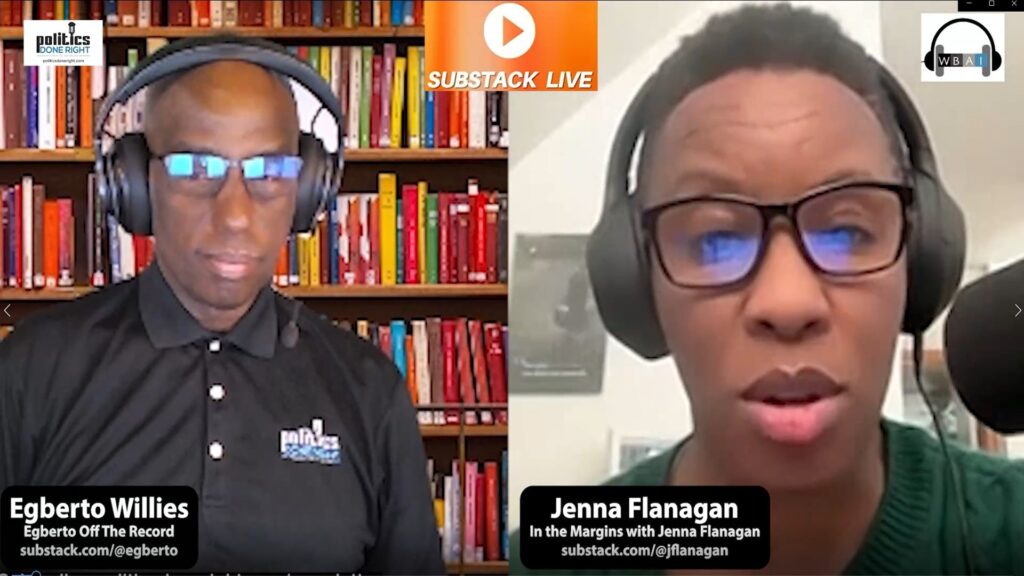
WBAI’s We Decide with Jenna Flanagan: The Supreme Court blocks Trump’s tariffs while Iran tensions mount and Cuba faces decades of U.S. blockade. Here’s what it means for power and accountability.
Supreme Court Blocks Trump Tariffs

Watch Politics Done Right T.V. here.

Podcasts (Video — Audio)
The embedded video contains solely the questions that WBAI’s We Decide’s Jenna Flanagan asked me. The entire panel discussion can be viewed here. We Decide is a joint Pacifica Affiliate WBAI production, and the We Decide: America at the Crossroads with Jenna Flanagan.
Summary
The Supreme Court’s decision to block Donald Trump’s sweeping tariffs surprised many, but it should not surprise anyone who understands power. The Court protects capital first. When executive overreach threatens billionaire interests, it draws a line. When it harms ordinary people, it often looks the other way.
- The Supreme Court, despite its conservative majority, struck down Trump’s tariffs after ruling for his administration in most prior cases.
- The tariffs function as regressive taxes designed to normalize shifting the burden from the wealthy to working people.
- Judicial pushback will likely occur only when policies materially disrupt corporate power or economic stability.
- Escalation with Iran risks war and serves as a convenient distraction from domestic scandals and sinking approval ratings.
- The crisis in Cuba reflects decades of U.S. blockade and economic strangulation, not simply ideological failure.\
This moment exposes a deeper truth: institutions do not act out of abstract principle. They act to preserve power. Working people must demand accountability at home and reject destabilization abroad.
Premium Content (Complimentary)
The Supreme Court’s decision to block Donald Trump’s expansive tariff regime sent shockwaves through Washington, but it clarified something fundamental about American power. Even with a 6–3 conservative majority—three appointed during Trump’s first term—the Court drew a line when the president’s trade war threatened entrenched economic interests. The justices had largely ruled in favor of his administration in earlier cases, yet when tariffs jeopardized corporate profitability and market stability, they intervened.
This ruling does not represent a sudden awakening to executive overreach. It represents a recalibration in defense of capital. Trump’s tariffs function as regressive taxes. Economists across ideological lines—from the Peterson Institute for International Economics to analyses published by the Congressional Budget Office—have shown that tariffs operate like consumption taxes. They raise prices on imported goods, and consumers pay the difference. Working families absorb the cost at the checkout counter while corporations often pass along the burden.
The political objective runs deeper. If consumers become accustomed to higher sales taxes through tariffs, policymakers can argue for reducing progressive income taxes. That shift benefits the wealthiest Americans disproportionately. It echoes long-standing conservative proposals to replace income taxes with national consumption taxes—policies that tilt the tax code further in favor of billionaires. The Supreme Court stepped in not to protect the working class but to prevent the destabilization of broader economic interests.
Judicial resistance may appear again in other arenas, particularly where executive actions threaten systemic economic stability. Consider birthright citizenship. Attempts to revoke it would disrupt labor markets, business planning, and constitutional norms. Corporations depend on predictable citizenship rules for workforce stability. When executive actions imperil that stability, judicial brakes engage.
At the same time, foreign policy escalation reveals another dangerous pattern. Rising tensions with Iran risk broader regional conflict. The Middle East Institute and the Council on Foreign Relations have warned that miscalculation could quickly spiral into confrontation. History offers sobering lessons. The 2003 invasion of Iraq destabilized an entire region. Civilian casualties mounted. Trillions of dollars evaporated. When military escalation coincides with domestic scandal—such as fallout from the Epstein files or historically low approval ratings—it inevitably raises questions about distraction.
War distracts. It rallies nationalist sentiment. It buries headlines. Yet it also costs lives—often of civilians far removed from Washington’s political theater. The Washington Post and ABC News polling cited during the panel discussion shows declining public support. In that context, saber-rattling abroad may offer short-term political cover, but it risks long-term catastrophe.
Then there is Cuba. The United Nations General Assembly has repeatedly condemned the U.S. embargo, with annual votes overwhelmingly opposing the blockade. Reports from UN human rights experts document how sanctions restrict access to medicine, fuel, and essential goods. While Cuban governance carries its own complexities and shortcomings, the economic siege has undeniably constrained development. Even scholars at institutions like Harvard’s Kennedy School have noted that sanctions significantly impair economic growth.
When Fidel Castro first consolidated power, he sought recognition from the United States. Diplomatic rejection and economic hostility pushed Havana toward the Soviet Union. The embargo hardened over decades, becoming one of the longest-running sanctions regimes in modern history. Today, shortages and blackouts persist not simply because of ideology but because financial transactions, trade, and credit access remain restricted. Blaming Cuba’s suffering solely on domestic policy erases the external chokehold that shaped its trajectory.
The larger lesson from these converging issues is systemic. Power protects itself. Courts intervene selectively. Military escalation distracts from domestic accountability. Economic sanctions punish populations more than leaders. The progressive imperative remains clear: demand democratic oversight of trade policy, resist militarism that sacrifices lives for political expediency, and acknowledge how economic coercion devastates ordinary people abroad.
Institutions do not correct themselves out of goodwill. They respond to organized pressure and material interests. The Supreme Court’s tariff ruling demonstrates that even a conservative judiciary will resist when billionaire interests face harm. The public must insist that similar urgency applies when working families suffer under regressive taxation, when foreign civilians bear the brunt of geopolitical gamesmanship, and when decades-long blockades choke struggling nations.
Democracy requires vigilance. It demands that citizens confront executive overreach at home and reject destabilization abroad. Economic justice and global peace remain intertwined. A nation that claims moral leadership must practice accountability—not only in its courts but in its trade, military, and foreign policy decisions.