


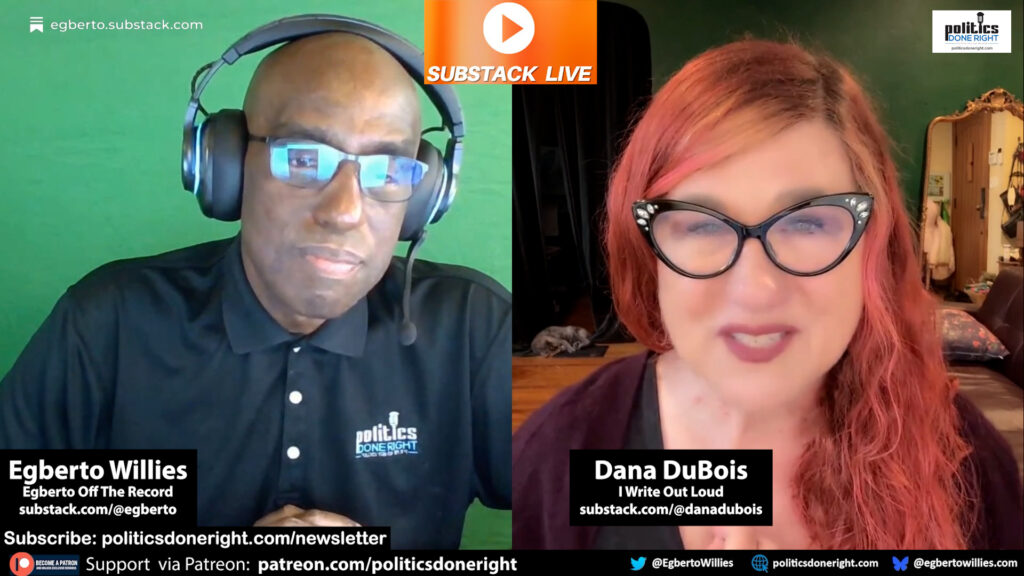
A deep conversation with Dana DuBois about creative nonfiction, AI ethics, Substack publishing, and why independent voices matter now more than ever.
Dana DuBois on AI

Watch Politics Done Right T.V. here.

Podcasts (Video — Audio)
Summary
A thoughtful conversation between Dana DuBois, publisher of “I Write Out Loud“ and Egberto Willies, publisher of Egberto Off The Record and host of media/radio show “Politics Done Right” explores the intersection of storytelling, technology, and political economy. The discussion moves from the power of creative nonfiction to the ethical dilemmas of artificial intelligence and corporate power.
- Dana DuBois built her writing career through creative nonfiction, first on Medium and later on Substack, where she launched I Write Out Loud as a home
- She argues that storytelling moves people more effectively than statistics because readers interpret narratives through their own lived experiences.
- Artificial intelligence can function as a powerful writing assistant—helping with outlining, editing, and idea organization—but it cannot authentically write a memoir or lived experience.
- Ethical concerns arise from corporate control of AI technologies and their potential partnerships with government surveillance and military institutions.
- The conversation ultimately frames technology as neither inherently good nor bad; its social impact depends on who controls it and whether the public asserts democratic oversight.
The conversation demonstrates how independent writers and journalists must navigate both technological opportunity and political power. Creative storytelling remains essential for moving hearts and minds, while the rise of artificial intelligence demands a democratic response to prevent corporate or authoritarian misuse. Writers, artists, and independent media voices therefore hold a dual responsibility: to create meaningful narratives and to challenge systems that concentrate power over information and technology.
Premium Content (Complimentary)
Independent journalism and creative storytelling have always thrived during periods of social upheaval. A conversation with writer/publisher Dana DuBois reveals exactly why. The dialogue centers on the power of narrative, the role of independent platforms like Substack, and the complicated promise and danger of artificial intelligence.
Dana DuBois describes her path to writing as rooted in creative nonfiction—stories about relationships, parenting, culture, and the lived experience of a Gen-X woman navigating a rapidly changing political world. She first began publishing essays online through Medium before migrating to Substack when changes to Medium’s ecosystem pushed many writers to seek new spaces.
That shift reflects a broader transformation in journalism and publishing. Traditional media institutions increasingly face pressure from corporate ownership, political influence, and declining trust. Independent platforms allow writers to connect directly with readers, bypassing editorial gatekeepers and corporate interests. Scholars studying digital journalism note that platforms like Substack represent a new hybrid model combining blogging, newsletters, and subscription media, enabling writers to build independent audiences and revenue streams.
For DuBois, however, the platform itself is only a vehicle. The real power lies in storytelling. She emphasizes that statistics rarely move people emotionally, while narrative allows readers to interpret experiences through their own lives.
This insight aligns with research in cognitive psychology and communication studies. Scholars such as Paul Zak and Melanie Green have shown that narrative storytelling increases empathy and persuasion because audiences mentally simulate experiences described in stories. Stories activate emotional engagement in ways that raw data cannot.
Creative nonfiction also allows writers to connect personal experience with broader social structures. DuBois points out that issues such as parenting teenage girls cannot be separated from cultural realities like sexism, exploitation, or political power.
This blending of memoir and social critique echoes traditions in progressive writing. Authors from James Baldwin to “yours truly” have used personal narrative to illuminate systemic injustice. Personal stories become a gateway into political consciousness.
The conversation then turns toward artificial intelligence—an emerging force reshaping journalism, writing, and nearly every field that processes information.
DuBois explains that AI tools can serve as valuable assistants. They help organize scattered ideas into outlines, identify narrative gaps, and perform editing tasks that once required teams of editors.
Yet she insists that AI cannot authentically produce memoir or creative nonfiction because those forms require lived experience and emotional truth.
That distinction matters. Technology can enhance creativity, but it cannot replace the human perspective that gives storytelling meaning.
The political economy of AI raises deeper concerns. Corporate control over artificial intelligence concentrates enormous power in a handful of companies. When those corporations collaborate with governments—particularly in areas like surveillance or military technology—the stakes become even higher.
DuBois points to the ethical question of whether technology companies should cooperate with government requests that undermine privacy or civil liberties. This reality came to a head when the U.S government penalized AI company Anthropic and started migrating to OpenAI. It caused her to ditch ChatGPT, an OpenAI-based chat box. She migrated to Anthropic’s Claude. She wrote about this event thoroughly in he Substack article “I’m Breaking Up With ChatGPT.”
These concerns mirror broader debates in technology policy. Scholars at institutions like MIT and Stanford have warned that AI governance will shape economic inequality, labor markets, and democratic institutions for decades to come.
The discussion ultimately arrives at a key progressive insight: technology itself is not the enemy. The problem lies in who owns it and how society distributes its benefits.
If the productivity gains from AI flowed to the public rather than a small group of billionaires, society could reduce work hours, expand leisure time, and invest in culture and creativity. Instead, the current economic system channels technological gains upward. A functional society using AI extensively is incompatible with capitalism.
That reality underscores the importance of independent media voices. Writers, journalists, and creators must continue producing narratives that expose injustice, challenge corporate narratives, and imagine alternatives.
In the end, the conversation returns to art itself. A world without storytelling, music, and creative expression would be a diminished world. Even during political crises, writers must keep creating. And Dana’s launch of her new publication, “I Write Out Loud,“ is a testament to that reality.
Stories shape how people understand their lives. And in a time when technology threatens to centralize power over information, the act of telling human stories becomes a form of democratic resistance.