


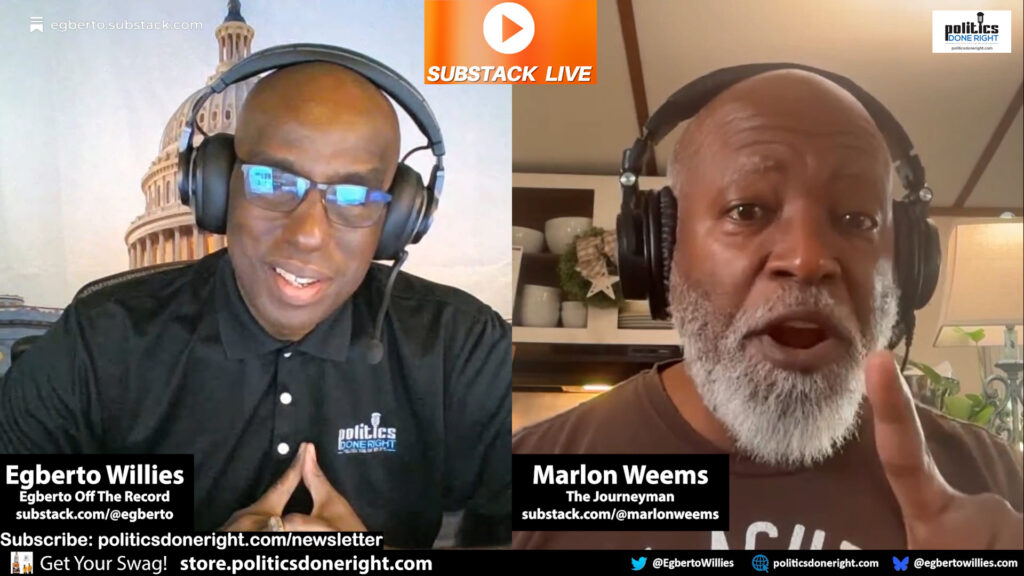
SCOTUS halted Trump’s sweeping tariffs, but Americans already paid higher prices. Now corporations may receive refunds. Will consumers see relief or another corporate windfall? Weems and Willies.
SCOTUS Neuters Trump on Tariffs

Watch Politics Done Right T.V. here.

Podcasts (Video — Audio)
Summary
This conversation between the publisher of The Journeyman., Marlon Weems, and the publisher of Egberto Off The Record, Egberto Willies, about the Supreme Court ruling that delivered a major blow to Donald Trump’s sweeping global tariffs is probative. The decision affirmed a fundamental constitutional principle: the power to tax belongs primarily to Congress, not the president acting unilaterally. While the ruling curbs executive overreach, the economic consequences of the tariffs already imposed remain unresolved. American consumers paid higher prices, corporations passed costs downstream, and now the question emerges—who actually benefits when the money flows back?
- Trump attempted to impose tariffs worldwide using emergency authority rather than congressional approval.
- Markets reacted negatively, with bond and stock markets showing immediate concern about economic instability.
- Economic research and federal reports confirmed that tariffs function as a tax on American consumers.
- Businesses raised prices to preserve profit margins, transferring the tariff burden to ordinary people.
- Now that the tariffs are invalidated, corporations may receive refunds while consumers who paid higher prices receive nothing.
The ruling represents an institutional check on executive power, but it also reveals a deeper structural problem in the American economy. When corporations raise prices to offset policy costs and later recover those costs through government refunds, they effectively capture a double benefit. Without regulatory intervention or political pressure, consumers—the people who paid the hidden tax—remain stuck with the bill.
Premium Content (Complimentary)
The Supreme Court’s decision limiting Donald Trump’s sweeping tariff policy represents a rare moment when constitutional structure intersects directly with economic justice. At its core, the ruling reminds the country of a foundational principle: taxation authority belongs to Congress. A president cannot simply declare an emergency and impose a global tax on imported goods without legislative oversight.
Yet while the legal question may be settled, the economic fallout continues to ripple through the American economy.
Trump’s tariff regime relied on emergency powers to impose duties on imports across the globe. The administration framed these tariffs as a tool to rebuild domestic manufacturing, punish foreign competitors, and generate revenue that would reduce the federal deficit. But the economic reality unfolded very differently.
Tariffs function as a consumption tax. Importers pay the tariff when goods arrive at U.S. ports, but those companies rarely absorb the cost themselves. Instead, they increase prices to protect profit margins. The result is predictable: consumers pay more.
Economists across the ideological spectrum have long documented this effect. A widely cited study by economists from Princeton University, Columbia University, and the Federal Reserve Bank of New York found that the majority of tariff costs fall on U.S. consumers rather than foreign exporters.
The conversation highlights this reality clearly. Businesses paid tariffs upfront but passed those costs to shoppers buying groceries, clothing, and everyday household goods.
That means working families—especially those already struggling with rising living costs—carried the heaviest burden.
Even more troubling is the regressive nature of tariffs. Lower-income households spend a higher percentage of their income on consumer goods, meaning tariff-driven price increases hit them disproportionately hard. Economists at the Peterson Institute for International Economics have repeatedly warned that tariffs function as regressive taxes that punish the poorest consumers the most.
In other words, tariffs do not redistribute wealth upward in theory. They do so in practice.
The Supreme Court’s decision, therefore, halts the policy, but it does not automatically repair the damage.
Corporations that paid tariffs can file claims to recover the money from the federal government. Large corporations possess the legal teams and financial resources necessary to pursue those refunds quickly. Smaller businesses often lack the capacity to navigate complex international trade claims, leaving them stuck with the losses.
Consumers, meanwhile, face an even harsher reality: they have no mechanism to recover the money they already paid through higher prices.
That creates a dangerous economic asymmetry.
Imagine the chain of events. Corporations raise prices to offset tariffs. Consumers pay those higher prices. Later, the government refunds tariffs to the corporations. Unless companies voluntarily reduce prices—which competitive markets rarely guarantee—they retain both the refund and the revenue generated by higher prices.
The result resembles a quiet corporate windfall.
This scenario illustrates a deeper problem embedded in the American political economy: corporations often socialize risk while privatizing profit. When policies fail, the public absorbs the costs. When those policies unwind, corporations frequently capture the benefits.
The political implications are just as important as the economic ones.
The ruling demonstrates that legal challenges can check executive overreach. But it also exposes the failure of political messaging around economic policy. Tariffs were marketed as a punishment against foreign countries, yet the evidence overwhelmingly shows that Americans paid the bill.
Progressives must articulate that truth clearly.
Economic nationalism often relies on emotionally appealing narratives—“bringing jobs home,” “punishing unfair trade,” or “protecting American workers.” But without structural reforms such as stronger labor protections, industrial policy, and progressive taxation, tariffs alone rarely deliver those promises.
Instead, they often become another mechanism through which corporate power and consumer vulnerability intersect.
The Supreme Court ruling may end this particular policy experiment. But it also offers a lesson: economic policy must be evaluated not by rhetoric but by who ultimately pays—and who ultimately profits.