


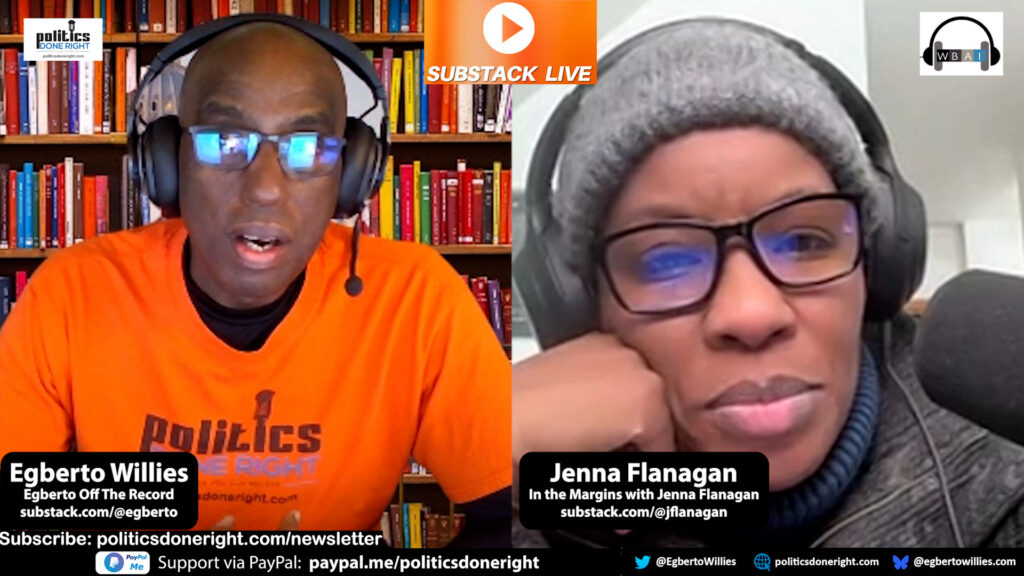
We Decide’s Jenna Flanagan: Trump urges election takeovers, elites evade accountability in the Epstein scandal, and the Washington Post collapses under billionaire control.
Trump’s Election Power Grab

Watch Politics Done Right T.V. here.

Podcasts (Video — Audio)
The embedded video contains solely the questions that WBAI’s We Decide’s Jenna Flanagan asked me. The entire panel discussion can be viewed here. We Decide is a joint Pacifica Affiliate WBAI production, and the We Decide: America at the Crossroads with Jenna Flanagan.
Summary
This is a warning. The conversation on WBAI’s We Decide made clear that the United States is not facing isolated controversies but a coordinated stress test of democracy itself. From an authoritarian call to seize election administration, to elite impunity in the Epstein scandal, to the gutting of one of the nation’s most influential newspapers, the pattern is unmistakable: power consolidates upward while democratic accountability erodes.
- Donald Trump’s call to “nationalize” midterm elections amounts to voter suppression by proxy, relying on state-level election takeovers in Democratic areas.
- The Georgia 2020 ballot controversy shows how manufactured doubt remains central to delegitimizing elections already proven secure.
- Closed-door testimony by Bill and Hillary Clinton in the Epstein matter highlights systemic elite protection, not accountability.
- The Washington Post’s 30% workforce cut and the resignation of CEO Will Lewis expose the failure of billionaire-owned media.
- Independent journalism now stands as the last credible firewall against authoritarian narratives.
Democracy cannot survive on norms alone. When elections are threatened, justice is delayed for the powerful, and journalism is hollowed out by plutocratic control, the public must respond by defending independent institutions and demanding structural reform—not symbolic outrage.
Premium Content (Complimentary)
The discussion on We Decide did not merely analyze the week’s headlines; it exposed a convergence of forces that now define American political life. The assertion that Republicans should “nationalize” the midterm elections is not rhetorical excess. It is a strategic signal. It invites state legislatures to replicate laws already passed in places like Texas, where Republican officials reserve the power to override local election authorities in heavily Democratic jurisdictions. That model does not strengthen election integrity; it undermines local democracy by centralizing partisan control. Constitutional scholars routinely point out that Article I, Section 4 limits federal interference in elections, but authoritarian movements rarely require legality—only plausibility. By repeating the claim publicly, Trump seeks to normalize the idea that elections are legitimate only when his party controls them WBAI’s.
The Georgia 2020 ballots fit neatly into this strategy. Despite exhaustive audits confirming the results, right-wing operatives continue to resurrect the issue. This persistence is not about evidence; it is about erosion. Research from the Brookings Institution and the Brennan Center for Justice demonstrates that sustained attacks on electoral legitimacy reduce public trust even when claims are false. The danger lies not in one lie, but in the repetition of many.
The Epstein scandal reveals a parallel failure—this time of elite accountability. The impending testimony of Bill and Hillary Clinton is unlikely to produce revelations that alter public understanding. The deeper issue is historical. For decades, powerful figures across party lines benefited from silence, sealed settlements, and institutional reluctance to confront wealth and influence. Deference to power delayed exposure of Epstein’s crimes. That failure created political conditions in which moral depravity lost its disqualifying force. When accountability collapses at the top, cynicism fills the void.
Nowhere is this collapse more visible than in corporate media. The Washington Post’s decision to cut nearly a third of its workforce while its billionaire owner retains enormous influence is not a market correction; it is a structural indictment. Concentrated ownership distorts editorial independence. Newsroom consolidation weakens investigative capacity and narrows the range of acceptable debate. When CEO Will Lewis stepped down, it did not signal renewal—it underscored instability inherent in plutocratic media models.
The consequence is predictable. As legacy outlets shrink, authoritarian actors face less scrutiny. The burden shifts to independent journalists, nonprofit newsrooms, and community radio—institutions that operate without billionaire backers but with public trust. This is not romanticism; it is necessity. Democracy depends on informed consent, and informed consent requires journalism free from corporate capture.
The We Decide panel underscored a single truth: these crises are interconnected. Election subversion, elite impunity, and media consolidation all serve the same end—concentrated power insulated from democratic challenge. Progressives must respond with equal coherence. That means federal protections for election administration, aggressive antitrust enforcement in media, and full transparency in investigations involving the powerful. Democracy is not self-sustaining. It survives only when people insist that it does.