


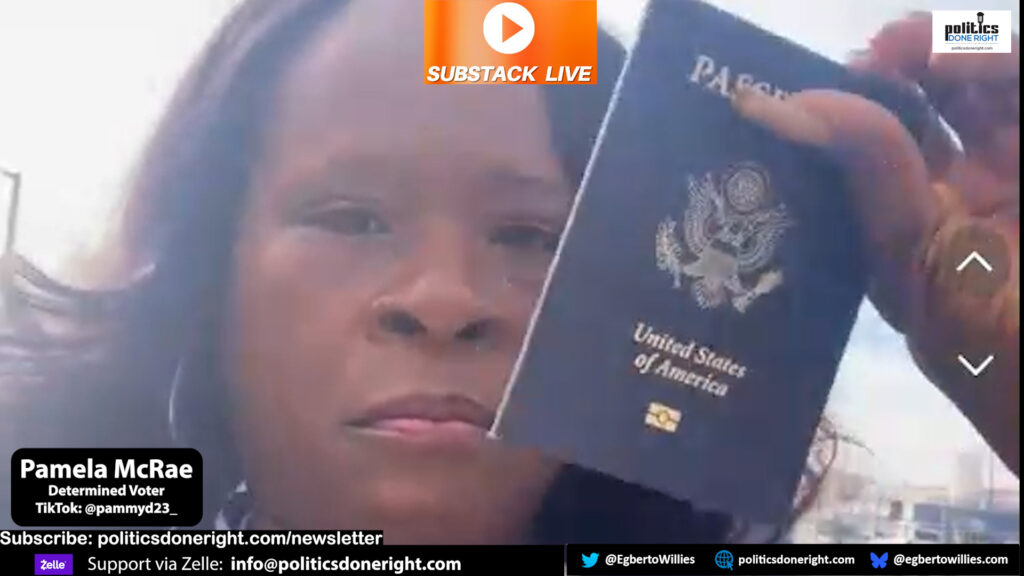
Pamela McRae voted before—then vanished from the rolls. This Texas voter’s defiance shines light on voter suppression tactics nationwide.
Texas Woman Refuses Silence After Roll Removal

Watch Politics Done Right T.V. here.

Podcasts (Video — Audio)
A Texas voter, Pamela McRae, refused to disappear quietly. When election officials told her she was no longer registered, she stood her ground, demanded accountability, and exposed a system that too often counts on silence. Her story, documented in the interview, is not just personal—it is political.
She showed up on the first day of early voting with a valid U.S. passport. Officials told her she was “not registered,” even though she had consistently voted in prior elections. Instead of walking away—as so many understandably do—she returned with additional identification, challenged the misinformation, and ultimately cast a provisional ballot. More importantly, she documented the experience publicly, inspiring many voters to return and successfully cast a regular ballot.
- She had voted in previous elections but was suddenly told she was not registered.
- Election workers shifted identification requirements mid-process.
- She refused to leave and documented the encounter publicly.
- She warned that provisional ballots are often a last resort and may not be counted.
- Her activism helped another voter return and successfully cast a regular ballot.
This was not simply a bureaucratic hiccup. It was a demonstration of how fragile voting rights become when vigilance declines. Suppression thrives in silence. Her defiance shows that democracy only works when ordinary people refuse to surrender it.
Premium Content (Complimentary)
Democracy does not collapse in one dramatic moment. It erodes quietly—through confusion, bureaucratic indifference, and administrative “errors” that disproportionately burden certain communities. This Texas woman, Pamela McRae, refused to leave her polling location after being told she was no longer registered to vote. It exposed voter suppression in real time. Her story reveals how voter roll purges and procedural obstacles intersect with lived experience.
Ms. McRae arrived prepared. She brought a valid U.S. passport—one of the strongest forms of identification recognized under Texas voter ID law. Yet election officials claimed they could not find her registration. She had voted before. She had followed the rules. Suddenly, she had vanished from the rolls.
This scenario does not occur in isolation. According to research from the Brennan Center for Justice, millions of voters have been removed from registration lists in recent years, often through aggressive list maintenance practices that disproportionately affect voters of color. The Center has documented that outdated data-matching systems and clerical errors frequently result in wrongful removals. While states argue these purges protect election integrity, the real-world impact often creates barriers for eligible citizens.
In 2018 alone, the Brennan Center reported that roughly 16 million voters were purged nationwide between 2014 and 2016—an increase compared to prior cycles. Such mass removals demand scrutiny. When a voter who has consistently participated in elections suddenly disappears from the rolls, the burden of proving eligibility unfairly shifts onto the citizen.
Ms. McRae’s experience also highlights confusion surrounding identification requirements. Under Texas law, a U.S. passport qualifies as acceptable photo ID. Yet she encountered shifting explanations and escalating demands. This kind of inconsistency discourages participation. The U.S. Election Assistance Commission has repeatedly emphasized that clear, uniform communication at polling places is essential to maintaining voter confidence.
To be clear, the valid forms of ID acceptable in Texas are:
- Texas Driver’s License issued by the Texas Department of Public Safety (DPS)
- Texas Election Identification Certificate issued by DPS
- Texas Personal Identification Card issued by DPS
- Texas Handgun License issued by DPS
- United States Military Identification Card containing the person’s photograph
- United States Citizenship Certificate containing the person’s photograph
- United States Passport (book or card)
It is ironic that a gun license is acceptable but not a student ID. That, of course, ensures that those predisposed to guns have more options than those getting an education.
Then came the provisional ballot. While provisional ballots serve as a safeguard in theory, they do not guarantee inclusion. Studies show that provisional ballots are rejected at higher rates than standard ballots due to paperwork errors or eligibility determinations made after Election Day. Ms. McRae understood the risk in this case. She accepted the provisional ballot only because time constraints forced her hand.
What transformed this moment from personal frustration into public resistance was her refusal to internalize the setback. She recorded her experience and shared it widely. That act of civic courage sparked ripple effects. Another voter, initially discouraged, returned to the polls and cast a regular ballot after receiving her guidance. And this continued as more voters engaged with her video.
That ripple matters.
Voting rights scholars from institutions such as the Harvard Kennedy School and the Ash Center for Democratic Governance and Innovation have demonstrated that peer-to-peer engagement significantly increases voter participation. Personal testimony mobilizes in ways policy briefs cannot. When voters see someone who looks like them confront obstacles and prevail, it shifts psychology from resignation to action.
This story also sits within a broader national context. Since the Supreme Court’s 2013 decision in Shelby County v. Holder weakened federal preclearance protections under the Voting Rights Act, states previously subject to oversight have implemented more aggressive voter roll maintenance and ID requirements. The absence of federal preclearance has allowed policy changes to move forward without prior review for discriminatory impact.
None of this means every poll worker acts maliciously. Many work diligently under complex regulations. But systemic design matters more than individual intent. When administrative structures generate confusion, shift burdens onto voters, and rely on silence to avoid accountability, democracy suffers.
Her closing message resonates: suppression flourishes in silence. That insight aligns with decades of civil rights history. The Voting Rights Act itself emerged because citizens refused to accept bureaucratic obstruction as inevitable.
Voters must check their registration status regularly. They must document discrepancies. They must refuse to walk away quietly. Independent media must amplify these experiences so they do not remain isolated anecdotes.
Democracy requires friction from below. It demands that citizens challenge systems that fail them. This Texas voter demonstrated that vigilance is not paranoia—it is participation. Her insistence was not disruptive; it was democratic.
When officials say “you’re not on the rolls,” the story need not end there. It can begin there.