


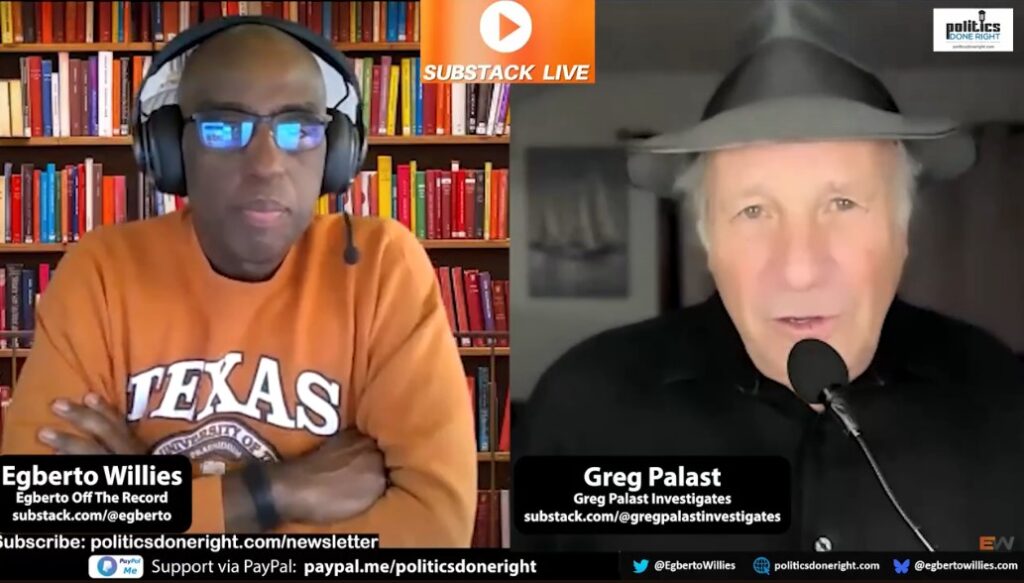
Greg Palast reveals how U.S. sanctions, oil interests, and regime-change politics drove the Venezuela crisis—not democracy or justice.
Greg Palast Exposes Venezuela Oil Lies

Watch Politics Done Right T.V. here.

Podcasts (Video — Audio)
Summary
A reckoning. This conversation strips away propaganda and exposes how U.S. power, oil interests, and political theater converged to destabilize Venezuela under the pretense of justice and democracy. In a forceful exchange, investigative journalist Greg Palast dismantles the official narrative surrounding U.S. actions against Venezuela, arguing that what Washington framed as law enforcement amounted to an act of imperial aggression rooted in oil politics and regime change.
- The U.S. treated Venezuela’s leadership as criminal while ignoring international evidence that contradicts drug-trafficking claims.
- Sanctions and embargoes, not internal policy alone, drove Venezuela’s economic collapse and mass migration.
- Oil—not democracy—motivated Washington’s fixation, despite Venezuela already supplying the U.S. with crude before sanctions.
- The U.S. selectively condemns authoritarianism, embracing allies like Saudi Arabia while vilifying Venezuela.
- Internal U.S. power struggles—among oil companies, political factions, and financiers—shape foreign policy more than human rights.
The real story reveals a familiar pattern: democracy rhetoric masks economic coercion, and Venezuelans pay the price for Washington’s geopolitical games. A progressive foreign policy demands accountability, restraint, and respect for national sovereignty—not kidnappings, embargoes, or corporate plunder.
Premium Content (Complimentary)
The conversation with investigative reporter Greg Palast exposes a truth rarely allowed into mainstream U.S. discourse: Washington’s actions against Venezuela were never about democracy, drugs, or human rights. They were about oil, control, and the maintenance of American imperial power in the Western Hemisphere. The language of “law enforcement” and “restoring democracy” served as cover for what Palast accurately describes as an invasion-by-proxy and a political kidnapping.
Palast speaks from experience, not speculation. He covered Venezuela for institutions like the BBC and The Guardian, reported directly from Caracas, and personally interviewed both Hugo Chávez and Nicolás Maduro. That history matters, because it dismantles the caricature Washington sells to the American public.
The claim that Venezuela functioned as a “narco-state” collapses under scrutiny. Palast points to United Nations drug-trafficking data showing that Venezuela neither produces nor meaningfully traffics narcotics. Major cocaine routes run through the Pacific corridor, not Venezuela’s heavily monitored Caribbean coast. The absurdity of portraying Maduro as a criminal kingpin becomes clear when compared with Washington’s treatment of actual convicted traffickers—figures embraced or pardoned when politically convenient.
Yet even acknowledging Maduro’s authoritarian behavior does not justify foreign kidnapping or regime change. Palast makes a critical distinction: flawed or even stolen elections do not grant foreign powers the right to abduct leaders, seize national assets, or impose economic strangulation. By that standard, U.S. alliances with Saudi Arabia would be indefensible. The selective outrage exposes the hypocrisy at the core of American foreign policy.
Sanctions form the centerpiece of that hypocrisy. The U.S. embargo deliberately crippled Venezuela’s economy, triggering shortages, unemployment, and mass emigration. Washington then blamed Venezuelan leadership for conditions it actively engineered. This mirrors a long Latin American history—from Chile to Nicaragua to Haiti—where economic warfare precedes political condemnation. The suffering of ordinary Venezuelans becomes collateral damage in a strategy designed to force political submission.
Oil remains the through-line. Venezuela possesses the largest proven oil reserves on the planet—greater even than Saudi Arabia. Before sanctions, the U.S. already imported over a million barrels per day from Venezuela. There was no need for confrontation. Ending the embargo would have secured stable supply, lower prices, and mutual benefit. Instead, U.S. policy destroyed Venezuela’s heavy-oil infrastructure, knowing that shutdowns turn pipelines into solid asphalt. That destruction conveniently opened the door for U.S. corporations to “rebuild” what sanctions ruined.
Here the internal contradictions sharpen. Companies like Chevron favor pragmatic engagement, while others, including ExxonMobil, align with hardline regime-change strategies. Overlaying this corporate conflict sits the geopolitical role of OPEC, which depends on state-controlled production. Privatizing Venezuela’s oil would destabilize the cartel and collapse global prices—something even U.S. oil giants fear.
The conversation also exposes the darker financial layer: vulture capital. Hedge funds moved to seize Venezuelan assets like Citgo at fire-sale prices, exploiting sanctions to loot public wealth. When courts intervened, executive power stepped in to freeze proceedings—not out of humanitarian concern, but to preserve leverage over oil negotiations. This is not free-market capitalism; it is state-sanctioned theft.
Ultimately, Palast’s warning cuts deeper than Venezuela. The normalization of kidnapping leaders, strangling economies, and laundering corruption through offshore finance corrodes American democracy itself. When the U.S. claims moral authority abroad while practicing coercion and hypocrisy, it undermines credibility at home. A progressive foreign policy rejects this model. It insists on diplomacy over domination, contracts over coups, and human dignity over corporate greed.
The real story behind Venezuela is not chaos—it is design. And recognizing that design marks the first step toward dismantling it.