


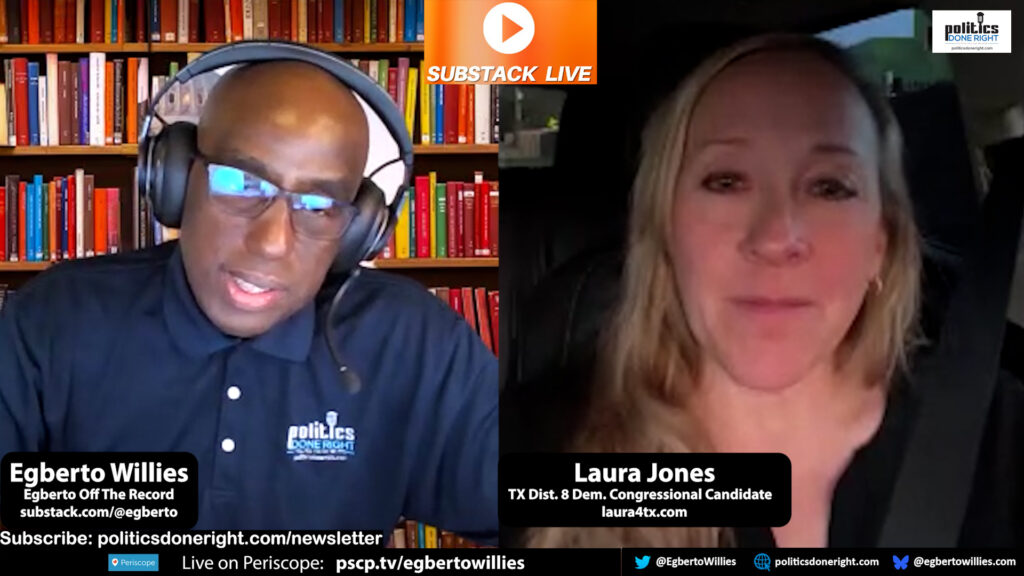
Laura Jones exposes rural neglect and lays out a people-first agenda shaped by her family’s health-care journey. She is the Congresswoman Texas District 8 deserves.
Laura Jones District 8

Watch Politics Done Right T.V. here.

Podcasts (Video — Audio)
Summary
Laura Jones emerges as a grounded, empathetic, working-class candidate whose lived experiences mirror those of the voters she seeks to represent. She speaks with clarity about the systemic neglect rural Texans endure, the cultural barriers that keep voters locked into political identity, and the economic pain created by policies crafted by legislators who have never lived the struggles of ordinary families. Her story—rooted in caregiving, labor, farming, and community—demonstrates why District 8 deserves a representative who understands its people not from afar, but from lived reality.
- Jones exposes the deep resource gaps affecting rural Texans, from healthcare to transportation to education.
- She explains how political identity pressure—not ideology—keeps many rural residents voting against their self-interest.
- Her own family’s healthcare crisis reveals the fragility of the U.S. system and the stakes for working families.
- Her campaign embodies a coalition approach: rural, urban, multiracial, working-class, immigrant, and faith-community voters.
- She argues that ordinary people—not elite political insiders—must reclaim representation to achieve real change.
District 8 sits at a turning point. Jones stands as a candidate shaped not by political privilege but by work, struggle, caregiving, and community. Her narrative shows why electing leaders who share the lived experiences of their constituents strengthens democracy and restores faith in public service. Her candidacy reminds voters that politics should serve people—not the wealthy, not corporations, and not those who have insulated themselves from consequence.
Premium Content (Complimentary)
The conversation with Laura Jones reveals a portrait of political leadership rooted not in performance but in lived truth. Her candidacy for Texas’s 8th Congressional District unfolds as an antidote to a political culture dominated by wealthy career politicians detached from the struggles working families face every day. Her voice rises from a place of experience, not abstraction, and she speaks with the authenticity of someone who has lived both the strain of economic uncertainty and the dignity of community-centered resilience.
Jones describes her journey from bustling Houston to the rural landscape of San Jacinto County, where she witnessed a profound disparity in resources—educational, medical, infrastructural—that stunned her into action. She encountered communities working hard yet receiving little. The absence of healthcare providers, the lack of public transportation, the limited job market, and the neglect from state and federal leadership created a silent crisis she could not ignore. Her advocacy begins with the recognition that countless rural Texans live in conditions shaped not by scarcity of effort but by scarcity of political will. In that realization, she discovered her purpose.
Her reflection on political identity within rural counties exposes a cultural dynamic ignored by mainstream commentary. Many voters agree with Democratic policies but feel trapped by social pressure—church circles, social networks, community traditions—that force them to maintain allegiance to the “red team” regardless of consequences. Her stories of Republicans who admire her, agree with her, even want to vote for her but fear the social cost illustrate a broader truth: vast numbers of rural voters are not ideological extremists; they are hostages to cultural conformity. The progressive movement, she suggests, must recognize this barrier and address it with empathy and strategic outreach rather than cynicism.
Jones’ most compelling argument emerges from her family’s healthcare crisis. Her husband’s sudden stroke at age 49 thrust her into the economic precarity that so many Americans face. Even with hard work and healthy living, a catastrophe can arrive unannounced. She describes the impossible choices—exorbitant insurance premiums, a year-long and continuing wait for disability benefits, the need to drive five hours daily for a job that pays enough to keep the household afloat. Her narrative illustrates what policy reports from the Kaiser Family Foundation and Commonwealth Fund repeatedly confirm: the American health-care system punishes illness with financial ruin, and working families bear the brunt.
Her lived experience gives her an authority that no corporate-funded incumbent can match. She speaks as someone navigating the very systems Congress debates. She understands rural issues because she farms. She understands working people because she has cleaned homes, run small businesses, stood in food pantries, and employed recovering women striving for stability. She understands racial justice because she is the mother of biracial children who face dangers that the political establishment refuses to confront head-on.
What distinguishes Jones is her refusal to silo the district. She recognizes that District 8 is both rural and metropolitan, spanning San Jacinto County to northwest Harris County. Her life bridges those worlds—Houston’s density and ambition, the rural county’s calm and deprivation. She argues that representation must reflect both, and she alone in this race carries the life experience to do so authentically.
Democracy cannot thrive when only the wealthy can afford to serve. District 8 deserves a representative shaped by the realities of labor, caregiving, cultural diversity, and economic struggle. Laura Jones stands not as a symbol but as a lived testimony that ordinary people must take the helm if America hopes to build a fairer and more humane society.