


From fake sedition claims to failed prosecutions and Venezuela escalation, Willies reveals how authoritarianism spreads unchecked.
Trump’s Payback Haunts James & Comey

Watch Politics Done Right T.V. here.

Podcasts (Video — Audio)
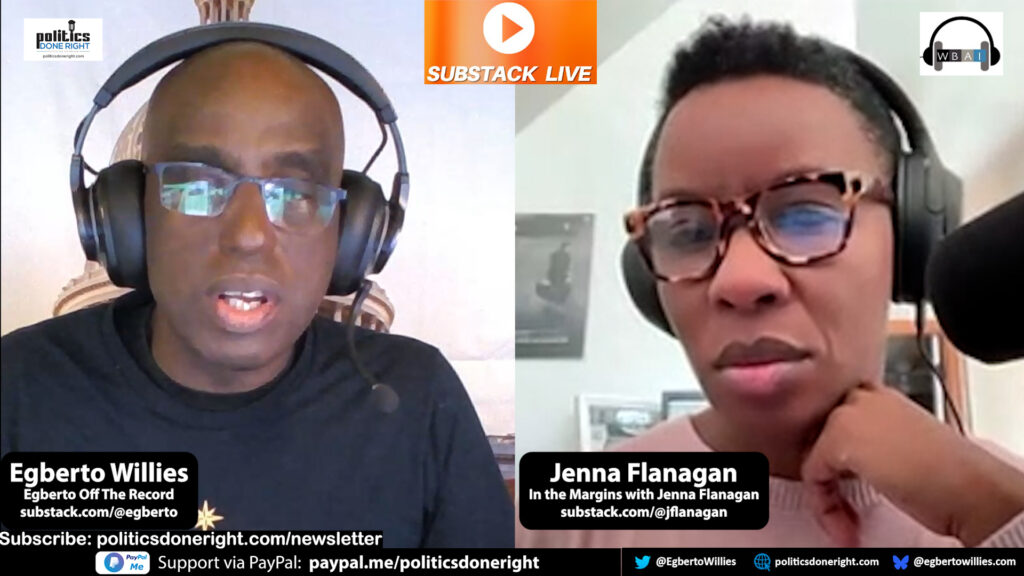
The embedded video contains solely the questions that WBAI’s We Decide’s Jenna Flanagan asked me. The entire panel discussion can be viewed here. We Decide is a joint Pacifica Affiliate WBAI production, and the We Decide: America at the Crossroads with Jenna Flanagan.
Summary
The discussion exposes how authoritarian retaliation, media malpractice, and distorted narratives erode democracy in real time. The segment examines the effort to reopen failed prosecutions against Letitia James and James Comey, showing how political vendettas are being repackaged as legal action. It highlights inconsistencies in claims about Afghan vetting and exposes how misleading narratives—despite being easily disproven—continue to circulate because mainstream media outlets refuse to call them out decisively. The conversation also warns against escalating hostilities toward Venezuela, pointing to the long history of destabilizing U.S. interventions in Latin America.
- Attempts to retry James and Comey reflect political retribution, not legal merit.
- Prosecutors avoid the case because the evidence is nonexistent, including the fabricated “realized gains.”
- Claims about Afghan vetting fail under scrutiny because asylum and radicalization occurred under Trump.
- Lawmakers citing the UCMJ are falsely labeled “seditious,” enabled by media platforms that amplify nonsense.
- Escalating tensions toward Venezuela risk repeating a century of harmful U.S. interventionism.
The segment demonstrates how authoritarian power thrives when bad-faith claims are treated as reasonable debate. Retaliatory prosecutions, attacks on lawful military guidance, and geopolitical saber-rattling form a pattern that undermines democratic norms. Only a vigilant public and a more responsible media ecosystem can prevent these narratives from driving the country deeper into crisis.
Premium Content (Complimentary)
The analysis begins by examining the renewed push to prosecute Letitia James and James Comey, despite a federal judge’s dismissal of the charges. This effort reflects a broader strategy in which political leaders attempt to repurpose the justice system as an instrument of revenge. The move is not grounded in evidence, legal theory, or criminal conduct; it exists almost entirely to intimidate critics and reinforce loyalty. Any legitimate prosecutor understands the dangers of participating in such an abuse of power. The case lacks legal merit, the numbers behind the supposed “realized gains” collapse upon inspection, and the reputational cost of pursuing a manufactured indictment is too high for any ethical professional to bear.
This dynamic reveals how authoritarian impulses seek legitimacy: by coercing institutions into enforcing political goals. When prosecutors refuse to play along, the system holds. When one finally yields, history shows how quickly the rule of law can unravel.
The narrative then shifts to the controversy surrounding Afghan vetting. The attempt to blame the previous administration falls apart immediately when compared with publicly available facts. The individual granted asylum did so under Trump, not Biden. The claim that he was radicalized inside the United States—and during Trump’s term—further undermines any effort to reassign blame. Yet the contradiction persists in political discourse because media outlets treat these assertions as just another perspective rather than deliberate misinformation.
The discussion broadens into a critique of mainstream journalism. When false narratives are allowed to circulate unchallenged, they metastasize. The birther conspiracy is a textbook example. Even after the nation knew the president’s birthplace and citizenship were indisputable, outlets amplified the lie in the name of neutrality and “balance.” The pattern repeats today as six lawmakers who restated the Uniform Code of Military Justice are smeared as seditious. They did nothing more than articulate longstanding military law: no service member must obey an illegal order. That should have ended the controversy immediately. Instead, media platforms revived the claim, rewarding political actors who manufacture outrage.
The consequences extend far beyond misinformed audiences. When propaganda receives legitimacy, authoritarian tendencies grow stronger, and the nation becomes more vulnerable to institutional manipulation. This dynamic threatens domestic stability while also shaping foreign policy in dangerous ways.
The conversation concludes with concerns about escalating tensions toward Venezuela. The United States has a long and often destructive history of interference in Latin America. Economists, historians, and human-rights groups have documented how interventions—whether overt military action or covert destabilization—have repeatedly produced violence, displacement, and political turmoil. Moving toward confrontation once again risks repeating a familiar cycle: undermining regional sovereignty, generating blowback, and reinforcing anti-democratic forces on all sides.
Ultimately, the discussion reveals a coherent pattern. Political retaliation masquerading as prosecution, media amplification of bad-faith narratives, and reckless foreign policy posturing all stem from the same root: a leadership class willing to bend or ignore the truth to consolidate power. Democracies do not collapse overnight; they erode slowly when institutions fail to defend reality itself. The antidote is a public that demands accountability and a media ecosystem willing to reject false equivalence. Without that vigilance, the country drifts toward a more dangerous future.