


Revealed on WBAI: How Trump’s shutdown, nuclear threats, and MAGA fractures expose a failing presidency — and why independent media is key to fighting misinformation.
Trump’s Crumbling Power Exposed

Watch Politics Done Right T.V. here.

Podcasts (Video — Audio)
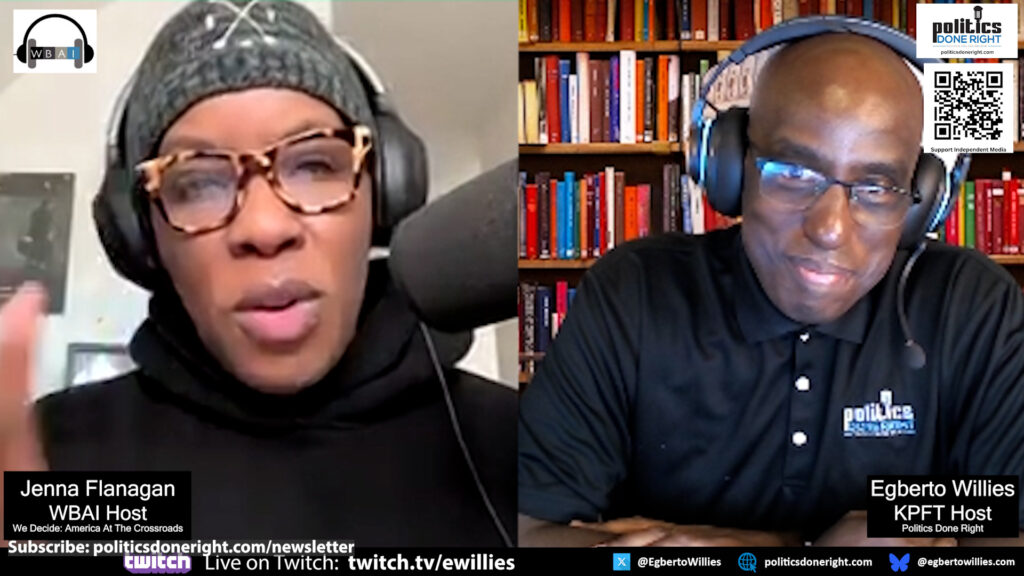
The embedded video contains solely the questions that WBAI’s We Decide’s Jenna Flanagan asked me. The entire panel discussion can be viewed here. We Decide is a joint Pacifica Affiliate WBAI production, and the We Decide: America at the Crossroads with Jenna Flanagan.
Summary
The panel discussion captures a moment when the façade of Trump’s political invincibility begins to fracture. We underscore how the government shutdown, nuclear escalation signals, and cracks within the MAGA base reveal a president failing at the most basic duties of governance. The country is waking up to manipulated narratives and the urgent need for independent media to counter corporate distortion.
- The government shutdown left lasting damage for workers and small businesses that will never be recovered.
- Growing cracks inside the MAGA base reflect voter fatigue and a desire to understand the truth beyond propaganda.
- Trump’s reckless comments about resuming nuclear testing give China political cover to escalate its own operations.
- Billionaire influence, especially from figures like Peter Thiel, shapes the GOP’s future more than its voters do.
- Independent media remains the essential counter to a mainstream press that normalizes Trump’s failures.
Trump’s chaos is not strength but manufactured power backed by billionaires and amplified by a compliant media. Grassroots, fact-based journalism remains the only path to reclaim a democracy captured by oligarchic interests.
The embedded video contains solely the questions that Jenna Flanagan asked me. The entire panel discussion can be viewed here.
Premium Content (Complimentary)
The conversation on WBAI’s We Decide: America at the Crossroads presents a vivid portrait of a nation grappling with the consequences of a presidency marked by chaos, misinformation, and the steady erosion of democratic norms. Throughout the panel discussion, the progressive perspective voiced by the guest commentator highlights how the failures of the Trump administration were not isolated episodes but interconnected crises enabled by a media landscape that was too eager to normalize dysfunction.
Early in the discussion, the commentator stresses that the end of the government shutdown should not be mistaken for recovery. While federal employees eventually received their back pay, the broader economic harm—especially for contract workers, small businesses, and community services—cannot be undone. Restaurants lost weeks of revenue, airport vendors watched their income evaporate, and countless service workers saw their financial stability shattered. Yet this reality was rarely highlighted in corporate media coverage. Instead, the shutdown was treated as a political chess match rather than a human catastrophe inflicted by political extremism.
The panel then turns to the theatrical apology offered by Marjorie Taylor Greene, an apology that corporate outlets treated with earnestness despite her long, documented record of spreading disinformation and endorsing policies that harm working people. Voices on the panel refused to entertain such political rebranding without material proof. For any elected official seeking redemption, the standard must be clear: support for universal basic income, paid family leave, living wages, and policies that uplift families. Without concrete policy commitments, public contrition is nothing more than performance.
From a Texas vantage point, the commentator notes a growing shift within the MAGA base. Callers and voters in conservative regions have begun expressing doubt, frustration, and even feelings of betrayal. For years, they were sold narratives that unraveled under the weight of lived experience. This growing skepticism contradicts the myth—heavily amplified by mainstream media—that Trump’s base is unshakable. In reality, polling has long shown his support hovering at historically low levels. The illusion of invincibility persists only because the corporate press grants him a level of coverage and deference that obscures the fragility of his political position.
The discussion intensifies when the conversation turns to Trump’s declaration that the United States should resume nuclear weapons testing. This reckless announcement, as the commentator explains, created immediate geopolitical consequences. China, long adhering to international disarmament norms, seized the political cover to expand operations at its desert nuclear testing site. Satellite evidence showing new boreholes makes clear that global stability is easily disrupted when U.S. leadership signals disregard for decades of delicate restraint. Trump’s impulsive rhetoric did not merely reflect poor judgment—it produced tangible risks on the world stage.
The panel then widens the lens to explore the billionaire influence behind Trump. The critique emphasizes that power brokers such as Peter Thiel have shaped Republican strategy far more than ordinary voters. Trump’s appeal lies not in his competence but in his malleability. Performative, uninformed, and driven by spectacle, he serves as a vessel for the ambitions of oligarchs who mold the political landscape to their advantage. The moment he ceases to be useful, another figure—such as JD Vance—stands ready to be elevated.
Yet, this is precisely where progressives can prevail. Billionaires wield enormous influence, but they are not invincible. Organized, informed communities can dismantle the fear-based narratives that empower authoritarian movements. The greatest threat to oligarchic control is an engaged public armed with accurate information.
Here is a powerful reminder: corporate media played a central role in creating the very political crisis the nation now confronts. By normalizing extremism, prioritizing spectacle over substance, and failing to challenge disinformation, major outlets have facilitated democratic decay. Only independent, people-funded journalism can restore truth to the civic sphere. Democracy cannot survive without media institutions that are answerable not to shareholders or billionaires, but to the public itself.
We are at a national crossroads—one where the public must choose between a system built to serve concentrated wealth and a democracy rooted in truth, accountability, and shared human dignity.