


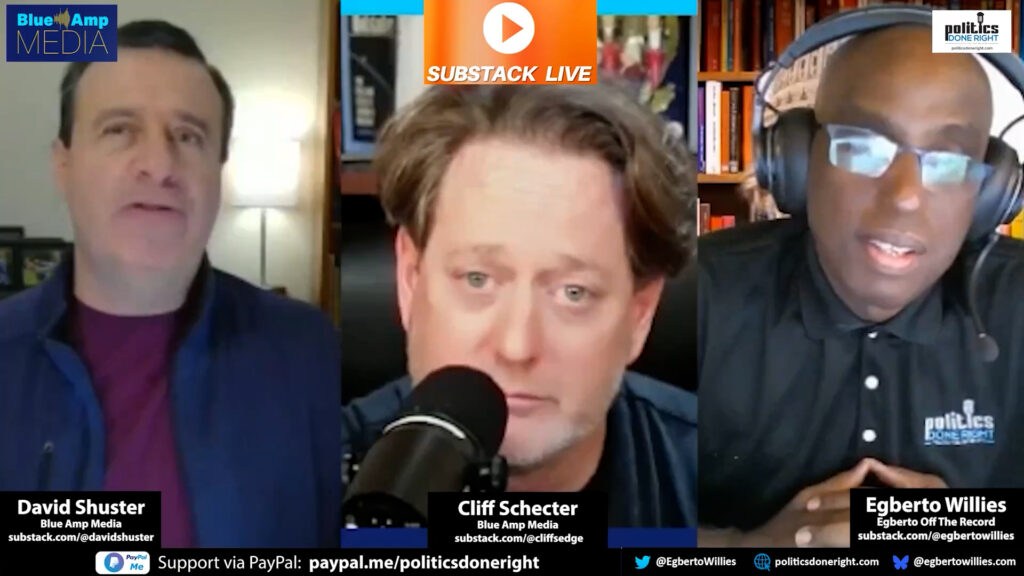
Cliff Schecter, David Shuster, and Egberto Willies dissect the Epstein email frenzy, media collapse, judicial corruption, and the rise of independent progressive media.
Media Failure and Epstein Email Hype Exposed

Watch Politics Done Right T.V. here.

Podcasts (Video — Audio)
Summary
In a far-reaching conversation, Blue Amp Media CEO Cliff Schecter, Emmy Award–winning journalist David Shuster, and Politics Done Right host Egberto Willies unravel the explosive revelations in the Epstein emails, the corporate media’s deepening failures, and the authoritarian rot spreading through American institutions. Their exchange exposes how weakened journalism, right-wing propaganda, and an increasingly corrupt judiciary have converged to endanger democracy itself.
- The hosts argue that the Epstein email frenzy distracts from Trump’s ongoing, documented criminality—acts the media routinely soft-pedals or ignores.
- They highlight how the Supreme Court and judiciary have become captured by extremist ideology, enabling authoritarian overreach.
- They expose how corporate media cutbacks have gutted investigative journalism, replacing expertise with cheap, conflict-driven TV theatrics.
- They emphasize that right-wing propaganda has systematically dehumanized progressives, creating psychological barriers to shared political reality.
- They argue that independent media—such as Substack, YouTube, and podcasts—now carry the torch of democratic accountability that mainstream outlets have abandoned.
For these three seasoned communicators, the path forward requires building independent media ecosystems, confronting disinformation head-on, and reclaiming a democratic narrative rooted in shared humanity rather than fear. Their conversation reminds progressives that the fight for truth is inseparable from the fight for justice—and that collective action remains the most potent antidote to the decay of authoritarianism.
Premium Content (Complimentary)
The conversation between Cliff Schecter, David Shuster, and Egberto Willies unfolds as a sweeping indictment of America’s media ecosystem and the institutional failures that have allowed authoritarianism to metastasize in real time. Together, they dissect the sudden media fixation on the newly released Epstein emails—an obsession driven not by public interest, but by sensationalism—while the ongoing, well-documented criminality of Donald Trump is treated as background noise. The trio of voices understands both the mechanics of media and the political danger of its collapse.
Schecter argues that the nation is operating under a judiciary no longer tethered to constitutional principles but to partisan loyalty. The Supreme Court’s interventions—halting SNAP benefits, granting wide-ranging immunity to the former president, and issuing decisions detached from legal history—serve as glaring signals that the federal bench is no longer a neutral arbiter. Shuster, drawing on years of experience inside mainstream media, explains how newsroom cutbacks and corporate consolidation have hollowed out journalism to the point where substantive accountability is structurally impossible. The erosion is not accidental; it is the result of a media model that prioritizes conflict for ratings over expertise and truth.
Willies brings global and historical context, comparing America’s downward slide to U.S. interventions abroad—such as Panama, Grenada, and others—where selective humanization has long served as a policy. In the current moment, he notes, the United States itself has become a projector of lawlessness, even engaging in extrajudicial killings at sea, acts recognized by the global South even as U.S. media avert their gaze. Their shared concern is apparent: a nation cannot hope to defend democracy when its own institutions perform authoritarianism with impunity.
The trio identifies a fundamental media failure: its inability—and unwillingness—to track Trump’s ongoing violations, from emoluments abuses to the weaponization of federal agencies, to Hatch Act violations, to illegal foreign gifts. Each act is treated as a discrete event, reported once and then forgotten. Schecter suggests that a “running count” of criminality should exist. Yet, corporate media refuse to take such a step because doing so would necessitate declaring the obvious: Trump’s behavior is not normal, and neither are the institutions protecting him.
Shuster details how journalists once tapped the top experts in their fields for foreign policy or economic analysis. Today, networks pull whoever can reach a Midtown studio and generate profitable on-air conflict. This shift was not simply a degradation of quality—it was a transformation of journalism into infotainment. When conflict replaces context, misinformation becomes inevitable.
The conversation turns toward a solution rooted in independent media. Substack, YouTube, podcasts, and grassroots journalism have become the last refuge for unfiltered truth-telling. These platforms enable progressives to bypass corporate control, allowing them to reach audiences directly with reporting, context, and moral clarity. But we must ensure they maintain some level of neutrality. Schecter notes that what once required enormous funding—email infrastructure, broadcast distribution, editorial control—can now be done at a fraction of the cost. The barriers to entry have fallen, opening the door for a new generation of democratic storytellers.
Yet they also acknowledge a darker possibility: that elements of both parties prefer a weakened progressive infrastructure, fearing that an empowered working-class majority would disrupt corporate influence. Still, the guests argue that current failures may be a turning point. The government shutdown debacle, for instance, did more than harm the vulnerable; it intensified the demand within the Democratic base for leadership that fights unapologetically for justice.
Ultimately, the conversation is not just about Epstein’s emails or the media collapse—it is about reclaiming democracy’s moral center. It is a call to build new institutions, confront disinformation, engage communities across divides, and never forget who benefits when the press fails to do its job. Their shared message rings clear: independent media is no longer an option; it is a democratic necessity. Only through collective, progressive advocacy can truth break through the cacophony of propaganda and help rebuild a nation drifting dangerously off course.