


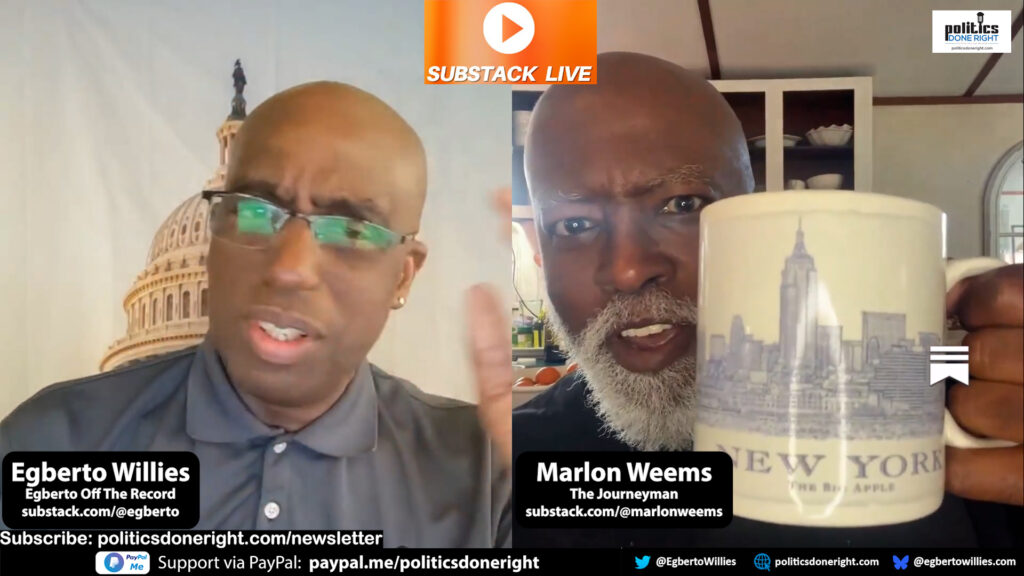
Marlon Weems and Egberto Willies unpack how progressive organizing, youth turnout, and Trump’s chaos delivered a stunning Democratic landslide.
Inside the Democratic Landslide

Watch Politics Done Right T.V. here.

Podcasts (Video — Audio)
Summary
In their post-election discussion, Marlon Weems and Egberto Willies dissect the Democrats’ sweeping victories across the nation. They credit grassroots organizing, the youth vote, and working-class engagement for this “Democratic landslide,” while underscoring how Donald Trump’s erratic behavior alienated moderates and independents. The conversation highlights how movements like the No Kings protests and local engagement turned protest energy into voter turnout. Both commentators, however, warn that Democrats must not rely on Trump’s failures but must build a lasting, progressive coalition rooted in working-class and multiracial solidarity.
- The Democrats’ victories defied polling expectations, with landslide margins in New Jersey, Virginia, and New York.
- Trump’s own political recklessness—tariffs, social division, and cruelty toward the poor—helped repel voters across ideological lines.
- The No Kings Protests and community-driven mobilizations demonstrated how protest movements can translate into electoral power.
- Young and first-time voters, who pollsters had long overlooked, turned out in record numbers, particularly motivated by economic and social justice issues.
- Egberto and Marlon insist Democrats must now lead with bold, progressive policies rather than rely on the right’s self-destruction.
The conversation celebrates a turning point: democracy, once on the ropes, struck back through organized activism and grassroots determination. Weems and Willies emphasize that progressive politics works when grounded in community needs—such as affordable housing, fair wages, and access to healthcare. They reject neoliberal complacency and argue that the Democratic Party’s future lies in authentically representing the working class, not catering to corporate donors or triangulating to the center.
Premium Content (Complimentary)
The conversation between Marlon Weems and Egberto Willies captures a rare moment of triumph for democracy’s defenders. The 2025 Democratic landslide—spanning from New York to Virginia to California—defied every poll and pundit prediction in scope. It was not just a partisan victory; it was the culmination of years of struggle by ordinary people who had grown weary of corruption, division, and economic precarity.
Weems, publisher of “The Journeyman,” newsletter, and Willies, the publisher of “Egberto Off The Record,” newsletter, frame the election as a vindication of grassroots politics. They note that the so-called “unlikely voters”—the young, disillusioned, and economically strained—showed up in droves. The establishment, addicted to outdated polling models that assume civic disengagement, missed the groundswell forming beneath their feet.
The two discuss how movements like the No Kings March—a protest that began as local resistance and grew into a national outcry—sparked civic reawakening. What started as moral outrage at creeping authoritarianism evolved into a disciplined, electoral machine capable of turning mass demonstrations into mass participation. Over ten million people ultimately joined the movement, proving that civic energy could translate into ballots, not just banners.
Trump’s own implosion, as Weems quips, “gave Democrats a favor.” His administration’s cruelty—banning food discounts for SNAP recipients, escalating tariffs that crushed farmers, and dismantling anti-poverty programs—pushed even loyal conservatives to the brink. The irony, Weems and Willies agree, is that red-state Americans suffered the most from the very policies they had been manipulated into supporting. Their conversation exposes the cognitive dissonance of voters who cling to cultural grievances while losing their livelihoods to oligarchic policy.
But Willies refuses to let Democrats rest on schadenfreude. The left cannot define itself merely as the antithesis of Trumpism. Real change, he insists, requires building an economy and democracy for working people. The model is not the centrist triangulation of Bill Clinton or the managerial moderation of establishment Democrats; it is the bold populism of organizers like Zohran Mamdani, who flipped a one-percent margin into a 51-percent mandate by addressing issues such as housing affordability, food deserts, and wage justice.
Their dialogue also situates this resurgence in historical context. Just as Barack Obama once electrified young voters, new progressive leaders are rekindling that sense of purpose. Weems recounts his daughter’s emotional reaction—“I just got a chill”—while watching a new generation of politicians speak with conviction about fairness and hope. That emotional connection, the hosts argue, is what moves voters, not poll-tested rhetoric or corporate money.
Yet they caution that the establishment is already misreading the moment. Corporate Democrats, desperate to reassert control, are trying to frame centrists like Abigail Spanberger as presidential templates. But as Willies notes, “They are not the template.” The path forward runs through the multiracial, working-class coalition forged by organizers, not donors.
The duo mocked Fox News’ alternate reality coverage, which framed redistricting and democratic gains as illegitimate. This epistemic divide, they argue, fuels misinformation and alienation—but the antidote remains civic engagement, grounded journalism, and progressive persistence.
Ultimately, the conversation is both analysis and manifesto. It affirms that democracy’s survival hinges not on charisma or chaos, but on everyday people organizing for justice. In this moment of reckoning, progressives are reminded that victory is not a finish line—it is a responsibility that must be fulfilled.