


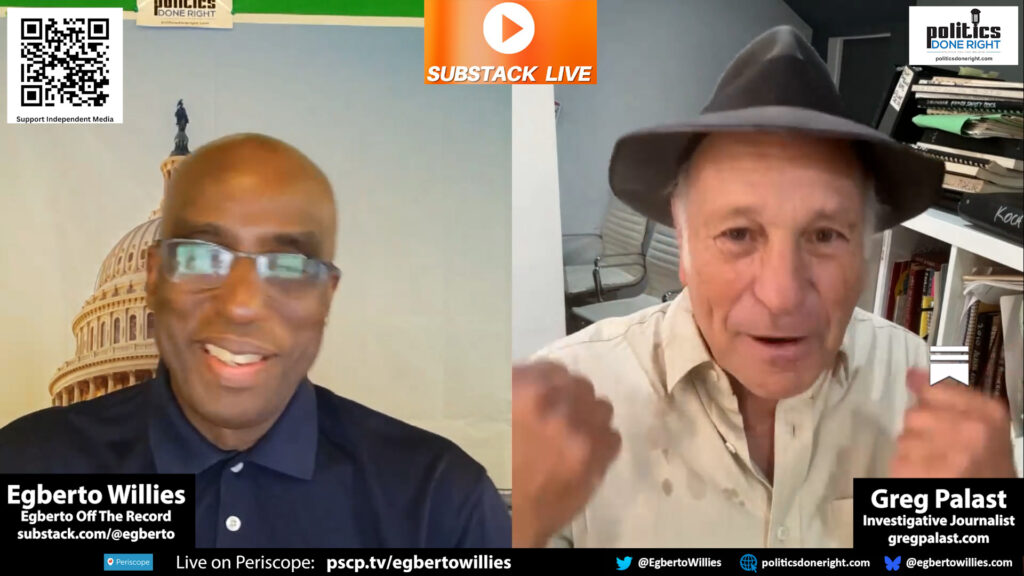
Greg Palast warns of RFK Jr.’s troubling Trump alliance and the rise of modern voter suppression. Independent media reveals what mainstream outlets won’t about the fight for democracy.
Greg Palast talks JFK Jr.

Watch Politics Done Right T.V. here.

Podcasts (Video — Audio)
Summary
In a substantive conversation, investigative journalist Greg Palast joins Egberto Willies on Politics Done Right to discuss his explosive article, “I Was on the Phone with RFK Jr. When He Lost His Mind.” Palast recounts his past partnership with Robert F. Kennedy Jr. and his deep concern over Kennedy’s transformation into a figure promoting dangerous anti-vaccine rhetoric and aligning with Donald Trump. The discussion expands to expose voter suppression tactics rooted in Ku Klux Klan-era methods, now digitized and weaponized against people of color, threatening democracy ahead of the 2024 election. Palast’s film Vigilantes, Inc. reveals these threats in detail.
- Greg Palast warns about RFK Jr.’s mental decline and his shift toward policies endangering public health, including stopping vital mRNA research.
- RFK Jr.’s alignment with Donald Trump undermines his past progressive advocacy, particularly in the area of environmental protection.
- Palast exposes voter suppression tactics modernized through digital “vigilante” operations targeting voters of color, especially in Georgia and Florida.
- Over 4.7 million voters were purged from the rolls before 2024, with 66% of removals being erroneous.
- Independent media is crucial to fight misinformation, as corporate media has acquiesced mainly to Trump’s narrative.
This conversation highlights a terrifying convergence of authoritarianism and corporate manipulation. RFK Jr.’s betrayal of his legacy reflects how trauma and opportunism can corrode even the most progressive champions. Meanwhile, Trump’s embrace of voter suppression through groups like Charlie Kirk’s network represents a direct assault on democracy. Independent media must rise to fill the void left by mainstream outlets that have chosen compliance over truth.
Premium Content (Complimentary)
Greg Palast’s conversation with Egberto Willies serves as both a warning and a call to action for anyone who values democracy and the pursuit of truth. Palast, a veteran investigative journalist known for uncovering corporate and political corruption, begins by recounting his long and close relationship with Robert F. Kennedy Jr. The two once collaborated on progressive causes, including voting rights and environmental protection. Kennedy was once a fierce advocate for clean energy and public health, a legal scholar who fought to protect the environment from corporate polluters.
But as Palast describes in his deeply personal account, something changed. Kennedy, who endured a lifetime of trauma — from witnessing his father’s assassination to the tragic suicide of his wife — began to exhibit alarming mental instability. A shocking revelation later confirmed that RFK Jr. had a live parasite in his brain, but Palast argues that trauma alone does not excuse his recent actions. Today, Kennedy has become a central figure in the anti-vaccine movement, spreading dangerous misinformation that has cost lives. Most disturbingly, he abruptly halted critical mRNA research that had the potential to unlock cancer vaccines and other groundbreaking treatments. By doing so, Kennedy has endangered not only public health but also the lives of millions who depend on scientific progress.
Kennedy’s political alignment with Donald Trump represents a complete betrayal of his former values. Trump, who has systematically dismantled environmental protections and waged war on climate science, stands in direct opposition to everything Kennedy once championed. Yet Kennedy now stands beside Trump, endorsing policies that would accelerate global warming and strip away basic health protections. This alignment is not just hypocrisy; it is a sign of how deeply authoritarian forces have co-opted figures once seen as progressive.
Palast’s investigative work goes beyond Kennedy’s troubling personal transformation. In his new documentary, Vigilantes, Inc., he exposes a chilling strategy to suppress the votes of millions of Americans, particularly voters of color. The film traces these tactics back to the Ku Klux Klan, which in 1946 launched campaigns to challenge Black voters at polling places. Today, these same methods have been digitized. Trump-aligned groups, including organizations tied to right-wing activist Charlie Kirk, are using sophisticated databases to challenge the eligibility of millions of voters.
Palast recounts the story of Major Gamaliel Turner, a Black military officer stationed in California whose ballot was denied in Georgia because he had been falsely challenged. Turner would have had to travel 2,500 miles to prove his right to vote. This was not an isolated incident: over 4.7 million voters were purged before the 2024 election, with Palast’s team finding that two-thirds of those removals were wrong. This kind of systemic disenfranchisement could swing entire states — and thus the presidency — by silencing marginalized communities.
The conversation concludes with a stark warning: mainstream media has failed to confront these threats. Instead, they have normalized Trump’s authoritarian tactics, leaving independent media as the last line of defense. As Palast and Willies emphasize, the fight to preserve democracy requires active resistance. Voters must check their registration status at vote.org, support independent journalism, and reject the culture of silence that allows fascism to grow unchecked.
Kennedy’s descent into Trumpism is a tragic personal story, but the broader threat is systemic. Palast’s work reminds us that democracy is not self-sustaining. It requires vigilance, truth-telling, and an unwavering commitment to justice. If Americans do not confront these forces now, they risk losing the very foundation of their republic.