


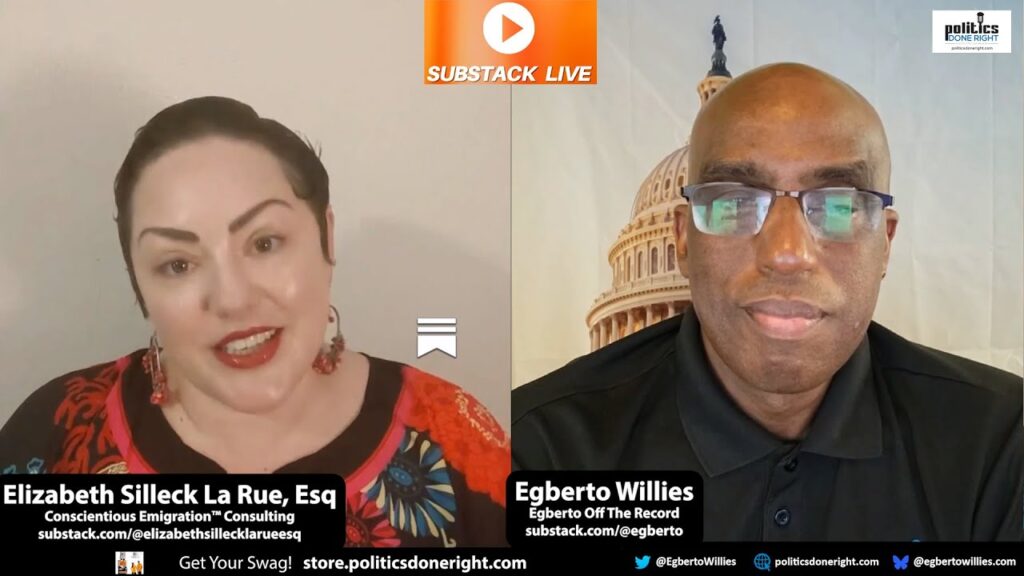
Elizabeth Silleck La Rue, Esq. joins Egberto Off The Record to discuss influencers, Substacking, politics, and more.
Elizabeth Silleck La Rue, Esq.

Watch Politics Done Right T.V. here.

Podcasts (Video — Audio)
Summary
The conversation between Elizabeth Silleck La Rue, Esq. and Egberto Willies centers on accountability in the influencer economy, the ethics of anonymity, “astroturfed” messaging, and the material consequences of gentrification—both in U.S. disaster zones and in popular expat destinations like Mexico City. Elizabeth argues that progressive audiences should support transparent creators who publish under their real names, disclose conflicts of interest, and ground their claims in lived expertise and verifiable evidence.
Five key points:
- Anonymity vs. expertise: Anonymous “experts” profit without accountability; real-name creators assume personal risk and should be prioritized by audiences.
- Astroturfing & pay-for-message: Opaque funding pipelines—from think tanks to “independent” influencers—manufacture consent; disclosure and due diligence are essential.
- Disaster gentrification is real: Capital flows chase catastrophe, displacing working-class and Black/Brown communities after storms and fires; policy must protect locals first.
- Expat influxes raise rents: Remote workers and U.S. earners can price out residents in Mexico City and beyond; ethical immigration requires cultural integration and anti-gentrification practices.
- Narrative warfare matters: Right-wing efforts like “Project 2025” and selective mass-shooting narratives thrive in opaque media ecosystems; progressive media must answer with facts and context.
Egberto frames a simple ethic: fund transparent people, not faceless pipelines. Elizabeth underscores that solidarity means refusing grifts—whether corporate astroturf or avatar “experts”—and choosing media that defends rights, communities, and truth over clicks.
Premium Content (Complimentary)
The exchange between Elizabeth Silleck La Rue, Esq. and Egberto Willies positions accountability as the beating heart of democratic media. He invited Elizabeth to dissect how influence, anonymity, and capital collide on platforms like Substack and TikTok, and she answered with the clarity of a lawyer and the memory of a long-time environmental advocate. Their shared thesis is direct: in an era of monetized outrage and algorithmic fog, the public should reward transparent communicators who show their faces, stake their reputations, and tell the unvarnished truth.
She traces the problem to a familiar industrial tactic: astroturfing—synthetic “grassroots” operations that hide funders to simulate public support. That tactic, long used in corporate and political campaigns, now merges with the creator economy, where avatar accounts, payrolled “explainers,” and shadow-funded initiatives can drown out independent reporting. The remedy begins with public literacy: learn to spot the tells (generic “coalition” names, slick sites, prefab scripts), demand disclosure, and follow the money.
Their conversation then widens from narrative ethics to material politics. Elizabeth maps a through-line from climate disaster to gentrification: when fires or storms devastate neighborhoods, outside capital snaps up land as residents—disproportionately low-income and Black or Latino—struggle to return. Researchers call this “hazard gentrification,” a pressure cooker where speculative redevelopment, tightened insurance markets, and updated codes combine to push locals out and welcome wealth in. Policy can blunt the harm: target aid to the lowest-income households, finance code-gap rebuilding, and center community voices in zoning and recovery. Egberto agreed—and highlighted how mainstream coverage rarely follows up on these structural stories once the cameras leave.
From U.S. disaster zones, La Rue shifts to cross-border ethics. The expat “value arbitrage” that accompanies remote work can inflate rents and transform neighborhoods, particularly foreign cities, opening the doors to wealthier nations. Studies now document significant affordability pressures and spatial segregation linked to these flows. Her work counsels conscientious immigration: learn the language, integrate culturally, avoid enclave consumption, and resist the “cheap land, big footprint” impulse that clears forests for condos and Airbnbs. Egberto adds that solidarity means understanding exchange-rate privilege—and choosing practices that don’t reproduce colonial dynamics.
Media narratives, they argue, shape whether communities can even see these dynamics. He points to the asymmetry of attention: mass shootings receive sensational coverage when they fit pre-loaded frames, but ignore the consistent facts that undercut scapegoating. Data show the vast majority of mass shooters are cisgender men; fixating on rare exceptions to wage culture war obscures the policy levers that save lives—background checks, waiting periods, and limits on high-capacity magazines. Progressive media’s duty is to center evidence over spectacle and refuse the bait.
The conversation also reveals the authoritarian project lurking behind the fog: “Project 2025,” a Heritage-led blueprint that concentrates executive power, guts the civil service, and hard-wires reactionary social policy. Civil liberties groups warn that such programs would erode rights and entrench minority rule. Opaque influencer networks can “normalize” these designs by laundering their talking points through seemingly independent feeds. The counterstrategy is movement media with transparent funding, rigorous sourcing, and community accountability.
Ultimately, La Rue and Willies converge on a practical map for audiences and creators alike:
- Follow transparency. Reward creators who publish under their own names, disclose any conflicts of interest, and provide receipts.
- Interrogate funding. If a channel can’t or won’t explain its backers, treat it as advertising.
- Center the material. Track how policies and capital move land, rents, wages, and rights—not just headlines.
- Practice solidarity. Whether rebuilding after a fire or relocating abroad, choose actions that reduce displacement and respect local cultures.
- Invest in independent media. Small-dollar subscriptions are a civic act—defenses against captured institutions and algorithmic noise.
Egberto insists that people power beats plutocracy when audiences become co-producers of public knowledge—supporting work that is accountable, verifiable, and rooted in community. Elizabeth underscores that ethics is not a luxury: it is the scaffold of trust that movements need to win durable change. Together, they argue for a progressive media commons where truth has a name, sources have links, and solidarity has consequences.