


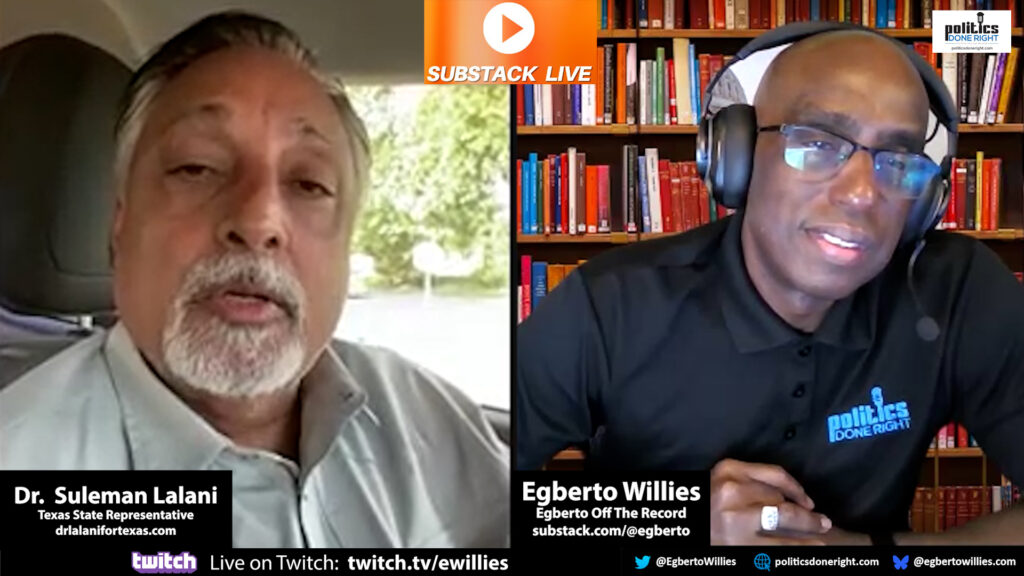
Texas Democratic State Rep. Suleman Lalani, a Sugar Land doctor, says that Texas Democrats will use all necessary means to fight redistricting and protect Texans.
Rep. Suleman Lalani on Democrats fighting redistricting.

Watch Politics Done Right T.V. here.

Podcasts (Video — Audio)
Summary
State Representative Suleman Lalani demonstrates the kind of progressive leadership Texas desperately needs as he stands against manufactured crises and fights for working families. The first Muslim legislator from Fort Bend County brings his medical expertise to bear on critical healthcare access issues while positioning himself at the forefront of Democratic resistance to Republican gerrymandering schemes. Lalani exposes the GOP’s cynical redistricting gambit as nothing more than an attempt to rig elections when they fear losing power, while simultaneously advocating for practical solutions to Texas’s systemic healthcare failures and disaster preparedness shortcomings.
- Redistricting represents a manufactured crisis designed to disenfranchise minority communities – Lalani correctly identifies the special session’s redistricting focus as Trump-driven voter suppression targeting Black and brown constituencies, with even Republicans privately opposing the unnecessary power grab
- Texas’s refusal to expand Medicaid continues killing Texans – The state’s ideological opposition to accepting federal healthcare dollars demonstrates penny-wise, pound-foolish governance that prioritizes politics over human lives, leaving 617,000 Texans in a coverage gap
- Climate disasters reveal Republican incompetence and misplaced priorities – From grid failures during winter storms to devastating floods, Texas leadership consistently fails to prioritize disaster preparedness while wasting time on divisive political theater
- Healthcare access transcends partisan politics – Lalani’s medical practice serves teachers, firefighters, and workers of all backgrounds, proving that disease doesn’t discriminate based on political affiliation or economic status
- Democratic unity and resistance tactics are essential – The progressive caucus stands ready to use all available tools, including quorum breaks, to prevent the erosion of voting rights and democratic representation
Representative Lalani embodies the pragmatic progressivism that could transform Texas politics if given the chance. His medical background provides credibility when discussing healthcare policy, while his immigrant story and position as the first Muslim legislator from Fort Bend County positions him as a powerful voice for inclusion and representation. The interview reveals a politician unafraid to call out Republican hypocrisy while offering concrete solutions to real problems affecting working families.
Premium Content (Complimentary)
In the sweltering heat of a Texas summer, while families across the state struggle with rising costs and climate disasters, Republican legislators have chosen to prioritize partisan power grabs over people’s lives. State Representative Suleman Lalani’s recent appearance on Politics and Right illuminates both the cynical nature of the GOP’s redistricting scheme and the progressive alternative that Democrats offer to Texas voters.
Lalani pulls no punches in describing the special session’s redistricting effort as exactly what it represents: a “manufactured crisis” designed to “steal the minority representation.” The proposed Texas map targets a number of districts currently held by Democrats, including two that stretch into the Rio Grande Valley in the south of the state and two in the Dallas-Fort Worth area. This represents nothing less than an attempt to rig the electoral system when Republicans fear losing power through legitimate democratic processes.
The timing reveals everything about Republican motivations. As Lalani astutely observes, this redistricting push comes directly from Trump’s declining poll numbers and growing fears about 2026 midterm elections. Democrats have few options to stop redistricting through conventional legislative means, but Lalani demonstrates the kind of principled resistance that progressives demand from their representatives. The fact that Republican legislators privately oppose the redistricting while publicly supporting it exposes the cowardice and political calculation driving this assault on voting rights.
What makes Lalani’s perspective particularly compelling comes from his unique position as both a medical professional and the first Muslim member of the Texas legislature from Fort Bend County. His immigrant story – arriving in the early 1990s to begin his medical career – represents the American dream that Republicans claim to support while simultaneously working to disenfranchise communities like his. As a founding member of the AAPI caucus, Lalani understands firsthand how redistricting targets communities of color for political elimination.
The healthcare crisis that Lalani describes represents another area where Republican ideology literally kills Texans. Of the 1.2 million Texans who could be covered under expansion, around 617,000 people are in a coverage gap, making too much to qualify for Medicaid but not enough to afford government-subsidized insurance in the ACA Marketplace. This coverage gap exists entirely due to Republican refusal to accept federal funding for Medicaid expansion – a decision that Lalani correctly characterizes as “penny-wise and bound foolish.”
The human cost of this ideological obstinacy becomes clear through Lalani’s medical practice stories. Teachers with fifty years of service cannot afford their diabetes medications. Patients with manageable conditions develop life-threatening complications due to lack of access. Emergency rooms become the most expensive form of primary care, with costs ultimately passed on to everyone. Texas is one of the only remaining states that has not passed Medicaid expansion, which would expand eligibility for Medicaid health insurance to include cashiers, waiters, housecleaners, and other uninsured adults under the poverty line.
Progressive healthcare policy recognizes what Lalani advocates: prevention costs far less than treatment of advanced disease. His proposal for a legislative committee to study healthcare access represents the kind of evidence-based policymaking that Republicans consistently reject in favor of ideological purity. The fact that diabetes affects people regardless of their political affiliation, race, or religion demonstrates why healthcare should be treated as a human right rather than a market commodity.
Climate disasters provide another lens through which to examine Republican governance failures. Lalani connects the dots between inadequate disaster preparedness, grid failures during winter storms, and the current flooding crisis. His specific focus on vulnerable populations – seniors in assisted living facilities losing power for life-sustaining equipment, diabetics unable to access insulin, dementia patients experiencing increased anxiety and paranoia – reveals the human cost of Republican priorities.
The flood response exposes the fundamental contradiction in Republican governance philosophy. While Republicans claim to support local control, major river systems like the Guadalupe River cross multiple jurisdictions and require state-level coordination. Lalani’s bill addressing youth camp emergency preparedness (HB 174) represents exactly the kind of practical, life-saving legislation that should be prioritized over partisan redistricting schemes.
What emerges from Lalani’s interview is a vision of progressive governance that puts people first. His approach to constituent services – declaring himself open for “adoption” by anyone seeking help regardless of district boundaries – reflects a commitment to collective welfare over narrow political calculation. This stands in stark contrast to Republican gerrymandering designed to insulate legislators from accountability to diverse constituencies.
The resistance strategy that Lalani endorses demonstrates progressive commitment to using every available tool to protect democracy. Democrats are in favor of taking the politics out of redistricting through a national system, but until such reforms are possible, tactical resistance becomes necessary. The willingness to consider quorum breaks reflects understanding that extraordinary circumstances require extraordinary responses.
Lalani’s call for “unprecedented leadership” that can “talk truth to power” articulates the progressive vision for political transformation. This leadership must be “fearless” in confronting entrenched interests, “compassionate” in addressing human suffering, and “honest” about the stakes involved in current political battles. The alternative – continued Republican dominance based on voter suppression and ideological extremism – threatens both democratic governance and human welfare.
The broader implications extend beyond Texas boundaries. Lalani correctly identifies the redistricting fight as having national significance, with other states watching Texas’s response to determine their own strategies. Progressive resistance in Texas therefore serves progressive interests nationwide, while Republican success emboldens similar attacks on democracy across the country.
For progressive activists and voters, Lalani’s message emphasizes the importance of sustained engagement beyond electoral cycles. Advocacy requires persistent pressure on elected officials, consistent attendance at hearings, and ongoing accountability demands. The success of his senior living facility backup power bill only after sustained pressure demonstrates how organized activism can overcome initial resistance.
The path forward requires recognizing that competence in governance is not a partisan issue, even when one party consistently demonstrates incompetence. Lalani’s examples of grid failures, flood damage, and environmental contamination reveal a pattern of Republican governance that prioritizes ideology over effectiveness. Progressive alternatives offer evidence-based policy making, investment in infrastructure and public health, and commitment to protecting vulnerable populations.
Representative Suleman Lalani’s interview reveals both the stakes of current political battles and the progressive vision that could transform Texas governance. His combination of professional expertise, personal experience with immigration and healthcare, and principled commitment to democratic values provides a model for progressive leadership across the state. The choice facing Texas voters becomes clear: continue accepting Republican manufactured crises and governance failures, or embrace progressive alternatives that prioritize people over politics, competence over ideology, and democracy over power grabs.
The redistricting fight may represent just the beginning of broader assaults on democratic governance, but Lalani’s resistance demonstrates that progressives will not surrender without a fight. The question remains whether Texas voters will support representatives willing to stand up for their interests, or continue enabling a Republican party that views democracy itself as an obstacle to maintaining power.