


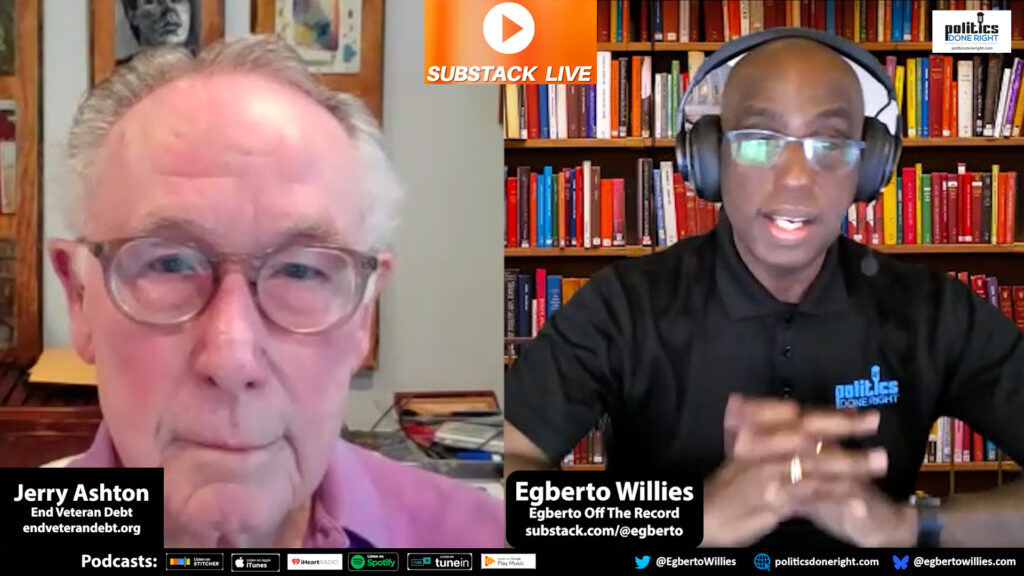
Jerry Ashton, founder of End Veteran Debt, a Navy veteran, and co-founder of RIP, which cleared $12 billion in debt, discusses the state of veteran debt and how his 501c3 helps.
Jerry Ashton, End Veteran Debt founder

Watch Politics Done Right T.V. here.

Podcasts (Video — Audio)
Summary
Jerry Ashton exemplifies how individuals can transform industries from within, evolving from debt collector to debt forgiver and exposing the predatory systems that exploit America’s most vulnerable populations. Through his organizations RIP Medical Debt (now Undue Medical Debt) and End Veteran Debt, Ashton has abolished over $20 billion in medical debt for more than 10 million Americans while pioneering a model that demonstrates how grassroots activism can address systemic economic injustices. His work reveals the hidden mechanics of the debt-buying industry, where medical and consumer debt trades for pennies on the dollar, creating opportunities for both predatory collection and charitable forgiveness.
- Whistleblowing as Social Justice: Ashton transforms insider knowledge from decades in debt collection into a powerful tool for exposing predatory practices, demonstrating how industry expertise can serve public interest rather than corporate profit.
- Veterans Face Systemic Financial Exploitation: The VA has refused to pay $6 billion in veteran medical bills over recent years, forcing service members into debt for healthcare that should be service-connected, while predatory lenders specifically target military communities.
- Debt Relief as Suicide Prevention: Ashton’s work directly addresses debt as a social determinant of suicidal ideation, with every dollar of forgiven debt representing potential lives saved and families kept intact.
- Hidden Debt Market Mechanics: The debt-buying industry purchases uncollectible medical and consumer debt for as little as one penny per dollar, creating a secondary market that few Americans understand but that significantly impacts their financial lives.
- Scalable Model for Change: End Veteran Debt’s approach of raising $50,000 to eliminate $1 million in veteran debt while supporting local veteran services demonstrates how strategic partnerships can maximize impact through both national debt forgiveness and community-level support.
Ashton’s transformation from debt collector to debt forgiver represents more than personal redemption—it embodies a fundamental challenge to the extractive capitalism that commodifies human suffering. His journey began at Occupy Wall Street, where he encountered a movement that named the systemic inequalities he had witnessed firsthand in the debt collection industry. This convergence of insider knowledge and grassroots activism created a powerful force for economic justice that has since evolved into a sophisticated operation capable of leveraging market mechanisms against themselves.
Premium Content (Complimentary)
Jerry Ashton’s evolution from debt collector to debt forgiver represents one of the most compelling examples of how individual conscience can challenge and ultimately transform predatory economic systems. His work through RIP Medical Debt and End Veteran Debt exposes the brutal mathematics of American healthcare and veteran services: institutions that should protect the vulnerable instead systematically exploit them through debt mechanisms that prioritize profit over human dignity.
The scale of Ashton’s impact—$20 billion in forgiven medical debt affecting over 10 million Americans—illuminates the staggering scope of medical debt crisis in America. Yet these numbers, impressive as they are, represent merely the visible portion of a much larger systemic failure. When Ashton reveals that the Veterans Administration has refused to pay $6 billion in medical bills that should rightfully be covered as service-connected care, he exposes how even institutions specifically designed to support veterans instead become mechanisms of their financial exploitation.
Ashton’s insider knowledge of the debt-buying industry provides crucial insight into how American capitalism transforms human suffering into commodity. The revelation that medical debt trades for as little as one penny per dollar demonstrates how hospitals and healthcare systems have essentially written off these debts—they have already received tax benefits for these losses, making the continued harassment of patients purely extractive. This system creates what Ashton identifies as a form of double exploitation: patients pay once through their illness and suffering, then pay again through years of financial harassment for care they often could not afford to refuse.
The targeting of veterans by predatory lenders reveals another layer of systemic exploitation that Ashton’s work addresses. Veterans, transitioning from military service to civilian life, often lack the financial literacy and support systems necessary to navigate predatory lending practices. The clustering of high-interest car lots and payday loan operations around military bases represents a deliberate strategy to exploit service members’ financial vulnerability during crucial transition periods. Ashton’s recognition that “debt is a social determinant of suicidal ideation” connects this financial exploitation directly to the veteran suicide crisis, making debt forgiveness literally a matter of life and death.
The innovative funding model that Ashton has developed through End Veteran Debt demonstrates how progressive organizing can leverage existing market mechanisms for social justice purposes. By raising $50,000 to eliminate $1 million in veteran debt while simultaneously supporting local veteran services, the organization creates multiple layers of impact. This approach recognizes that debt forgiveness alone, while crucial, must be coupled with broader support systems that address the underlying conditions that create financial vulnerability.
Ashton’s emphasis on whistleblowing and independent journalism reflects a deeper understanding of how information asymmetries maintain exploitative systems. His revelation that only 2% of newsroom staff are veterans, despite veterans comprising 6% of the population, highlights how mainstream media systematically excludes the voices and perspectives of those most affected by policy decisions around military service and veteran affairs. The development of “Now Hear This” as a platform for independent journalists represents an attempt to create alternative information infrastructure that can challenge the corporate media’s narrative control.
The partnership between End Veteran Debt and Craig Antico’s Forgive Co. demonstrates how former industry insiders can repurpose their expertise for social good. This collaboration leverages decades of experience in debt markets to maximize the impact of charitable donations, turning every donated dollar into five dollars of debt relief. This approach doesn’t simply treat the symptoms of predatory debt—it actively undermines the business model that makes such predation profitable.
Ashton’s work also reveals the psychological dimensions of debt trauma that extend far beyond immediate financial impact. The recognition that debt functions as a “social determinant” of suicide connects individual financial stress to broader patterns of social isolation, shame, and despair that characterize American economic inequality. By addressing debt not merely as a financial issue but as a public health crisis, Ashton’s approach anticipates more comprehensive solutions that treat financial wellness as inseparable from mental health and community wellbeing.
The deliberate targeting of veteran communities by predatory lenders represents a particularly cruel irony in American society—those who have sacrificed most for their country become prime targets for financial exploitation upon their return. Ashton’s documentation of this pattern exposes how the rhetoric of “supporting our troops” often masks policies and practices that systematically disadvantage veterans in civilian life. The $6 billion in unpaid VA medical bills represents a form of institutional betrayal that forces veterans to choose between their health and their financial stability.
The broader implications of Ashton’s work extend beyond debt forgiveness to challenge fundamental assumptions about economic morality in American society. His transformation from debt collector to debt forgiver demonstrates that industries built on extraction and exploitation are not inevitable—they represent choices that can be challenged and changed by individuals willing to act on their conscience. The success of his organizations proves that alternative models are not only possible but can operate at scale within existing economic structures.
The connection between debt relief and suicide prevention that Ashton emphasizes reveals how individual financial struggles connect to broader patterns of social death in American society. When medical debt forces families into bankruptcy, when veterans cannot access promised healthcare, when predatory lenders target the most vulnerable populations, the resulting isolation and despair contribute to what amounts to a form of social murder—deaths that result not from individual choices but from systemic abandonment.
Ashton’s call for more whistleblowers and independent journalists reflects an understanding that transformation requires not just individual action but the creation of alternative information systems that can challenge dominant narratives about economic necessity and social possibility. His recognition that “truth is more important than ego” in organizing independent media suggests a model of journalism that prioritizes community benefit over individual advancement—a crucial shift in an era when corporate media increasingly serves elite interests rather than democratic participation.
The pillar award that recognizes Ashton’s whistleblowing work acknowledges not just his individual courage but the broader social necessity of challenging institutional power from within. His example demonstrates that expertise gained within exploitative systems can be repurposed for liberatory ends, but only when individuals are willing to risk their position within those systems for broader social benefit. This willingness to sacrifice personal advantage for collective good represents the kind of moral courage that progressive movements require to challenge entrenched power structures.
Jerry Ashton’s work ultimately represents a practical demonstration of how progressive values can be implemented within existing economic structures while simultaneously working to transform those structures. His evolution from debt collector to debt forgiver provides a roadmap for how individuals can leverage their professional expertise for social justice purposes, while his organizational innovations demonstrate scalable models for addressing systemic inequality. Most importantly, his emphasis on the life-and-death consequences of debt relief reminds us that economic justice is not an abstract policy goal but an urgent moral imperative that affects real people’s survival and dignity.