


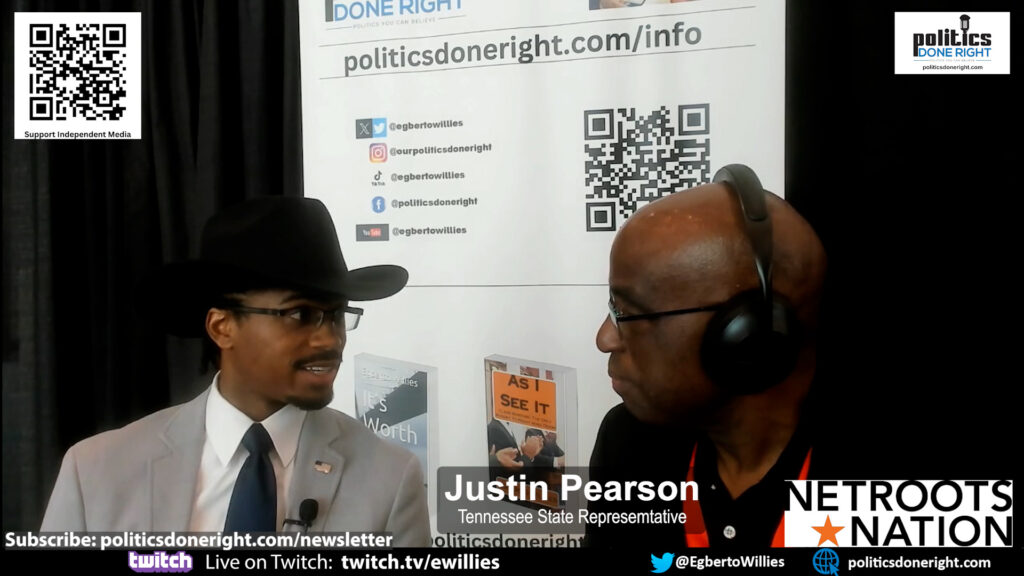
From teenage activist to expelled lawmaker, Tennessee State Rep. Justin Pearson shares his journey and why love, family, and grassroots organizing are central to defeating authoritarianism.
Tennessee State Rep. Justin Pearson

Watch Politics Done Right T.V. here.

Podcasts (Video — Audio)
Summary
In this compelling interview on Politics Done Right at Netroots Nation 2025, host Egberto Willies sits down with Tennessee State Representative Justin Pearson, one of the most dynamic young voices in American politics. Pearson recounts his journey from teenage activism to organizing against corporate pipelines in Black neighborhoods, to his election and subsequent expulsion from the Tennessee legislature for protesting gun violence alongside fellow representatives. His story illustrates both the dangers of entrenched corporate and political power and the resilience of grassroots movements determined to center people, not lobbyists, in policymaking. The conversation underscores the need for authentic leadership that bridges urban and rural divides while keeping justice, family, and love at the center of the struggle.
- Grassroots Origins: Pearson began as a teenage activist demanding textbooks and later fought successfully against a corporate pipeline threatening Black neighborhoods in Memphis.
- Gun Violence Protest: After the Covenant School shooting, Pearson and colleagues demanded action on gun reform, only to be silenced, expelled, and later reinstated.
- Corporate Capture: Pearson highlights how Tennessee’s legislature serves corporations and the NRA rather than constituents, despite broad public support for common-sense gun laws.
- Rural and Urban Unity: He stresses the importance of Democrats engaging rural communities with authenticity and compassion, building bridges across divides.
- Sustained by Love and Family: Pearson grounds his activism in family, community, and love, emphasizing that progressives must remember what they are fighting for, not just against.
Egberto Willies’ conversation with Justin Pearson reveals the stakes of modern democracy: whether lawmakers will continue bending to corporate and extremist interests, or whether authentic grassroots leaders will redefine the future. Pearson embodies the latter, showing that courage, clarity, and community-rooted action can outlast reactionary backlash. His message—that the fight for justice must be rooted in love and sustained by unity—offers hope for a progressive politics that transcends old boundaries and centers humanity above profit.
Premium Content (Complimentary)
Tennessee State Representative Justin Pearson represents the vanguard of a new generation of progressive leaders who are reshaping the political landscape in America. In his conversation with Egberto Willies on Politics Done Right, Pearson lays bare the challenges he has faced as an outspoken advocate for justice, while also offering a vision of politics centered on community, compassion, and courage.
Pearson’s journey into activism began early. At just 15 years old, he was demanding textbooks for his peers in Memphis, recognizing that even something as basic as equitable access to education required bold advocacy. This instinct to fight for fairness only deepened as corporate power encroached on his community. When Valero and Plains All American attempted to force a 49-mile pipeline through a Black neighborhood, Pearson organized across racial and generational lines. The coalition defeated the project, proving that grassroots organizing could triumph over billion-dollar corporations. This victory cemented his belief in the power of collective action, laying the foundation for his political career.
That career, however, would quickly be tested in ways both dramatic and dangerous. On March 27, 2023, Tennessee suffered the deadliest mass shooting in its history at the Covenant School, claiming the lives of three children and three adults. Pearson, freshly sworn in, watched as thousands of Tennesseans flooded the Capitol demanding action on gun reform. Yet the Republican-controlled legislature ignored them, silencing debate and even cutting off Pearson’s microphone. When Pearson and colleagues Justin Jones and Gloria Johnson stood at the well of the House floor to amplify their constituents’ voices, Republicans retaliated with one of the most antidemocratic maneuvers in modern history: expelling duly elected representatives.
This act of political vengeance exposed both the fragility of democracy and the racial inequities embedded within it. Johnson, a white colleague, narrowly escaped expulsion, while both Justins—Pearson and Jones—were expelled. Yet, the story did not end in defeat. Their local communities immediately reappointed them, and the people of Tennessee re-elected them in special elections. The sham expulsion had backfired, transforming Pearson and his colleagues into national symbols of resilience and democratic defiance.
Pearson identifies the deeper forces at work: the Tennessee legislature’s servitude to the National Rifle Association, the Tennessee Firearms Association, and corporate lobbyists. As he notes, the legislature is not writing laws for the people but for the corporations. This truth resonates across the country, where corporate interests consistently override the needs of working families. The epidemic of gun violence—now the leading cause of death for American children—illustrates the moral bankruptcy of lawmakers who claim to support “life” while refusing to pass even basic gun safety laws.
But Pearson’s message is not simply one of critique; it is one of possibility. He challenges Democrats to expand beyond urban centers like Memphis and Nashville, engaging rural communities long written off by consultants in Washington. His travels across states like Nebraska and Maine have shown him that whether one is a farmer, steelworker, or LGBTQ advocate, people share common concerns: healthcare, safety, dignity, and climate resilience. What is needed is authenticity, compassion, and the courage to speak plainly. Pearson rejects the reliance on overpaid consultants who dilute messaging; instead, he advocates for direct human connection as the key to political transformation.
At the heart of Pearson’s vision is love. Recently married and deeply rooted in family and community, he insists that progressives must not only define themselves by what they oppose—whether white supremacy, authoritarianism, or corporate exploitation—but by what they affirm. Justice, dignity, and the flourishing of all people are the goals that sustain movements through adversity. Love, as Pearson frames it, is not sentimental; it is radical and political, a force capable of uniting diverse communities in the struggle for liberation.
Egberto Willies’ interview with Pearson underscores a broader truth: authentic leadership grounded in community can withstand even the harshest assaults from reactionary forces. Pearson’s courage in standing against gun violence, his clarity in exposing corporate capture, and his insistence on building bridges across divides mark him as one of the most important progressive voices of his generation. His story is both a warning and an inspiration: democracy remains fragile and under siege, but the resilience of grassroots leaders offers hope.
Ultimately, Pearson reminds us that politics must be reclaimed from the stranglehold of corporations and returned to the people. This reclamation requires leaders who do not shy away from confrontation, who speak truth even when silenced, and who root their struggle in love. The arc of his story—from teenage activist to expelled representative to re-elected symbol of democratic resistance—illustrates the possibility of such politics. If America is to overcome its crises of violence, inequality, and authoritarian drift, it will be through leaders like Justin Pearson, whose authenticity and courage light the path forward.