


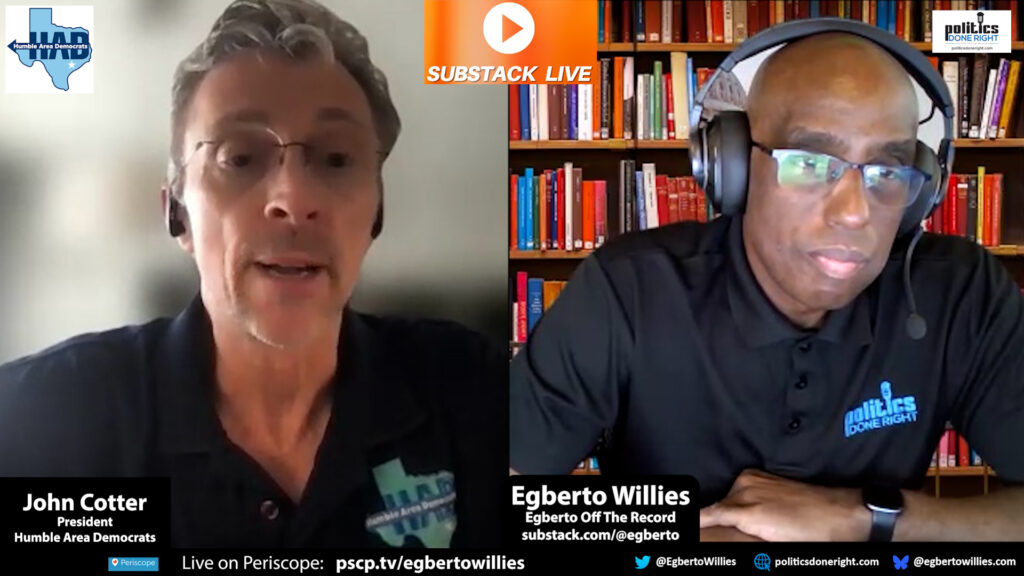
The president of the Humble Area Democrats, John Cotter, has a suggestion for national Democrats: neuter Texas’s attempt to stack the House of Representatives with redistricting in mid-census.
John Cotter, the President of the Humble Area Democrats

Watch Politics Done Right T.V. here.

Podcasts (Video — Audio)
Summary
John Cotter reveals the urgent crisis facing Texas Democrats as Governor Abbott orchestrates a mid-cycle redistricting scheme targeting four Democratic House seats, particularly minority-majority districts like the 18th that once sent Sheila Jackson Lee and Sylvester Turner to Congress. This calculated assault on democratic representation threatens to tip the balance of power in the House after 2026, while Democratic leadership at state and national levels appears asleep at the wheel, lacking both the urgency and financial commitment needed to mount effective resistance.
- Targeted Gerrymandering: Abbott specifically targets four long-held Democratic seats and minority-majority districts to dilute voting power and extract additional Republican seats that don’t reflect Texas’s proper political balance.
- Breaking Quorum Strategy: Cotter advocates for Texas Democratic legislators to leave the state during the special session to deny Republicans the quorum necessary to pass redistricting legislation, a tactic similar to previous successful efforts.
- Financial Barriers: Many Democratic state representatives work other jobs and cannot afford extended out-of-state stays without financial support, creating a critical obstacle to resistance efforts.
- National Stakes: This redistricting push extends beyond Texas to states like Ohio, representing a coordinated Republican effort to maintain control of the House ahead of the 2026 midterms.
- Democratic Leadership Failure: Despite having millions in coffers ($15 million at DNC, $13 million between Schumer and Jeffries), national Democratic leadership tends to refuse to invest in protecting Texas seats, treating the state as a lost cause rather than recognizing its purple reality.
The battle over Texas redistricting exposes the Democratic establishment’s fundamental misunderstanding of both the stakes and the state itself. Cotter correctly identifies Texas as “not a red state” but “a non-voting state.” Yet, national Democrats continue writing off the nation’s second-largest state while simultaneously depending on its representatives to maintain their slim House margins. This shortsighted approach reflects a broader pattern of Democratic leadership prioritizing safe blue strongholds over competitive purple territories where progressive organizing could yield transformative results.
Premium Content (Complimentary)
The conversation with John Cotter illuminates a critical moment in American democracy that demands immediate progressive action. Abbott’s mid-cycle redistricting represents more than typical political maneuvering—it constitutes a direct assault on communities of color and working-class districts that have fought for decades to secure meaningful representation. The targeting of seats like the 18th District, which mourns the recent losses of both Sheila Jackson Lee and Sylvester Turner, reveals the cynical calculation behind this power grab.
Cotter’s analysis exposes the fundamental weakness plaguing Democratic resistance efforts. While Republicans coordinate across state lines to maximize their electoral advantages, Democratic leadership remains trapped in outdated thinking that treats Texas as permanently red territory. The numbers tell a different story. The DNC sits on $15 million. Chuck Schumer and Hakeem Jeffries control another $13 million between them, yet Democratic representatives in Texas face the prospect of choosing between their principles and their financial stability.
The breaking quorum strategy Cotter advocates represents both practical politics and moral imperative. When institutions fail to protect democratic norms, those committed to justice must use every available tool to resist authoritarian overreach. The precedent exists—Texas Democrats successfully employed this tactic before, and the mere threat of sustained absence could force Republicans to reconsider their most extreme gerrymandering proposals.
However, the success of this strategy depends entirely on national Democratic leadership recognizing the interconnected nature of political power. Every seat lost in Texas requires Democrats to work harder in New York, California, and other blue states to maintain their majority in the House. The mathematics of resistance demands investment in purple states where demographic trends favor long-term Democratic growth.
Cotter’s grassroots perspective reveals the disconnect between Washington’s political establishment and local organizers who understand the stakes. His work with the Humble Area Democrats demonstrates how community-based organizing can build the foundation for sustained political change, but only if national resources support local efforts. The progressive movement’s future depends on bridging this gap between local organizing and national strategy.
The redistricting fight also exposes broader questions about Democratic priorities and values. If the party claims to champion voting rights and racial justice, those commitments must extend beyond symbolic gestures to concrete financial and political support for communities under attack. The targeting of minority-majority districts in Texas parallels similar efforts nationwide, requiring coordinated resistance that treats each attack as part of a larger authoritarian strategy.
Progressive activists must pressure Democratic leadership to abandon their defeatist approach to Texas politics. The state’s growing urban centers, changing demographics, and energized grassroots organizing create unprecedented opportunities for electoral gains, but only if national Democrats provide the resources necessary to compete effectively. The alternative—allowing Republicans to entrench their power through gerrymandering—guarantees continued progressive defeats across the country.
Cotter’s call for solidarity between local and national Democrats resonates beyond Texas redistricting to encompass the broader struggle for democratic governance. When Republicans break institutional norms to maintain power, Democrats must respond with equal determination and creativity. Breaking quorum represents just one tactic in a larger arsenal of resistance strategies that progressives must be willing to deploy.
The stakes extend beyond electoral calculations to fundamental questions of representation and democracy. The communities targeted by Abbott’s redistricting scheme—predominantly Black and Latino districts that have fought for political voice—deserve more than symbolic support from Democratic leadership. They deserve concrete action that matches the urgency of the threat they face.
The progressive movement’s response to Texas redistricting will signal whether it possesses the strategic vision and political courage necessary to confront authoritarian challenges. Half-measures and compromise positions won’t suffice when opponents show no similar restraint. The time for Democratic leadership to choose sides has arrived, and their decision will reverberate through every subsequent electoral battle.
Cotter and his cohort’s grassroots organizing offers a model for building sustainable political power from the ground up; however, his success depends on national Democrats recognizing Texas as a battleground state worthy of investment, rather than a lost cause to abandon. The progressive future requires this fundamental shift in thinking, backed by concrete financial commitments that enable local organizers to compete effectively against well-funded conservative opponents.