


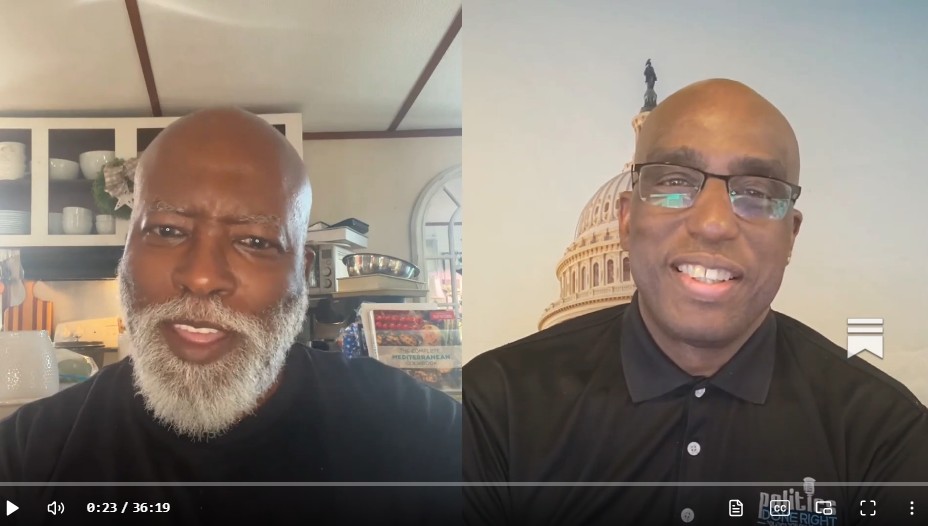
Marlon Weems, Author of “The Journeyman” Substack newsletter, invited Egberto Willies, author of the “Egberto Off The Record” Substack newsletter, for a conversation on birthright citizenship.
Birthright citizenship.

Watch Politics Done Right T.V. here.

Podcasts (Video — Audio)
Summary
Two progressive commentators, Marlon Williams and Egberto Willies, discuss the far-reaching implications of Trump’s birthright citizenship policies and recent Supreme Court decisions that effectively strengthen executive power while weakening judicial oversight. The hosts warn that these policies extend beyond targeting undocumented immigrants to threaten naturalized citizens and even native-born Americans, particularly communities of color. At the same time, Democrats fail to mount adequate resistance due to outdated political strategies and institutional capture.
Key Points
- Supreme Court Power Consolidation: The Supreme Court’s recent ruling on nationwide injunctions effectively transferred power from lower courts to the executive branch, allowing Trump to implement controversial policies with minimal judicial interference
- Denaturalization Expansion: The Justice Department has announced plans to prioritize denaturalization cases involving naturalized citizens who commit certain crimes, creating a precedent for broader citizenship-stripping
- Historical Context of Exclusion: The hosts emphasize that birthright citizenship attacks echo historical patterns of excluding people of color from full citizenship, dating back to the Dred Scott decision
- Coalition Building Necessity: Willis argues that Black Americans must support Latino communities facing deportation threats, as these policies will eventually expand to target all communities of color
- Democratic Leadership Failures: The conversation critiques aging Democratic leadership for operating with outdated assumptions about bipartisan cooperation while facing an increasingly authoritarian Republican party.
Premium Content (Complimentary)
The conversation between Marlon Williams and Egberto Willies exposes a chilling reality that mainstream media coverage often obscures: Trump’s assault on birthright citizenship represents far more than immigration policy—it constitutes a systematic attack on the foundational principle of American citizenship itself. Their analysis reveals how the Supreme Court’s recent decisions have created a dangerous power imbalance that enables unprecedented executive overreach while neutering judicial protections for vulnerable communities.
The Supreme Court did not rule on the birthright issue itself. Still, Trump called the ruling a “monumental victory for the Constitution, the separation of powers and the rule of law” in what represents a masterful example of Orwellian doublespeak. The decision concentrates power in the executive branch while systematically dismantling the checks and balances that have historically protected minority rights. Willies astutely observes that the conservative majority justices “lied to us when they won their Senate hearing,” referring to their confirmation testimony that suggested respect for precedent while systematically dismantling established constitutional protections.
The hosts’ discussion of denaturalization policies reveals the administration’s calculated strategy to create legal precedents that can be used to target broader populations. The Justice Department’s announcement, which prioritizes denaturalization cases involving naturalized citizens who commit certain crimes, establishes a framework that could easily expand to target political dissidents, activists, or anyone deemed undesirable by the administration. Willies’s fear about traveling internationally as a naturalized citizen demonstrates how these policies create a chilling effect that extends far beyond their immediate targets.
The historical context both hosts provide illuminates the deeper significance of these attacks. When Willis notes that “the constitution pretty much was written by good guys but fairly uninformed and backwards” who created “a capital document for white men and only white landowning white men,” he highlights how originalist interpretations of the Constitution can be weaponized to exclude entire populations from citizenship rights. This connects directly to Williams’s observation about the Dred Scott decision, which declared that Black Americans could never be citizens regardless of their birth status.
The conversation reveals how the Supreme Court’s conservative majority has effectively undermined the separation of powers by weakening the ability of lower courts to check executive power. The Supreme Court’s 6-3 ruling could have far-reaching consequences for Trump’s second term, even if his birthright citizenship order is never enforced, because it will limit the power of courts to strike down other policies in the future. This represents a fundamental transformation of American governance that concentrates power in the executive branch while removing judicial protections for vulnerable communities.
The hosts’ discussion of coalition building reveals the insidious nature of authoritarian strategies that divide potential allies through manufactured grievances. Willies’s frustration with Black Americans who refuse to support Latino communities facing deportation threats because “a lot of them didn’t come up and show up for Kamala” demonstrates how divide-and-conquer tactics prevent unified resistance to authoritarianism. His observation that “these are problems that they create that prank and the oligarchy create to divide us up” identifies the fundamental dynamic at play.
The analysis of Democratic leadership failures exposes how institutional Democrats remain trapped in outdated paradigms that assume good faith from Republican opponents. Willies criticism of Biden’s appointment of Merrick Garland as Attorney General highlights how Democrats consistently fail to match the urgency of the moment with appropriate responses. The hosts note that Biden and other aging Democratic leaders “are living with a Republican party that used to be,” rather than confronting the white nationalist movement that has captured the GOP.
Willies’s observation that “we have to remember in the days when look, I am not a constitutional scholar, but I read the constitution and I kind of tend to believe I understand English” highlights how constitutional interpretation has become a tool of elite manipulation rather than democratic governance. The Supreme Court’s conservative majority routinely ignores clear constitutional language when it conflicts with their political objectives while claiming adherence to originalist principles.
The hosts’ discussion of the oligarchy’s capture of the Supreme Court through decades of strategic planning reveals the fundamental asymmetry in American politics. While Democrats focus on electoral politics and procedural norms, conservatives have systematically captured the judiciary to implement unpopular policies without democratic accountability. Willies notes that “Republicans have always known that their policies are anathema to everything Americans want” and therefore focused on capturing “the only portion of our governmental system that isn’t democratic.”
The conversation ultimately reveals how birthright citizenship attacks represent a broader authoritarian strategy to redefine American citizenship around racial and ideological conformity rather than constitutional principles. By systematically dismantling legal protections for vulnerable communities while concentrating power in the executive branch, the Trump administration has created the infrastructure for a more comprehensive assault on democratic governance.
The hosts’ call for sustained resistance and coalition building offers a pathway forward, but their analysis suggests that traditional Democratic strategies remain inadequate to the current moment. Only through recognizing the full scope of the authoritarian threat and building genuine solidarity across racial and ethnic lines can Americans hope to preserve the democratic principles that birthright citizenship represents.