


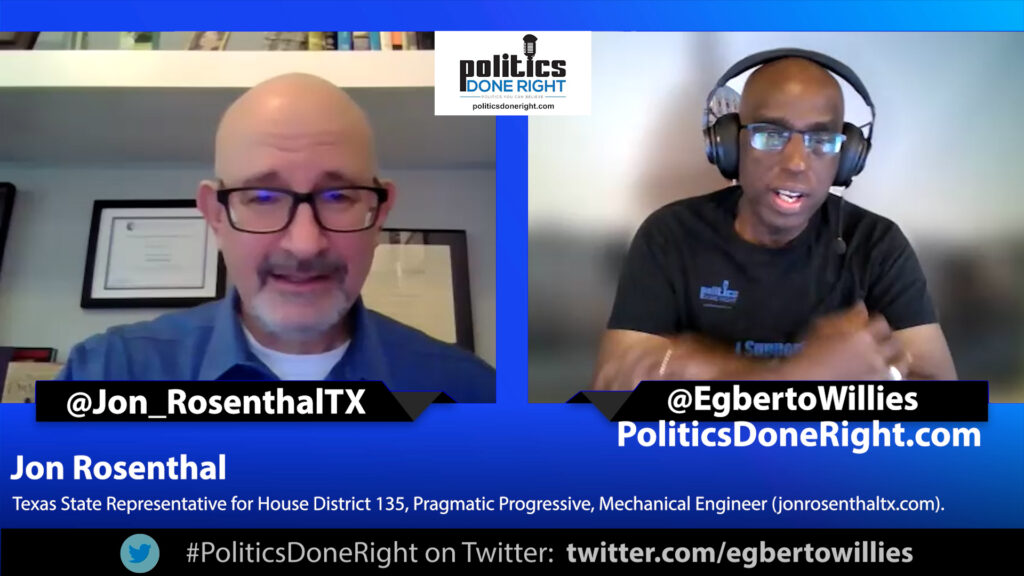
State Representative Jon Rosenthal discusses how Democrats will effectively work in the majority Republican Texas Legislature.
Jon Rosenthal on Dems Fight in the Republican Legislature

Watch Politics Done Right T.V. here.

Podcasts (Video — Audio)
Summary
In a Politics Done Right interview, Texas State Representative Jon Rosenthal discussed his efforts to navigate a Republican-dominated legislature while advocating for progressive priorities. Rosenthal highlighted the importance of bipartisan collaboration, strategic decision-making in the speaker’s race, and addressing critical issues like healthcare, public education, and community violence. He also emphasized improving Democratic messaging to reach rural and working-class Texans.
- Bipartisan Cooperation: The Texas House operates more collegially than Washington, with most legislation passing with broad bipartisan support.
- Speaker’s Race Strategy: Democrats supported a moderate Republican speaker to maintain legislative tools and avoid extreme right-wing dominance.
- Progressive Priorities: Rosenthal focuses on expanding Medicaid, blocking school vouchers, and addressing community violence and child marriage.
- Improved Communication: The Democratic caucus enhances messaging efforts to connect with rural voters and independent media.
- Pragmatism and Advocacy: Democrats balance compromise with resistance to fight harmful Republican policies while advancing progressive goals.
Jon Rosenthal’s leadership exemplifies the power of pragmatism and progressive advocacy in a challenging political environment. By preserving bipartisan cooperation and focusing on transformative policies like healthcare expansion and education equity, Rosenthal and Texas Democrats are standing up for working families and marginalized communities. Their commitment to fighting harmful legislation and amplifying their message signals a hopeful path toward a more equitable Texas.
[ppp_patron_only level=2]
Texas State Representative Jon Rosenthal, a mechanical engineer turned lawmaker, offers a unique perspective on navigating the challenges of being a Democrat in a Republican-dominated legislature. In a wide-ranging discussion on the program Politics Done Right, Rosenthal shared insights into the bipartisan efforts, legislative challenges, and strategic decisions necessary to advocate for progressive policies in a state often resistant to them.
Bipartisanship in Action
Rosenthal highlighted the distinctive nature of the Texas House of Representatives, which he described as more collegial than the often contentious environment in Washington, D.C. While the media frequently focuses on polarizing issues, Rosenthal pointed out that the vast majority of legislation—over 85%—passes with broad bipartisan support. Key accomplishments like public education funding, statewide disaster mitigation, and broadband expansion demonstrate that lawmakers from both parties can work together for the common good.
This cooperative dynamic, however, faces challenges from more extreme elements within the legislature. Rosenthal noted the importance of maintaining tools for bipartisan governance, such as the ability for Democrats to hold committee chair positions. These mechanisms allow for balanced decision-making and ensure that all Texans, regardless of political affiliation, have their voices represented.
The Speaker’s Race: A Strategic Victory
A central focus of the conversation was the recent speaker’s race in the Texas House. Rosenthal explained how Democrats played a pivotal role in electing Dustin Burrows as Speaker, choosing him over the more extreme candidate, David Cook, aligned with Lt. Governor Dan Patrick. The decision, he argued, was not just a victory for Democrats but for all Texans who value a functional legislature.
Had the more extreme candidate won, Democrats could have been sidelined entirely, with proposals to eliminate Democratic committee chairs and strip Democrats of their ability to bring legislation to the floor. These changes would have severely undermined the bipartisan ethos of the House and marginalized Democratic constituents. By supporting Burrows, Democrats preserved their ability to participate meaningfully in the legislative process, a pragmatic decision in a challenging political environment.
Challenges and Opportunities
Rosenthal did not shy away from discussing the pressing issues facing Texas, many of which disproportionately impact marginalized communities. Chief among these is the state’s refusal to expand Medicaid under the Affordable Care Act. This decision leaves billions of dollars in federal funding on the table and denies healthcare access to millions of Texans. Rosenthal criticized the Republican leadership for prioritizing partisan ideology over the well-being of Texans, calling it a moral and fiscal failure.
Beyond healthcare, Rosenthal identified education funding and the fight against school voucher programs as top priorities. He argued that vouchers threaten to privatize public education, diverting resources from public schools that serve most Texas children. Blocking these efforts is critical to ensuring that every child in Texas has access to quality education, regardless of their ZIP code.
The Role of Messaging
A recurring theme in the conversation was the need for Democrats to improve their communication strategies, particularly in rural areas. Rosenthal acknowledged that the Democratic Party has struggled to connect with rural voters and the white working class, who often feel overlooked by the party’s messaging. He emphasized the importance of engaging directly with these communities, highlighting how progressive policies like Medicaid expansion and increased education funding would benefit them.
Rosenthal praised newly elected House Democratic Caucus Chair Gene Wu for prioritizing communications, including hiring a full-time communications director to coordinate messaging efforts statewide. He also stressed the importance of working with independent media to amplify Democratic voices, particularly in a media landscape often dominated by conservative narratives.
Personal Legislative Goals
In addition to broad Democratic priorities, Rosenthal discussed his legislative agenda, which includes initiatives to address community violence, end child marriage in Texas, and reform municipal utility districts and homeowners’ associations. These issues, while sometimes overlooked, have significant implications for the quality of life in his suburban district and across the state.
Rosenthal’s focus on practical, impactful legislation underscores his commitment to serving his constituents. By addressing issues like community violence and child marriage, he seeks to create a safer, fairer Texas for all.
A Call to Action
Rosenthal’s message to Democrats in Texas and nationally is clear: progress requires a balance of pragmatism and principle. While it is essential to fight against egregious policies, it is equally important to work within the system to achieve meaningful victories for constituents. This dual approach—combining strategic compromise with unwavering advocacy—offers a blueprint for navigating the challenges of minority-party governance.
As the session progresses, Rosenthal and his Democratic colleagues face an uphill battle. Yet, their efforts to preserve bipartisan cooperation, block harmful legislation, and advocate for progressive policies reflect a commitment to serving all Texans. For those who believe in a more equitable and inclusive Texas, their work offers hope in a challenging political landscape.
By amplifying their successes and addressing their shortcomings, Texas Democrats can build a stronger coalition that delivers the policies that Texans need and deserve.
[/ppp_patron_only]