


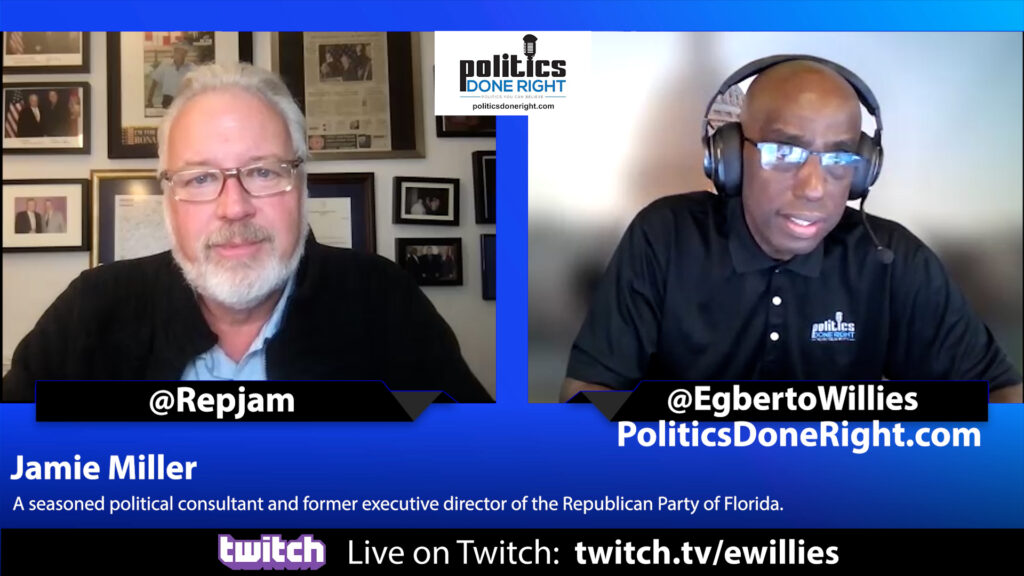
Former Executive Director of the Florida Republican Party, Jamie Miller, discussed Jan 6, Trump, healthcare, and more. Much was an alternate state of reality on many issues.
Jamie Miller, Fmr. Exec. Dir. of Florida GOP

Watch Politics Done Right T.V. here.

Podcasts (Video — Audio)
Summary
In a spirited discussion, Jamie Miller, former Executive Director of the Republican Party of Florida, debated critical issues with a progressive host. Topics ranged from January 6 and its consequences to systemic racial and gender inequalities, healthcare policy, and the GOP’s internal contradictions under Donald Trump. The dialogue highlighted deep divides between conservative and progressive views while emphasizing the need for honest conversation to address America’s most pressing challenges.
Key Points:
- January 6 and False Equivalencies: Miller framed January 6 as involving both malicious actors and “accidental tourists,” comparing it to Black Lives Matter protests—a point the host dismantled by emphasizing the insurrection’s direct attack on democracy.
- Racial and Gender Biases: The host critiqued the GOP’s resistance to diverse leadership, spotlighting Kamala Harris and the role of racial and gender biases in shaping voter behavior.
- Healthcare Policy Divides: Miller acknowledged some merits of the Affordable Care Act, but his skepticism toward universal healthcare contrasted with the host’s advocacy for a Medicare-for-All baseline system.
- The Trump Effect: Miller recognized Trump’s appeal and divisive impact, highlighting his celebrity-driven support while lamenting the GOP’s difficulty moving beyond Trumpism.
- Dialogue as a Tool for Change: Both participants underscored the value of engaging in meaningful conversations across ideological lines to foster understanding and accountability.
Progressive Perspective
The dialogue underscored the GOP’s failure to reconcile its contradictions, particularly around justice, diversity, and equitable policy. By dismantling false equivalencies and promoting bold solutions like universal healthcare and systemic justice reform, progressives can expose the weaknesses in conservative arguments while championing a vision of democracy and inclusion that serves all Americans.
[ppp_patron_only level=2]
The juxtaposition of Jamie Miller’s insights and progressive perspectives offers a compelling lens to dissect the ideological fissures within contemporary Republican politics. As the former Executive Director of the Republican Party of Florida, Miller possesses a wealth of experience, and his reflections on issues like January 6, healthcare, and societal divides reflect broader tensions within the GOP. Engaging in dialogue with a progressive host underscores the value of critical conversation in dissecting Republican contradictions and fostering a deeper understanding of the party’s policies.
January 6: A Tale of False Equivalencies
Miller’s framing of January 6 as an event with a mix of “accidental tourists” and malicious actors betrays the more significant systemic issues. While he concedes that those who entered the Capitol unlawfully should face consequences, his emphasis on FBI “assets” and the perceived disparity in justice between Black Lives Matter (BLM) protests and the insurrection perpetuates a false equivalence. The host rightly underscores the fundamental difference: BLM protests, even when a minority turned violent, arose from systemic racial injustice and police brutality, while January 6 was a direct attack on democratic institutions.
Labeling January 6 as an insurrection is not hyperbolic; it meets the definition of terrorism, as it sought to disrupt the peaceful transfer of power through violence. Comparing this to BLM protests, which overwhelmingly focused on advancing racial equity, ignores the gravity of attempting to subvert democracy. Miller’s argument highlights a standard Republican talking point that equates civil rights activism with violent unrest, diverting attention from the existential threat posed by authoritarianism within the GOP.
Race and Gender: The GOP’s Unspoken Barriers
Miller’s discussion of race and gender touches on uncomfortable truths within the Republican electorate. Progressive critiques emphasize how ingrained biases against women and people of color hinder the political ascent of figures like Kamala Harris. The host’s observation that white women voters often reject women of color as leaders speaks to a broader societal issue of internalized prejudice. This challenge transcends party lines but manifests acutely in GOP politics. This intersection of race, gender, and power reveals the Republican Party’s struggles to diversify its leadership and appeal to a broader electorate.
Healthcare: Republican Reluctance and Progressive Solutions
Miller’s acknowledgment of the value in specific Affordable Care Act provisions, such as coverage for pre-existing conditions and young adults, suggests that even staunch conservatives recognize the merits of progressive healthcare policies. However, his skepticism toward universal healthcare reflects a broader Republican reliance on privatization and market-driven solutions.
The host’s advocacy for a baseline Medicare-for-All system with options for supplemental private insurance demonstrates a progressive vision rooted in equity and pragmatism. This model ensures universal access while allowing market-based enhancements for those who can afford them. The clash between these views encapsulates a key ideological divide: Republicans often prioritize corporate interests and profit, while progressives center human rights and public welfare.
Republican Contradictions: The Trump Factor
Miller’s nuanced critique of Donald Trump reveals the internal contradictions that plague the GOP. While acknowledging Trump’s celebrity appeal and grassroots support, he concedes that Trump has alienated moderates and tarnished the party’s image. The Republican losses in key congressional and Senate races underscore the consequences of tying the party’s fate to a polarizing figure.
However, Miller’s reluctance to confront Trump’s role on January 6 directly reflects a broader GOP trend of minimizing his culpability to maintain party unity. This ambivalence stifles efforts to chart a post-Trump future, leaving the party in ideological disarray.
The Role of Dialogue in Bridging Divides
The host’s commitment to fostering dialogue, even with ideological opponents, exemplifies the progressive belief in democratic discourse. By allowing Miller to present his views unimpeded, the conversation highlights the importance of confronting opposing perspectives with facts and reason. This approach not only exposes the weaknesses in Republican arguments but also fosters mutual understanding—an essential step in bridging America’s deep political divides.
Conclusion: A Path Forward
Miller’s reflections and the progressive critique thereof underscore the need for honest introspection within the Republican Party and American politics at large. The GOP’s contradictions on issues like justice, race, and healthcare reveal a party at odds with itself, grappling with the influence of Trumpism and the demands of a changing electorate. Meanwhile, progressive solutions rooted in equity and inclusivity offer a clear path forward, emphasizing the need for systemic reform and accountable leadership.
Conversations like this in an era of polarized politics provide a vital forum for examining the ideological and policy divides shaping America’s future. By engaging in these debates, progressives can continue to challenge Republican contradictions while advocating for a vision of justice, equality, and democracy that serves all Americans.
[/ppp_patron_only]