


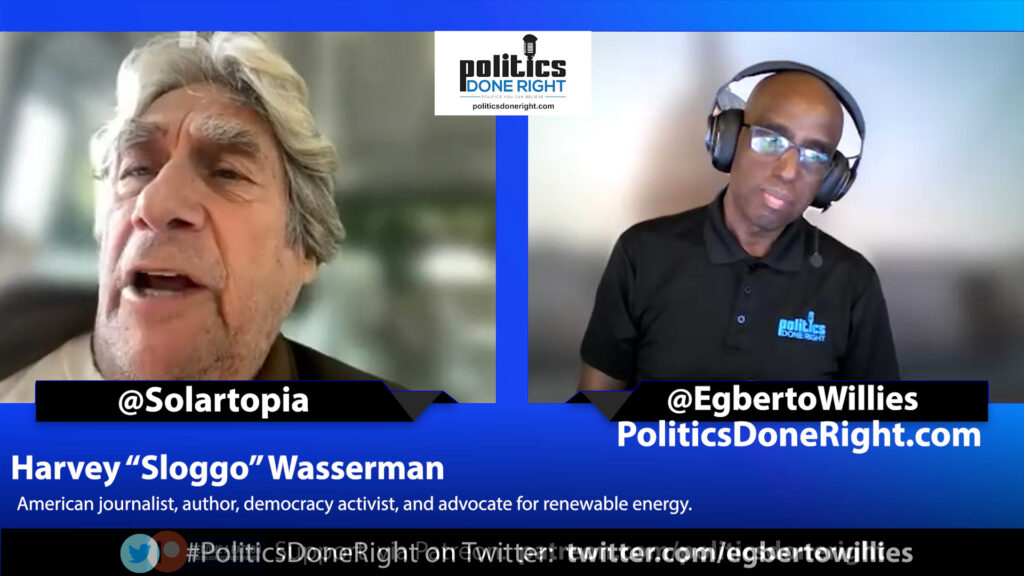
Harvey Wasserman, a journalist and environmental activist, urges smart rebuilding from the LA fire and the closure of the Diablo Canyon Power Plant.
Harvey Wasserman on LA fires & Diablo Canyon Nuclear Power

Watch Politics Done Right T.V. here.

Podcasts (Video — Audio)
Summary
A veteran journalist and renewable energy advocate, Harvey Wasserman, discusses the intertwined crises of California’s devastating wildfires and the dangers posed by the aging Diablo Canyon Nuclear Power Plant. He criticizes the failure of political leaders, particularly Governor Gavin Newsom, to prioritize renewable energy solutions, which could mitigate these threats. Wasserman advocates for solar panels, microgrids, and local energy independence as sustainable alternatives, emphasizing the urgent need for action to protect public safety and the environment.
Key Points
- California Wildfires: Recent fires near Los Angeles, likely caused by utility power lines, highlight the systemic risks of outdated energy infrastructure.
- Diablo Canyon Nuclear Plant: This 40-year-old facility poses severe risks due to its location near earthquake faults and embrittled state.
- Governor Newsom’s Decision: Newsom reversed a 2018 agreement to close Diablo Canyon, jeopardizing public safety and ignoring renewable alternatives.
- Renewable Energy Solutions: Wasserman emphasizes solar panels, microgrids, and improved battery technology as safe, cost-effective energy solutions.
- Political and Corporate Resistance: Utility companies and fossil fuel interests block progress toward decentralized, renewable energy systems to maintain control.
Progressive Perspective
Harvey Wasserman’s urgent call for action underscores the need to abandon dangerous, outdated energy systems like nuclear power in favor of renewable solutions. With advanced solar and battery technologies, California has the tools to protect its residents from fires and radioactive risks while combating climate change. The obstacles are political, driven by corporate greed and complacency. Achieving a clean energy future requires bold leadership and grassroots advocacy to prioritize the safety and well-being of people over profits.
[ppp_patron_only level=2]
In a recent discussion with Harvey Wasserman, also known as “Sluggo,” the noted journalist, democracy activist, and renewable energy advocate shared stark insights about the interwoven threats of wildfires and nuclear energy. Living near California’s devastating fires, Wasserman offered a timely critique of the state’s energy policies, particularly the decision to keep the Diablo Canyon Nuclear Power Plant operational. His commentary highlights the immediate risks and systemic failures that perpetuate dependence on outdated and dangerous energy sources.
Fires and Their Root Causes: The Role of Utilities
California’s fire season has grown increasingly destructive, fueled by climate change and poor infrastructure management. Wasserman pointed to Southern California Edison’s power lines as a probable cause of one of the recent fires. This scenario mirrors the infamous 2018 Northern California fires caused by PG&E’s equipment, which destroyed the town of Paradise and claimed 80 lives. Wasserman’s frustration is palpable: the state has failed to adopt preventative measures, such as requiring solarized homes and microgrids, which could reduce dependency on risky centralized power infrastructure.
The costs of maintaining this outdated energy system are not merely financial. They extend to the lives, homes, and natural landscapes destroyed annually by preventable disasters. Wasserman’s critique goes beyond utilities, implicating politicians like Governor Gavin Newsom, who reversed a 2018 agreement to close the aging Diablo Canyon Nuclear Power Plant.
Diablo Canyon: A Disaster Waiting to Happen
The Diablo Canyon Nuclear Power Plant, located near multiple earthquake fault lines, represents an existential risk to millions in California. Wasserman compared the potential fallout from a nuclear disaster there to Chernobyl or Fukushima, underscoring the state’s unpreparedness for such a catastrophe. These reactors, over 40 years old, are embrittled and vulnerable. The governor’s decision to extend their operation disregards these glaring dangers, prioritizing short-term political expediency over long-term public safety.
Critically, Wasserman debunked the myth that Diablo Canyon is indispensable for meeting California’s energy needs. He pointed out that renewable energy sources like solar and wind have already proven capable of supplying reliable and affordable power. The state’s reluctance to fully embrace renewables stems from technical limitations and the entrenched influence of utility companies, which prioritize profit over safety and innovation.
A Renewable Energy Future: Solutions Within Reach
Wasserman passionately advocated for a paradigm shift in California’s energy infrastructure. He outlined a vision where solar panels and microgrids power every home, reducing fire risks, slashing electric bills, and ensuring energy independence. This decentralized model would eliminate the need for vulnerable power lines traversing fire-prone forests.
Technological advances make this vision more attainable than ever. The plummeting cost of solar panels and the rise of efficient battery technologies—shifting from lithium to more abundant sodium—render renewables both affordable and practical. Wasserman highlighted the irony of Texas, often criticized for its conservative policies, leading the way in wind energy. In West Texas, wind power is so abundant that electricity is sometimes given away for free at night. This contrasts sharply with nuclear power, whose costs continue to soar.
The crux of Wasserman’s argument lies in the need for political will. He lambasted the bipartisan failure to prioritize renewables, citing the undue influence of utility companies and fossil fuel interests. Transitioning to a renewable energy system would challenge the centralized control these entities exert, but it is a necessary step for both environmental sustainability and public safety.
Rebuilding Los Angeles: A Call to Action
The recent fires provide an urgent impetus to rethink how California rebuilds. Wasserman argued that every new structure in Los Angeles should feature solar panels and integrate into a microgrid. The 2028 Olympics offer a symbolic and practical deadline for achieving a solar-powered Los Angeles. However, achieving this goal requires grassroots advocacy to counteract corporate resistance and political inertia.
Wasserman’s vision is not merely idealistic—it is grounded in practical, proven solutions. By decentralizing energy production and investing in renewables, California can address the twin wildfires and nuclear risk crises while leading the nation toward a sustainable future.
Conclusion: A Progressive Vision for Energy and Safety
Harvey Wasserman’s message is clear: California has the technology and resources to protect its residents and transition to a clean energy future. What it lacks is the political courage to challenge entrenched corporate interests. Wasserman’s tireless advocacy serves as a reminder that change will not come from those benefiting from the status quo. Instead, it requires collective action from those envisioning a safer, greener world.
By sharing his insights and solutions, Wasserman underscores the urgency of embracing renewable energy and abandoning outdated, dangerous systems like nuclear power. His vision offers a roadmap for California and the entire nation to follow, proving that a safer, cleaner future is within reach—if we have the will to pursue it.
[/ppp_patron_only]